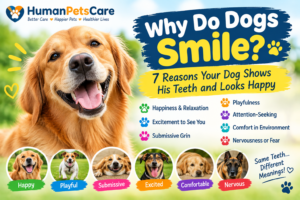

Why Do Dogs Smile? 7 Reasons Your Dog Shows His Teeth and Looks Happy
Have you ever looked at your dog and noticed him showing his teeth while appearing completely happy? You may have wondered, “Why do dogs smile?” Dogs do not smile exactly the same way humans do, but they can display facial expressions that look remarkably similar to a human smile.
When a dog is excited, at ease, anxious, or attempting to communicate, he may pull back his lips, relax his mouth, lift the corners of his lips, or display his front teeth. It’s crucial to read your dog’s entire body language because showing teeth doesn’t always indicate happiness.
In this article, we will explore 7 reasons why dogs show their teeth and look happy, how to recognize a genuine happy dog smile, and how to tell the difference between a friendly expression and a warning.
Do Dogs Really Smile?
Dogs do not smile for exactly the same emotional reasons that humans do. When people smile, it is often a social expression associated with happiness, amusement, or friendliness. Dogs communicate primarily through body language, facial expressions, sounds, posture, and behavior.
However, some dogs develop facial expressions that look like a smile when they are relaxed or excited.
A happy-looking dog may have:
- A relaxed open mouth
- Soft facial muscles
- Relaxed ears
- Bright but relaxed eyes
- A loose body
- A gently wagging tail
- A slightly raised lip
- A relaxed tongue
The most important thing is to look at your dog’s whole body language, rather than focusing only on his teeth.
7 Reasons Your Dog Shows His Teeth and Looks Happy
1. Your Dog Is Relaxed and Happy
One of the most common explanations for a dog that appears to smile is simple happiness.
When a dog is comfortable around his family, he may relax his facial muscles and open his mouth slightly. Some dogs naturally pull their lips backward, creating what looks like a smile.
You may notice this expression when your dog:
- Sees you after you come home
- Gets ready for a walk
- Receives attention
- Plays with his favorite toy
- Lies comfortably beside you
- Gets a favorite treat
If the rest of your dog’s body is loose and relaxed, the expression is usually a positive sign.
2. Your Dog Is Excited to See You
Dogs can become extremely excited when their favorite person returns home.
Some dogs respond with jumping, tail wagging, playful movements, vocalizations, and a happy-looking facial expression.
An excited dog may have an open mouth, relaxed lips, bright eyes, and a rapidly wagging tail. He may also move his entire body from side to side.
This is one reason people often describe their dog as “smiling when they see me.”
Your dog’s expression may be his way of showing excitement and social engagement rather than an intentional human-like smile.
3. Your Dog Is Showing a Submissive Smile
Some dogs display something called a submissive grin or submissive smile. This expression can look very similar to a happy smile, but its meaning is different.
A submissive grin is generally a social signal that communicates that the dog is not looking for conflict.
A dog displaying this behavior may:
- Pull his lips upward
- Show his front teeth
- Lower his body
- Keep his ears back
- Avoid direct eye contact
- Wag his tail
- Appear slightly nervous or uncertain
This behavior is especially important to recognize because the dog may not actually be feeling happy.
If your dog frequently displays this expression around strangers, children, loud voices, or unfamiliar situations, give him plenty of space and avoid forcing interaction.
4. Your Dog Is Playing
Play can also make dogs look as if they are smiling.
During play, dogs often keep their mouths open and display relaxed facial expressions. Their bodies may become bouncy and energetic.
You may see a dog smile-like expression when he is:
- Playing fetch
- Chasing another dog
- Running around the yard
- Playing tug-of-war
- Greeting a familiar dog
- Inviting someone to play
Look for other playful body-language signals, such as a play bow. A play bow occurs when the dog’s front legs and chest move toward the ground while his rear remains raised.
This is a classic invitation to play.
5. Your Dog Has Learned That the Expression Gets Attention
Dogs are excellent observers of human behavior. If you laugh, talk, pet your dog, or give him attention whenever he makes a particular facial expression, he may repeat it.
Your dog may learn:
“When I make this face, my human gives me attention.”
Over time, this can become a learned social behavior.
This does not necessarily mean the dog understands the human concept of smiling. Instead, he may associate a particular expression with positive interaction.
That is one reason some dogs seem to “smile for the camera” or make the expression whenever their owner approaches with a phone.
6. Your Dog Is Comfortable in His Environment
Dogs may exhibit loose, calm body language in a relaxed home setting.
Your dog may just be at ease if he is lying on the couch with his eyes soft, his body relaxed, and his mouth slightly open.
Dogs often display relaxed expressions after:
- Eating
- Exercising
- Taking a walk
- Playing
- Spending time with family
- Resting in a favorite location
A relaxed facial expression combined with relaxed body language is generally a good sign.
7. Your Dog May Be Nervous — Not Happy
This is one of the most important reasons to understand dog smiling behavior carefully.
Showing teeth does not always mean your dog is happy.
A dog may pull his lips back or show his teeth when he feels frightened, stressed, threatened, or uncomfortable.
Warning signs can include:
- Stiff body posture
- Hard staring
- Growling
- Lip lifting
- Ears pinned tightly back
- Tail tucked underneath the body
- Raised hackles
- Excessive licking of the lips
- Avoiding interaction
- Freezing in place
If your dog displays these signs, do not assume he is smiling.
Give him space and remove the source of stress when possible.
How to Tell if Your Dog Is Actually Happy
The easiest way to understand your dog’s expression is to consider his entire body.
A happy and relaxed dog may have:
- A loose body
- Relaxed facial muscles
- Soft eyes
- Naturally positioned ears
- A relaxed or gently wagging tail
- An open mouth
- Playful movements
- Interest in people or surroundings
A stressed or uncomfortable dog may have:
- A stiff body
- A tightly closed mouth
- Wide or tense eyes
- Flattened ears
- A tucked tail
- Lip licking
- Yawning when not tired
- Avoidance
- Growling or snapping
Context matters.
For example, a dog showing his teeth while running toward his owner with a loose body and wagging tail may be expressing excitement. A dog showing his teeth while standing stiffly and growling is communicating something very different.
Why Do Dogs Show Their Teeth?
Dogs use their mouths as part of their communication system.
Showing teeth can communicate different messages depending on the situation.
It may indicate:
- Excitement
- Playfulness
- Submission
- Nervousness
- Fear
- Discomfort
- A warning
- Relaxation in certain dogs
This is why it is important not to automatically interpret every tooth display as a smile.
Learning your individual dog’s normal behavior will help you recognize changes more easily.
What Is a Submissive Grin in Dogs?
A submissive grin is a distinctive behavior in which a dog pulls his lips back and exposes his front teeth.
It can look surprisingly similar to a human smile.
Dogs may display this behavior when greeting people they know, especially when they are excited but also trying to communicate that they are not a threat.
A submissive grin can be accompanied by:
- A lowered body
- Tail wagging
- Ears pulled backward
- Squinting
- Avoidance of direct eye contact
- Wiggling
- Licking
Not every dog displays this behavior, and it should not be confused with an aggressive display.
Is a Dog Showing Teeth Always Aggressive?
No. A dog showing teeth is not automatically aggressive.
The meaning depends on the dog’s overall body language and the situation.
A relaxed dog may show his front teeth during a submissive grin, while another dog may bare his teeth because he feels threatened.
Never rely on the teeth alone to determine a dog’s emotional state.
If you see stiff posture, growling, lunging, intense staring, or other warning signs, treat the situation seriously and give the dog space.
Do Dogs Smile When They Are Happy?
Dogs can display facial expressions that humans interpret as smiles, particularly when they are relaxed, excited, or socially engaged.
However, scientists and animal behavior experts generally encourage owners to interpret dog behavior using the complete body-language picture rather than assuming that a human facial expression has exactly the same emotional meaning in dogs.
Your dog may look like he is smiling because his mouth and facial muscles naturally form that expression when he is comfortable.
How Can You Make Your Dog Happy?
Rather than trying to make your dog smile, focus on providing things that support his physical and emotional well-being.
Give Your Dog Regular Exercise
Daily walks, age-appropriate exercise, and play can help keep dogs physically active and mentally stimulated.
Spend Quality Time Together
Dogs are social animals and often enjoy positive interaction with their families.
Training, playing, grooming, or simply relaxing together can strengthen your relationship.
Use Positive Training
Reward-based training can help dogs learn desirable behaviors while creating positive interactions between dogs and their owners.
Provide Mental Stimulation
Puzzle toys, scent games, training exercises, and safe exploration can help prevent boredom.
Respect Your Dog’s Boundaries
If your dog looks uncomfortable, give him space. Understanding when your dog wants interaction and when he wants distance is an important part of responsible pet ownership.
When Should You Be Concerned About Your Dog’s Teeth?
If your dog’s behavior suddenly changes, it is worth paying attention.
Contact a veterinarian if your dog suddenly begins showing his teeth along with:
- Signs of pain
- Difficulty eating
- Excessive drooling
- Facial swelling
- Bad breath
- Bleeding from the mouth
- Difficulty opening or closing the mouth
- Pawing at the mouth
- Sudden aggression
- Unusual sensitivity around the face
Dental disease and oral pain can sometimes change a dog’s behavior.
If your dog’s teeth or facial expressions look different from normal, a veterinary examination can help identify potential health problems.
Frequently Asked Questions About Dog Smiling
Why does my dog show his teeth when he sees me?
Your dog may show his teeth when greeting you because he is excited, relaxed, or displaying a submissive grin. Look at his complete body language to understand what he is communicating.
Why does my dog look like he is smiling?
Some dogs naturally make facial expressions that resemble human smiles. A relaxed mouth, open jaw, and pulled-back lips can create a smile-like appearance.
Is my dog happy when he smiles?
He may be happy, but not necessarily. A dog that looks like he is smiling can also be nervous or displaying a submissive grin. Relaxed body language is a better indication of comfort.
Why does my dog show his teeth but not growl?
Showing teeth without growling can have several meanings. Your dog could be excited, submissive, playful, nervous, or uncomfortable. Consider the entire body-language picture and the situation.
Is a submissive grin normal in dogs?
Yes. Some dogs naturally display submissive grinning as a social behavior. It is usually not a sign of aggression when accompanied by relaxed or submissive body language.
Should I punish my dog for showing his teeth?
No. Punishing a dog for communicating discomfort can potentially make future interactions less predictable. Instead, identify what is making the dog uncomfortable and give him appropriate space.
Final Thoughts
So, why do dogs smile? The answer is more complicated than simply saying that dogs smile because they are happy. Dogs can make smile-like facial expressions when they are relaxed, excited, playful, comfortable, or displaying a submissive grin.
At the same time, showing teeth can also be a sign of fear, stress, discomfort, or a warning. That is why responsible dog owners should always look at the dog’s entire body language and the surrounding situation.
A relaxed body, soft eyes, loose tail, playful movements, and a comfortable posture are generally more useful indicators of a happy dog than the appearance of his mouth alone.
The next time your dog gives you a big toothy grin, take a moment to observe the rest of his body. You may discover that your dog is communicating much more than simply “I’m happy