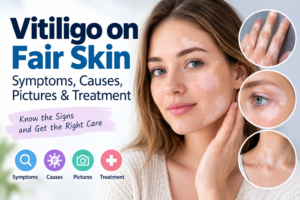

Vitiligo on Fair Skin: Symptoms, Causes, Pictures, and Treatment Options
Vitiligo is a skin condition that causes certain areas of the skin to lose their natural color, creating white or lighter patches. It can affect people of every skin tone, including those with fair or white skin. However, identifying vitiligo on lighter skin can sometimes be difficult because the affected areas may not look very different from the surrounding skin.
Although vitiligo is not usually painful or physically harmful, changes in skin color can affect a person’s confidence and emotional well-being. Several other skin conditions can also cause white spots, making it important to receive an accurate diagnosis before starting treatment.
In this guide, we will explain what vitiligo looks like on fair skin, its possible causes, common symptoms, similar skin conditions, and available treatment options.
What Is Vitiligo?
Vitiligo is a chronic skin condition in which areas of the skin lose their pigment. It develops when melanocytes, the cells responsible for producing melanin, stop functioning properly or are destroyed.
Melanin gives skin, hair, and eyes their natural color. When the skin loses melanin, affected areas may become lighter than the surrounding skin or turn completely white.
The exact cause of vitiligo is not fully understood. However, researchers believe that an autoimmune process plays an important role in many cases. This means the immune system mistakenly attacks the body’s own melanocytes.
Vitiligo can develop at any age and affect people of all ethnic backgrounds. It may appear on the face, hands, arms, legs, neck, or other parts of the body. In some people, the condition remains limited to a few small patches, while others develop more widespread changes in skin color.
Vitiligo is not contagious. You cannot catch it through touching, sharing personal items, or having close contact with someone who has the condition.
Common Symptoms of Vitiligo
The most noticeable symptom of vitiligo is the development of white or milky-colored patches on the skin. These patches can vary in size, shape, and location.
Common signs and symptoms include:
- White or very light patches on different areas of the body
- Patches with clearly defined borders
- Loss of color in areas such as the face, hands, elbows, and knees
- White or gray hair growing within affected areas
- Loss of pigment around the eyes, mouth, or other body openings
- Gradual enlargement or development of additional patches in some people
Vitiligo usually does not cause itching, pain, or other physical symptoms. However, the affected skin may be more sensitive to sunlight because it has less protective melanin.
The condition progresses differently from person to person. Some people experience little change for years, while others notice new patches developing over time.
Youtube Video
Types of Vitiligo
Doctors generally classify vitiligo according to the areas of the body it affects and how widely the patches are distributed.
1. Generalized Vitiligo
Generalized vitiligo is the most common type. It causes patches to appear in multiple areas of the body, often on both sides in a relatively symmetrical pattern.
For example, a person may notice white patches on both hands, around the eyes, or on both knees.
2. Localized Vitiligo
Localized vitiligo affects only a limited area of the body. A person may have a few small patches on the face, fingers, or another specific location.
The condition may remain limited, although its future development can vary.
3. Universal Vitiligo
Universal vitiligo is a rare form in which pigment loss affects most of the body’s skin. Extensive depigmentation can make the skin appear almost entirely white.
4. Segmental Vitiligo
Segmental vitiligo typically affects one side or a particular section of the body. It often develops earlier in life and may stop spreading after an initial period.
A dermatologist can help identify the type of vitiligo by examining the pattern and distribution of the affected areas.
What Does Vitiligo Look Like on Fair Skin?
Vitiligo can be more difficult to recognize on fair skin because the contrast between affected and unaffected areas is less noticeable.
On lighter skin, the patches may appear pale white, milky white, or slightly pinkish-white. Their appearance depends on the amount of pigment lost, the surrounding skin color, and the stage of the condition.
Early Signs of Vitiligo on White Skin
In its early stages, vitiligo may appear as a small, lighter area that gradually becomes more noticeable. Some patches begin on the fingers, hands, face, or around the eyes and mouth.
As the condition develops, the affected areas may become completely white and develop more distinct borders.
Vitiligo on the Face
Facial vitiligo may appear around the eyes, lips, nose, or forehead. When pigment loss affects the eyelids or eyebrows, nearby eyelashes or eyebrow hairs may also turn white.
Vitiligo on the Hands and Fingers
The hands and fingers are common locations for vitiligo. White patches may appear around the fingertips, knuckles, or fingernails.
Vitiligo on the Neck and Body
Patches may develop on the neck, chest, arms, legs, and other parts of the body. They can become easier to see during summer because the unaffected skin tans while vitiligo patches usually do not tan normally.
People with vitiligo should protect their skin from excessive sun exposure, regardless of their natural skin tone.
Skin Conditions That Can Be Mistaken for Vitiligo
Not every white spot on the skin is vitiligo. Several other conditions can cause lighter patches, and some may look similar during their early stages.
A dermatologist can help determine the cause by examining the skin, reviewing symptoms, and using additional tests when necessary.
1. Pityriasis Alba
Pityriasis alba is a common skin condition that causes pale patches, especially on the face, arms, and upper body. It occurs most often in children and teenagers and may be associated with dry skin or eczema.
Unlike typical vitiligo patches, areas affected by pityriasis alba usually retain some pigment. The patches may have less distinct borders and sometimes appear dry or slightly scaly.
Moisturizers and gentle skin care may help improve the appearance of affected areas.
2. Idiopathic Guttate Hypomelanosis
Idiopathic guttate hypomelanosis causes small, round, white spots, usually on sun-exposed areas such as the arms and legs.
These spots are generally harmless and become more common with age. Long-term sun exposure may contribute to their development.
Unlike vitiligo, the spots are usually small and separate rather than forming larger patches of complete pigment loss.
3. Tinea Versicolor
Tinea versicolor is a common fungal skin condition caused by an overgrowth of a yeast that naturally lives on the skin.
It can produce lighter, darker, or pinkish patches, particularly on the chest, back, shoulders, and neck. The affected skin may have fine scales and sometimes mild itching.
Treatment usually involves antifungal medications. The skin’s color may take weeks or months to return to normal even after the infection has cleared.
4. Post-Inflammatory Hypopigmentation
Post-inflammatory hypopigmentation occurs when skin becomes lighter after inflammation or injury. It can develop after acne, eczema, a rash, burns, or other skin irritation.
The affected area may lose some pigment but generally does not become completely white. The color may gradually improve as the skin recovers, although the timeline varies.
Avoiding further irritation and treating the original skin condition may help support recovery.
How Is Vitiligo Diagnosed?
A healthcare professional, particularly a dermatologist, can evaluate white patches and determine whether they are consistent with vitiligo.
Diagnosis usually begins with a physical examination and questions about when the patches appeared, whether they have changed, and whether similar conditions occur in the family.
A Wood’s lamp, which produces a specific type of ultraviolet light, may help make pigment loss more visible. This examination can be particularly useful when vitiligo is difficult to distinguish from surrounding fair skin.
In some cases, the doctor may recommend additional tests to rule out other skin conditions. A skin biopsy is occasionally needed when the diagnosis remains uncertain.
Depending on the person’s symptoms and medical history, a clinician may also consider testing for associated autoimmune conditions when appropriate.
Getting the correct diagnosis is important because treatments for vitiligo, fungal infections, and other causes of white patches are different.
How to Treat Vitiligo on Fair Skin
There is currently no guaranteed cure for vitiligo, but several treatments can help slow its progression, encourage repigmentation, or improve the appearance of affected skin.
Treatment recommendations are generally similar across skin tones. The best option depends on the extent of pigment loss, the location of the patches, how quickly the condition is changing, and the person’s preferences.
1. Prescription Medicated Creams
Topical medications are often used for vitiligo that affects limited areas of the body.
Options may include topical corticosteroids, calcineurin inhibitors such as tacrolimus, and ruxolitinib cream, sold under the brand name Opzelura in the United States for eligible patients with nonsegmental vitiligo.
Ruxolitinib cream is an FDA-approved treatment for certain patients with nonsegmental vitiligo. Its suitability depends on factors such as age, treatment area, and medical history.
Topical corticosteroids may help some patients regain pigment, but prolonged or inappropriate use can cause skin thinning and other side effects. Calcineurin inhibitors may be useful for sensitive areas such as the face.
A dermatologist should recommend the appropriate medication and explain how to use it safely. Not every treatment is suitable for every person.
2. Light Therapy
Phototherapy uses controlled ultraviolet light to help stimulate pigment production in affected skin.
Narrowband UVB therapy is a commonly used option for people with widespread vitiligo or patches that have not responded adequately to topical treatment.
Treatment is generally performed in a medical setting over multiple sessions. Improvement can take several months, and results vary.
A healthcare professional can explain the expected benefits, possible side effects, and number of sessions that may be needed.
3. Oral or Other Systemic Medications
For rapidly progressing or more extensive vitiligo, a specialist may sometimes consider medications that work throughout the body.
Examples include certain corticosteroid regimens and other immune-modulating treatments in selected situations. These medications may help control disease activity, but they can also cause significant side effects.
Systemic treatment is not necessary for everyone with vitiligo. It requires an individualized medical assessment and appropriate monitoring.
4. Surgical Treatment
Surgical approaches may be considered for selected patients whose vitiligo has remained stable and has not responded sufficiently to other treatments.
Procedures can involve transferring pigment-producing cells or small areas of normally pigmented skin into affected areas.
These treatments are not appropriate for every type of vitiligo. Their success depends on factors such as disease stability, treatment location, and the technique used.
A dermatologist experienced in vitiligo treatment can help determine whether surgery is a reasonable option.
5. Sunscreen and Sun Protection
Sun protection is an important part of managing vitiligo.
Areas with reduced pigment are more vulnerable to sunburn. Sunburn can cause discomfort and may contribute to further skin problems.
To protect your skin:
- Use a broad-spectrum sunscreen with SPF 30 or higher.
- Reapply sunscreen approximately every two hours when outdoors and after swimming or sweating.
- Wear protective clothing and a wide-brimmed hat when appropriate.
- Seek shade during periods of strong sunlight.
- Avoid tanning beds and intentional tanning.
Sun protection also reduces the contrast between unaffected skin and lighter patches by limiting tanning in surrounding areas.
6. Camouflage Makeup and Self-Tanning Products
Some people choose cosmetic products to make vitiligo patches less noticeable.
Camouflage makeup is available in different shades and can be selected to blend with the surrounding skin. Certain self-tanning products may also help reduce the visual contrast, although they do not restore natural melanin or treat the underlying condition.
Choose products that suit your skin and avoid ingredients that cause irritation. Patch-testing a new cosmetic product may help identify sensitivity before applying it to larger areas.
Cosmetic camouflage is optional. Whether to use it is a personal decision, and it does not replace medical treatment when treatment is desired.
Can Vitiligo Be Prevented?
There is currently no proven method to prevent vitiligo. Its development is influenced by factors that are not completely understood, including immune system activity and genetic susceptibility.
However, people with vitiligo can take steps to protect their skin and manage the condition.
Avoid unnecessary skin irritation, protect exposed skin from sunburn, and seek medical advice if new white patches appear or existing patches change.
It is also important to avoid unproven remedies that claim to cure vitiligo. Some products may irritate the skin or delay appropriate diagnosis and treatment.
Is Vitiligo Genetic?
Vitiligo can run in families, but having a family history does not mean that someone will definitely develop the condition.
Many people with vitiligo have no close relatives with the same condition. Researchers believe that a combination of genetic susceptibility, immune system factors, and other influences may contribute to its development.
If several family members have vitiligo, a healthcare professional can explain what is currently known about inherited risk.
Does Vitiligo Cause Other Health Problems?
Vitiligo primarily affects skin pigmentation and is not usually physically dangerous by itself. However, it can sometimes occur alongside other autoimmune conditions, including autoimmune thyroid disease.
This does not mean that everyone with vitiligo will develop another health problem. A clinician can decide whether further evaluation is appropriate based on symptoms and personal or family medical history.
Vitiligo may also affect emotional well-being. Some people experience stress, embarrassment, or anxiety because of visible skin changes. Support from healthcare professionals, friends, family, or patient communities may help.
Frequently Asked Questions About Vitiligo on Fair Skin
Is vitiligo harder to recognize on white skin?
Yes. Vitiligo may be less noticeable on fair skin because the difference between affected and unaffected areas is smaller. The patches may become easier to identify when surrounding skin tans.
Does vitiligo start as small white spots?
It can. Some people first notice small, lighter areas that gradually become whiter or larger. However, the early appearance and progression vary from person to person.
Is vitiligo contagious?
No. Vitiligo is not an infection and cannot spread from one person to another through physical contact.
Can vitiligo go away on its own?
Vitiligo is a chronic condition, and spontaneous repigmentation can sometimes occur. However, it is not possible to predict whether this will happen or how much pigment may return. Medical treatment may help some people achieve repigmentation.
Does sunscreen help treat vitiligo?
Sunscreen does not restore lost pigment, but it helps prevent sunburn and protects affected skin. Regular sun protection is an important part of care.
When should you see a dermatologist?
Arrange an evaluation if you notice new white patches, patches that are spreading, or changes in skin color that you cannot explain. Seek medical advice before using prescription treatments or strong skin-lightening or whitening products.
The Bottom Line
Vitiligo is a chronic skin condition that causes white patches to develop when pigment-producing cells stop functioning properly or are lost. It can affect people with every skin tone, but it may be harder to recognize on fair skin because the contrast between affected and unaffected areas is less obvious.
Other conditions, including pityriasis alba, tinea versicolor, idiopathic guttate hypomelanosis, and post-inflammatory hypopigmentation, can also cause lighter areas of skin. An accurate diagnosis is essential because these conditions require different treatments.
Although there is no guaranteed cure for vitiligo, prescription creams, phototherapy, selected systemic medications, and surgical procedures may help appropriate patients. Daily sun protection can reduce the risk of sunburn, while camouflage products may help those who wish to minimize the appearance of white patches.
If you suspect vitiligo, consult a dermatologist to confirm the diagnosis and discuss a treatment plan suited to your skin and individual needs.