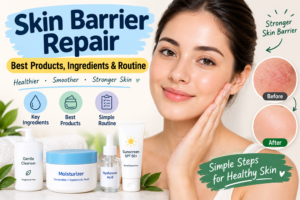

A healthy skin barrier is one of the most important foundations of good skin. When your skin barrier is damaged, your face may feel dry, tight, rough, itchy, red, or unusually sensitive. Products that once worked well may suddenly sting or burn.
The good news is that skin barrier repair usually starts with a simple approach: reduce irritation, add moisture, use barrier-supporting ingredients, and protect your skin from the sun.
Your skin barrier is the outermost layer of your skin. It helps keep water inside the skin while protecting the deeper layers from environmental irritants. Its structure includes skin cells and natural lipids such as ceramides, cholesterol, and fatty acids.
In this guide, you’ll learn the signs of a damaged skin barrier, the best ingredients to look for, which products can help, and a simple skin barrier repair routine you can follow.
What Is the Skin Barrier?
The skin barrier is mainly found in the outermost part of the epidermis, known as the stratum corneum. Think of it like a protective wall around your skin.
Skin cells act like the “bricks,” while natural lipids—including ceramides, cholesterol, and fatty acids—help fill the spaces between them. This structure helps reduce water loss and protects your skin from outside irritants.
When this barrier becomes weakened, the skin can lose moisture more easily and become more vulnerable to irritation.
Common causes include:
- Over-exfoliating
- Using too many active ingredients
- Harsh cleansers
- Very hot water
- Excessive washing
- Fragranced products
- Cold or dry weather
- Sun exposure
- Scrubbing the skin
- Using strong acne or anti-aging products too frequently
Signs of a Damaged Skin Barrier
How do you know whether you need skin barrier repair?
Some common signs include:
1. Dryness and Flaking
Your skin may feel rough, tight, flaky, or uncomfortable even after applying moisturizer.
2. Increased Sensitivity
Products that previously felt comfortable may suddenly sting or burn.
3. Redness
A weakened barrier can make your skin appear red or irritated.
4. Tight or Uncomfortable Skin
Your face may feel tight after cleansing or throughout the day.
5. Rough Texture
Instead of feeling smooth, your skin may become rough, uneven, or patchy.
6. More Irritation
You may notice that your skin reacts more easily to skincare products, weather, or environmental conditions.
Persistent redness, itching, burning, or rash can also indicate conditions such as eczema or dermatitis, so severe or ongoing symptoms should be evaluated by a dermatologist.
Best Ingredients for Skin Barrier Repair
Choosing the right ingredients can make a major difference. You don’t need a complicated collection of products. A few well-chosen ingredients can provide hydration and support the barrier.
1. Ceramides
Ceramides are among the most important ingredients for skin barrier repair.
They are naturally occurring lipids found in the skin and help support the protective barrier and reduce moisture loss.
Look for moisturizers containing ceramides such as:
- Ceramide NP
- Ceramide AP
- Ceramide EOP
Dermatologists commonly recommend ceramide-containing moisturizers for dry and sensitive skin.
2. Hyaluronic Acid
Hyaluronic acid is a humectant that helps attract and hold water in the skin.
It can be especially useful when your skin feels dehydrated and tight. However, it works best as part of a moisturizing routine rather than being your only barrier-repair product.
The American Academy of Dermatology lists hyaluronic acid among useful moisturizing ingredients for dry or sensitive skin.
3. Glycerin
Glycerin is another effective humectant. It helps draw water toward the skin and can make dry skin feel softer and more comfortable.
Because it is generally gentle, glycerin can be a useful ingredient for simple barrier-focused routines.
4. Petrolatum
Petrolatum is an occlusive ingredient that helps reduce water loss from the skin.
It can be particularly useful on extremely dry areas, especially at night. Cleveland Clinic notes that petrolatum can help seal moisture into the skin when used as an occlusive layer.
5. Dimethicone
Dimethicone is a silicone-based ingredient that can form a protective layer over the skin.
It can help reduce moisture loss and protect irritated skin. The AAD also lists dimethicone as an ingredient that can help protect irritated skin.
6. Squalane
Squalane is an emollient that can help soften dry skin and support a more comfortable skin feel.
It can be particularly useful if your skin feels dry but you prefer a lighter texture than heavy petrolatum-based products.
7. Colloidal Oatmeal
Colloidal oatmeal can be soothing for dry and irritated skin. It contains compounds with moisturizing and anti-inflammatory properties and is often found in products designed for sensitive or eczema-prone skin.
8. Fatty Acids and Cholesterol
Fatty acids and cholesterol are naturally important components of the skin barrier.
Some barrier-repair moisturizers combine ceramides, cholesterol, and fatty acids to support the skin’s lipid structure.
Best Products for Skin Barrier Repair
You don’t necessarily need expensive skincare products to repair your barrier. The most useful product categories are simple.
1. Gentle, Fragrance-Free Cleanser
Choose a cleanser that removes dirt and sunscreen without leaving your face feeling tight or squeaky clean.
Look for labels such as:
- Fragrance-free
- Gentle
- Sensitive skin
- Hydrating
- Non-stripping
The AAD recommends gentle, fragrance-free skincare for dry and sensitive skin.
2. Barrier Repair Moisturizer
This should be the main product in your routine.
Look for a moisturizer containing combinations of:
- Ceramides
- Glycerin
- Hyaluronic acid
- Dimethicone
- Fatty acids
- Cholesterol
- Squalane
Creams are generally better for very dry skin, while lotions may be more comfortable for normal or combination skin. Gel moisturizers can be useful for oily skin.
3. Occlusive Balm or Petrolatum
If certain areas are extremely dry, a thin layer of petrolatum can help seal in moisture.
This is often most useful at night and on areas such as dry cheeks, around the nose, or lips.
4. Broad-Spectrum Sunscreen
Sunscreen is an important part of protecting your skin barrier.
Use a broad-spectrum SPF 30 or higher every morning. Dermatologists recommend daily sun protection because UV exposure can damage skin and contribute to premature aging.
Simple Skin Barrier Repair Routine
When your barrier is damaged, less is often more.
You don’t need seven or eight products. Start with a basic routine and gradually reintroduce other products after your skin becomes comfortable again.
Morning Routine
Step 1: Gentle Cleanse
If your skin is very dry or sensitive, you may not need a strong morning cleanser. A gentle cleanser or lukewarm water may be enough for some people.
Avoid very hot water.
Step 2: Hydrating Serum
If your skin tolerates it, use a simple hydrating serum containing ingredients such as glycerin or hyaluronic acid.
This step is optional.
Step 3: Barrier Moisturizer
Apply a fragrance-free moisturizer containing ceramides and other moisturizing ingredients.
Applying moisturizer after washing helps maintain hydration.
Step 4: Sunscreen
Finish with broad-spectrum SPF 30 or higher.
This step should remain part of your daily routine even when your skin barrier is recovering.
Night Routine
Step 1: Gentle Cleanser
Remove sunscreen, makeup, oil, and dirt with a gentle cleanser.
Don’t scrub aggressively or cleanse for an unnecessarily long time. Over-cleansing can contribute to barrier damage.
Step 2: Moisturizer
Apply your barrier-repair moisturizer while your skin is slightly damp.
Step 3: Occlusive Layer
If your skin is extremely dry, apply a thin layer of petrolatum or another suitable occlusive over particularly dry areas.
This can help reduce overnight moisture loss.
What to Avoid During Skin Barrier Repair
One of the biggest mistakes people make is trying to fix damaged skin with even more active ingredients.
Temporarily simplify your routine if your skin is irritated.
Consider avoiding or reducing:
- Strong exfoliating acids
- Physical scrubs
- Frequent clay masks
- Retinoids if they are causing significant irritation
- Strong acne treatments
- Fragranced skincare
- Essential oils
- Very hot water
- Aggressive cleansing
- Picking or scratching
- Multiple new products at once
The AAD specifically warns that fragrance, essential oils, rubbing alcohol, and abrasive physical exfoliants can irritate sensitive skin.
This doesn’t mean you can never use active ingredients. Once your skin has recovered, you can gradually reintroduce them based on your skin’s tolerance.
How Long Does Skin Barrier Repair Take?
There isn’t one exact timeline for everyone.
Mild dryness caused by over-cleansing or temporary irritation may improve relatively quickly after you simplify your routine and moisturize consistently. More significant irritation or an underlying skin condition may take longer.
The key is consistency.
Instead of constantly changing products, give your skin time to respond to a simple routine.
If your skin remains very red, painful, itchy, cracked, swollen, or irritated despite simplifying your skincare, speak with a dermatologist. Persistent symptoms may indicate eczema, contact dermatitis, infection, or another skin condition rather than simple barrier damage.
Skin Barrier Repair for Different Skin Types
Dry Skin
Choose a richer cream containing ceramides, glycerin, hyaluronic acid, fatty acids, or petrolatum.
Avoid harsh cleansers and excessive exfoliation.
Oily Skin
You can still have a damaged skin barrier even if your skin produces plenty of oil.
Choose a lightweight, non-comedogenic moisturizer rather than skipping moisturizer altogether.
Combination Skin
Use a lightweight moisturizer over the entire face and apply a richer cream only to particularly dry areas.
Sensitive Skin
Keep your routine as simple as possible.
Fragrance-free products are generally preferable, and introducing one new product at a time makes it easier to identify potential irritants.
Acne-Prone Skin
Don’t automatically stop moisturizing because you’re worried about breakouts.
Choose non-comedogenic products and avoid overusing acne treatments. Excessive drying can make your skin uncomfortable and harder to manage.
Common Skin Barrier Repair Mistakes
Mistake 1: Using Too Many Products
Adding five new products at once makes it difficult to know what is helping or irritating your skin.
Mistake 2: Exfoliating Flaky Skin
Flaking doesn’t always mean your skin needs exfoliation. Scrubbing can make irritation worse.
Mistake 3: Skipping Moisturizer
Even oily or acne-prone skin may need moisturizer when the barrier is compromised.
Mistake 4: Using Hot Water
Hot showers and face washing can worsen dryness. Lukewarm water is generally a better choice for dry or irritated skin.
Mistake 5: Ignoring Sunscreen
UV exposure can contribute to skin damage, so daily sun protection remains important during barrier recovery.
Frequently Asked Questions
Can I repair my skin barrier naturally?
Yes. Your skin has natural repair mechanisms. Supporting them means reducing irritation, avoiding over-cleansing, moisturizing consistently, and protecting your skin from environmental damage.
Is hyaluronic acid good for a damaged skin barrier?
Yes. Hyaluronic acid can help hydrate the skin and is commonly used in moisturizers and hydrating products. For barrier repair, however, it is best combined with a moisturizer that contains emollients or occlusives.
Are ceramides good for skin barrier repair?
Yes. Ceramides are naturally important skin lipids and are among the most useful ingredients to look for in a barrier-supporting moisturizer.
Should I stop using retinol if my skin barrier is damaged?
If retinol is causing burning, significant dryness, peeling, or irritation, taking a temporary break may be sensible. Once your skin feels comfortable again, you can discuss how to reintroduce it gradually with a dermatologist.
Can I use niacinamide during skin barrier repair?
Low concentrations of niacinamide may be tolerated by many people and can be useful in skincare. However, if your skin is actively burning or highly irritated, keep your routine simple and focus first on gentle cleansing and moisturizing.
What is the best moisturizer for a damaged skin barrier?
There isn’t one universal best moisturizer. Look for a fragrance-free formula containing barrier-supporting ingredients such as ceramides, glycerin, hyaluronic acid, fatty acids, cholesterol, dimethicone, or petrolatum. Your ideal texture depends on your skin type and how dry or sensitive your skin is.
Final Thoughts
Skin barrier repair doesn’t have to be complicated. The most effective approach is often a simple routine built around gentle cleansing, consistent moisturizing, and daily sun protection.
If your skin is dry, tight, flaky, red, or unusually sensitive, temporarily reduce harsh actives and exfoliation. Choose products containing ingredients such as ceramides, glycerin, hyaluronic acid, squalane, dimethicone, fatty acids, and petrolatum to support hydration and reduce moisture loss.
Most importantly, don’t keep changing your routine every few days. Give your skin time to recover, introduce new products slowly, and pay attention to how your skin responds.
If irritation is persistent or severe, don’t assume it is simply a damaged barrier. Conditions such as eczema or dermatitis can produce similar symptoms and may require professional treatment.