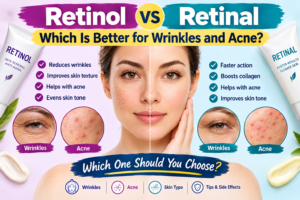

Two common vitamin A components in skincare products for acne and anti-aging are retinal and retinol. Both can enhance the texture of the skin, encourage the production of collagen, and lessen the visibility of breakouts and fine lines. They are not exactly the same, though, and it can be difficult to decide between them.
You might question whether retinal or retinol is a better option if you want smoother skin, fewer pimples, and a more youthful appearance. Your skin type, sensitivity, skincare objectives, and frequency of use all influence the answer.
In this guide, we will compare retinol vs retinal, explain how each ingredient works, discuss their benefits for wrinkles and acne, and help you choose the right option for your skincare routine.
What Is Retinol?
Retinol is a vitamin A derivative widely used in skincare products. It is a type of retinoid that can help improve skin renewal, reduce the appearance of fine lines, and support clearer skin.
Retinol is not directly active in the same way as prescription retinoic acid. Once applied to the skin, it must be converted into retinal and then into retinoic acid, the form that interacts with retinoid receptors in skin cells.
This conversion process is one reason retinol products may be gentler than some stronger retinoids. However, the actual strength of a product depends on its formulation, concentration, stability, and how the skin responds.
Benefits of Retinol for Skin
Retinol may help:
- Reduce the appearance of fine lines and wrinkles.
- Improve uneven skin texture.
- Support collagen production.
- Reduce the appearance of mild acne and clogged pores.
- Improve the appearance of some pigmentation and post-acne marks over time.
Retinol is available in many over-the-counter creams, serums, and moisturizers. It is often a popular starting point for people who want to add a vitamin A ingredient to their nighttime skincare routine.
What Is Retinal?
Retinal, also called retinaldehyde, is another vitamin A derivative. It is chemically closer to retinoic acid than retinol because it requires one conversion step instead of two.
In the skin, retinal is transformed into retinoic acid. Although not all retinal products are stronger or more effective than all retinol products, this shorter conversion pathway is frequently linked to a more direct retinoid effect.
Because it may provide observable benefits while still being appropriate for some individuals who cannot tolerate stronger retinoids, retinal is becoming more and more popular in anti-aging and acne skincare products.
Benefits of Retinal for Skin
Retinal may help:
- Improve the appearance of fine lines and wrinkles.
- Support skin renewal and smoother texture.
- Reduce the appearance of acne and clogged pores.
- Improve uneven skin tone.
- Support a more radiant-looking complexion.
Retinal products can vary in concentration and formulation. A well-formulated retinal serum may perform differently from another product containing the same ingredient.
Retinol vs Retinal: What Is the Main Difference?
The main difference between retinol and retinal is how many conversion steps are needed before the ingredient becomes retinoic acid.
Retinol requires two conversions, while retinal requires one. Both are vitamin A derivatives, and both can provide skin benefits.
| Feature | Retinol | Retinal |
|---|---|---|
| Vitamin A derivative | Retinol | Retinaldehyde |
| Conversion to retinoic acid | Two steps | One step |
| Main skincare benefits | Wrinkles, texture, acne | Wrinkles, texture, acne |
| Typical use | Beginners and general anti-aging routines | Anti-aging and acne routines |
| Irritation | May cause dryness and irritation | May also cause dryness and irritation |
| Best choice | Depends on skin tolerance and goals | Depends on skin tolerance and goals |
The shorter conversion pathway of retinal does not automatically guarantee better results. Product quality, concentration, consistency, and individual skin response are all important.
Retinol vs Retinal for Wrinkles
Fine lines and wrinkles develop as the skin ages. Collagen production decreases over time, and repeated sun exposure can accelerate visible skin aging.
Retinol and retinal may help improve the appearance of wrinkles by supporting skin renewal and collagen-related processes. With consistent use, some people notice smoother texture and a more even-looking complexion.
Which Is Better for Anti-Aging?
Retinal may be a good option for someone who wants a more direct vitamin A derivative and can tolerate it. Retinol may be a useful choice for beginners or people who prefer a familiar, widely available ingredient.
There is no universal winner. A well-formulated retinol used consistently may produce better results than a retinal product that causes irritation and is used only occasionally.
For anti-aging skincare, daily sunscreen is also essential. UV exposure contributes significantly to premature skin aging, and retinoids cannot replace sun protection.
Retinol vs Retinal for Acne
Acne develops when hair follicles become clogged with oil and dead skin cells. Inflammation and excess oil production can contribute to pimples, blackheads, and whiteheads.
Retinoids can help keep pores clear by supporting normal skin cell turnover. Retinol and retinal may therefore be useful in skincare routines for mild acne and clogged pores.
Which Is Better for Acne?
Retinal may be appealing to people who want a vitamin A ingredient for both acne and anti-aging concerns. Retinol may also be helpful, particularly for mild breakouts and uneven texture.
However, neither ingredient should be considered a guaranteed acne cure. Moderate or severe acne may require a dermatologist’s treatment plan, including an appropriate acne medication.
If your main concern is persistent inflammatory acne, a proven acne treatment such as adapalene may be more appropriate than relying on a cosmetic retinol or retinal serum alone.
Which Is Better for Sensitive Skin?
Sensitive skin can react to both retinol and retinal. Possible reactions include redness, dryness, flaking, burning, and irritation.
Retinol is often chosen by beginners because many formulations are designed for gradual introduction. However, a low-strength retinal product may also be tolerated well by some people.
The best option for sensitive skin is usually the one that provides benefits without causing persistent irritation.
How to Start Safely
- Begin with a low concentration and use the product according to its instructions.
- Apply a small amount to dry skin at night.
- Start two nights per week, then increase gradually if tolerated.
- Use a gentle moisturizer to support the skin barrier.
- Avoid using multiple strong exfoliating products at the same time.
- Stop or reduce use if you develop significant irritation.
A dermatologist can help you choose an appropriate retinoid if you have eczema, rosacea, or a history of severe skin sensitivity.
How to Use Retinol or Retinal in Your Skincare Routine
Both ingredients are commonly used at night because they can increase skin sensitivity to irritation and sunlight.
A simple nighttime routine may include the following steps:
- Cleanse your face with a gentle cleanser.
- Allow your skin to dry.
- Apply a small amount of retinol or retinal according to the product directions.
- Follow with a moisturizer.
- Use sunscreen the next morning.
Some people with sensitive skin prefer applying moisturizer before and after their retinoid, often called the sandwich method. This may help reduce irritation.
Do not apply more product than recommended. Using extra retinoid will not necessarily produce faster results and may increase dryness or irritation.
Retinol vs Retinal Side Effects
Both ingredients can cause similar side effects, especially when introduced too quickly.
Common reactions include:
- Dryness or flaking.
- Redness.
- Mild burning or stinging.
- Temporary irritation.
- Increased sensitivity to other skincare products.
Some people experience an initial increase in breakouts when beginning a retinoid, but not every breakout is a normal adjustment. Severe acne, swelling, blistering, or persistent burning should be assessed by a healthcare professional.
Retinal is not automatically irritation-free, and retinol is not automatically gentler. Your skin’s response matters more than the ingredient name alone.
How Long Does It Take to See Results?
Retinol and retinal require patience. Skin renewal and collagen-related changes take time, so visible results are usually gradual.
For acne, some improvement may occur after several weeks, but more noticeable changes can take a few months. Anti-aging benefits often require consistent use over several months.
Results vary depending on the product, concentration, skin condition, and whether you use sunscreen regularly.
Avoid changing products every few days. Give a new skincare routine enough time to show whether it is helping, unless you experience significant irritation.
Can You Use Retinol and Retinal Together?
Using retinol and retinal together is generally unnecessary for most people. Both are vitamin A derivatives, and combining them may increase irritation without providing a clear additional benefit.
Instead, choose one product and use it consistently. If you want to change from retinol to retinal, introduce the new product gradually rather than applying both at full frequency.
Do not combine retinoids with strong exfoliating acids, benzoyl peroxide, or other potentially irritating ingredients without considering your skin’s tolerance and the product instructions.
Is Retinol or Retinal Better for Dark Spots?
Retinol and retinal may improve the appearance of some pigmentation by supporting skin renewal. They may be useful for post-acne marks and uneven skin tone.
However, dark spots have different causes. Melasma, sun spots, and post-inflammatory hyperpigmentation may require different treatment strategies.
For persistent pigmentation, sunscreen and appropriate pigment-control ingredients are important. A dermatologist can recommend a suitable treatment if the spots are widespread, recurring, or worsening.
Who Should Avoid Retinol and Retinal?
People who are pregnant or planning pregnancy should avoid topical retinoids unless their healthcare professional specifically advises otherwise. Retinoids are generally avoided during pregnancy as a precaution.
If you are breastfeeding, ask your healthcare professional before starting a retinoid. Also seek advice if you have a skin condition, use prescription acne treatments, or have significant irritation.
Never use a prescription-strength retinoid or combine multiple vitamin A products without professional guidance.
Final Verdict: Retinol vs Retinal
Because both ingredients can help with wrinkles, acne, and uneven skin texture, retinol and retinal are frequently compared in skincare products.
For those who can tolerate it and prefer a more direct vitamin A derivative, retinal might be a good option. For novices and those seeking a readily accessible anti-aging ingredient, retinol might be a good choice.
Your skin type, product formulation, concentration, and consistency will determine which option is best for you. For everyone, neither ingredient is inherently better.
Start slowly, moisturize regularly, and use broad-spectrum sunscreen every morning. If you have persistent acne, severe irritation, or significant pigmentation, consult a dermatologist for a personalized treatment plan.
The most effective retinoid is the one your skin can tolerate and you can use consistently.