
A broken dog nail can be frightening for both dogs and their owners. One moment your dog is playing normally, and the next you may notice blood on the floor, limping, licking a paw, or a nail hanging awkwardly.
Fortunately, many minor nail injuries can heal successfully with appropriate care. However, some broken nails are painful and may expose the sensitive tissue inside the nail, increasing the risk of infection.
Knowing what to do immediately can make the situation much easier.
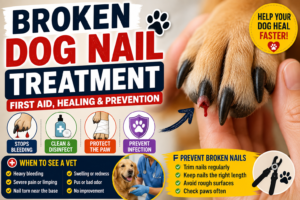
This guide explains broken dog nail treatment, including how to stop bleeding, clean the injury, protect the paw, recognize infection, and determine when professional veterinary care is necessary.
What Causes a Dog’s Nail to Break?
Dogs can break or tear their nails for several reasons.
Common causes include:
- Running on rough surfaces
- Getting a nail caught in carpet or fabric
- Jumping or landing awkwardly
- Playing aggressively
- Long or overgrown nails
- Brittle nails
- Trauma or accidents
- Nails becoming caught between objects
- Excessive scratching
Dogs with long nails may be more likely to experience nail injuries because longer nails can catch on surfaces more easily.
Regular nail trimming can reduce the risk of some types of nail trauma.
What Does a Broken Dog Nail Look Like?
A broken nail can look different depending on how severe the injury is.
You might notice:
- A cracked nail
- A partially torn nail
- A nail hanging from the toe
- Bleeding
- Swelling around the nail
- Limping
- Excessive licking
- Whining when the paw is touched
- A nail broken close to the base
- Exposed sensitive tissue
A small crack at the very tip may be relatively minor, while a nail torn near the base can be significantly more painful and may require veterinary treatment.
Why Is a Broken Dog Nail Painful?
A dog’s nail is not simply a piece of dead material.
Inside the hard outer nail is a sensitive area called the quick. It contains blood vessels and nerves.
If a nail breaks through or close to the quick, the injury can cause:
- Pain
- Bleeding
- Sensitivity
- Licking
- Limping
This is why even a small-looking nail injury can make a dog uncomfortable.
Broken Dog Nail Treatment: What to Do First
If your dog’s nail has broken, try to remain calm.
Dogs can become anxious when they see blood or when someone handles a painful paw.
Step 1: Keep Your Dog Calm
Move your dog to a quiet area.
Prevent running, jumping, or rough play because additional activity can make the nail bleed again.
If your dog is frightened or painful, avoid forcing the paw into an uncomfortable position.
Step 2: Examine the Nail Carefully
Look at the injured nail without pulling on it.
Determine whether:
- Only the tip is cracked
- The nail is partially torn
- The nail is completely detached
- The nail is bleeding
- The nail is broken near the base
- There is swelling or discharge
If the nail is hanging and your dog is very painful, don’t repeatedly manipulate it.
A veterinarian may need to handle the damaged portion safely.
Step 3: Stop the Bleeding
Bleeding is common when a broken nail damages the quick.
Apply gentle, steady pressure with clean gauze or a clean cloth.
Hold pressure for several minutes rather than repeatedly removing the cloth to check.
A pet-safe styptic product can also be useful for minor nail bleeding.
If you don’t have a clotting product available, clean gauze and steady pressure are appropriate first-aid measures while you assess whether veterinary care is needed.
When bleeding is an emergency
Contact a veterinarian if:
- Bleeding is heavy
- Bleeding does not stop with sustained pressure
- Your dog appears weak or distressed
- The injury is extensive
- Your dog has another condition that makes bleeding more concerning
Step 4: Clean the Injured Area
Once bleeding is controlled, gently clean the paw.
Use clean water or a veterinarian-recommended wound-cleaning solution.
The goal is to remove visible dirt and debris without aggressively scrubbing the injured nail.
Avoid putting harsh household chemicals, alcohol, or other irritating substances directly onto an open nail injury unless specifically instructed by a veterinarian.
If the nail has been exposed to dirt, mud, or contaminated surfaces, careful cleaning is particularly important.
Step 5: Don’t Pull Off a Partially Attached Nail
One of the most common mistakes owners make is trying to remove a broken nail themselves.
If a nail is partially attached, pulling or twisting it can cause additional pain and bleeding.
A small loose piece at the very tip may sometimes be safely trimmed, but a nail that is attached near the quick or base is better assessed by a veterinary professional.
The veterinarian can determine whether the damaged portion should be trimmed or removed and how best to protect the exposed tissue.
Should You Bandage a Broken Dog Nail?
A temporary protective covering may sometimes help prevent your dog from licking or damaging the injured nail.
However, bandages need to be used carefully.
A bandage that is too tight can interfere with circulation and cause additional problems.
If you are not experienced with paw bandaging, ask your veterinarian or veterinary technician to demonstrate the appropriate technique.
Keep the bandage clean and dry.
If it becomes wet, dirty, slips, or causes swelling of the toes, contact your veterinarian or have it changed appropriately.
Prevent Your Dog From Licking the Nail
Dogs naturally lick painful or irritated areas.
Unfortunately, excessive licking can delay healing and introduce bacteria into the injured area.
If your dog constantly licks the paw, your veterinarian may recommend an appropriate protective device, such as an Elizabethan collar or another suitable alternative.
Do not rely on a bandage alone if your dog is determined to chew through it.
Can a Broken Dog Nail Get Infected?
Yes.
A broken nail can create an opening through which bacteria may enter.
Signs of a possible nail or toe infection include:
- Increasing redness
- Swelling
- Heat around the toe
- Pus or unusual discharge
- Bad odor
- Increasing pain
- Persistent licking
- Worsening limping
- Loss of appetite or unusual tiredness
If you notice these signs, contact your veterinarian.
An infection can sometimes spread into deeper tissues, so prompt evaluation is important.
How Long Does a Broken Dog Nail Take to Heal?
Healing time depends on how severe the injury is.
A minor crack near the tip may improve relatively quickly once the damaged portion is protected.
A deeper break involving the quick can take longer because the sensitive tissue needs time to recover and the nail needs to grow.
Toenails grow gradually, so the damaged nail may look abnormal for some time even after the injury has healed.
Don’t judge recovery solely by how quickly the nail looks normal.
Instead, monitor:
- Pain
- Bleeding
- Swelling
- Discharge
- Limping
- New healthy nail growth
What If the Nail Is Completely Torn Off?
A completely torn nail can be painful because the quick may be exposed.
Do not assume that the nail will immediately be fine simply because the hard nail is gone.
Keep the paw clean and prevent excessive licking.
Because a completely torn nail can involve significant trauma, veterinary assessment is recommended, particularly if there is substantial bleeding, an exposed quick, severe pain, or contamination.
A veterinarian can determine whether additional treatment or protection is necessary.
When Should You Take Your Dog to the Vet?
Some broken nails can be managed with basic first aid, but others need professional care.
Contact your veterinarian if:
The nail is broken near the base
A proximal nail injury can be more painful and complicated.
The nail is hanging
Don’t pull it off yourself if it remains attached.
Your dog is severely painful
A dog that cannot put weight on the paw or reacts strongly to gentle handling may need veterinary evaluation.
Bleeding won’t stop
Persistent bleeding requires professional attention.
The toe is swollen
Significant swelling can indicate trauma or infection.
There is pus or foul odor
These can be signs of infection.
Your dog won’t stop licking
Persistent licking can interfere with healing.
Your dog keeps getting broken nails
Repeated nail injuries may warrant investigation into nail health, grooming, environmental factors, or other underlying causes.
Broken Dog Nail vs. Cracked Dog Nail
Not every nail crack is equally serious.
Minor cracked nail
A small crack limited to the outer portion may not expose the quick.
Deep cracked nail
A crack extending toward the quick can be painful and may bleed.
Torn nail
A nail partially detached from the nail bed can be more serious and may require veterinary treatment.
Completely detached nail
The sensitive tissue underneath may be exposed and painful.
When in doubt, treat a painful or deep crack more seriously rather than attempting aggressive home trimming.
Pain Management for a Dog With a Broken Nail
A broken nail can hurt, especially when the quick is involved.
Do not give your dog human pain medications unless your veterinarian specifically tells you to do so.
Some common human medications can be dangerous or toxic to dogs.
Your veterinarian can recommend an appropriate pain-management plan if your dog is uncomfortable.
Until then, keep your dog quiet and limit activities that put pressure on the injured paw.
How to Help Your Dog Recover
Recovery is usually easier when the paw is protected from repeated trauma.
Keep activity controlled
Avoid intense running, jumping, and rough play until the nail has improved.
Keep the paw clean
Prevent exposure to dirty or contaminated environments while the injury is healing.
Monitor the nail daily
Look for changes in swelling, redness, discharge, bleeding, and pain.
Prevent licking
Use appropriate protection if necessary.
Follow veterinary instructions
If your veterinarian prescribes medication or recommends specific wound care, follow those instructions carefully.
How to Prevent Broken Dog Nails
Prevention starts with regular nail care.
Trim nails regularly
Overgrown nails can catch on carpets, furniture, grass, and other surfaces.
Keeping nails at an appropriate length may reduce the risk of some injuries.
Use proper nail tools
Choose nail clippers or grinders designed for dogs.
Avoid using dull tools that can crush or split the nail.
Inspect paws regularly
Check your dog’s nails and paw pads during routine grooming.
Early detection of cracks can prevent some injuries from becoming worse.
Keep your dog’s environment safe
Remove objects that could catch a nail.
Be especially careful with loose carpeting, damaged flooring, or rough surfaces.
Introduce nail trimming gradually
If your dog becomes anxious during nail trims, use positive reinforcement and gradual paw-handling exercises.
A frightened dog is more likely to move suddenly during trimming.
How Often Should You Cut Dog Nails?
There is no single schedule that works for every dog.
Nail growth varies according to the individual dog, activity level, environment, and natural nail wear.
Many dogs need their nails checked every few weeks.
Dogs that spend most of their time indoors may need more frequent trimming than dogs that regularly walk on surfaces that naturally wear down the nails.
Regular inspection is more useful than following a rigid calendar.
What About Dewclaws?
Don’t forget your dog’s dewclaws.
Dewclaws are located higher on the leg and may not contact the ground enough to wear down naturally.
As a result, they can become excessively long and catch on objects.
A broken or overgrown dewclaw can be particularly painful.
Check dewclaws during every grooming session and trim them appropriately.
Common Mistakes After a Dog Nail Injury
Ignoring the injury
Even a small broken nail should be monitored.
Pulling a hanging nail
This can cause additional trauma.
Letting the dog lick constantly
Licking may delay healing and introduce bacteria.
Using harsh chemicals
Some household products can irritate damaged tissue.
Giving human painkillers
Never give human medication without veterinary direction.
Allowing rough activity
Running and jumping can reopen the injury.
Waiting too long when infection develops
Increasing swelling, pain, discharge, or odor should be taken seriously.
Frequently Asked Questions
How do I treat a broken dog nail at home?
Keep your dog calm, control bleeding with gentle pressure, clean the area with an appropriate solution, prevent licking, and restrict activity. If the nail is deeply torn, hanging, severely painful, or bleeding persistently, contact a veterinarian.
Will a dog’s broken nail grow back?
In many cases, yes. The nail can gradually regrow as the underlying nail-producing tissue remains healthy. However, the appearance and growth rate depend on the severity of the injury.
How do I stop a dog’s broken nail from bleeding?
Apply gentle, steady pressure with clean gauze. A pet-safe styptic product can help with minor bleeding. If bleeding does not stop or is severe, seek veterinary care.
Should I pull off my dog’s broken nail?
No. If the nail remains attached, especially near the base, do not pull it off yourself. A veterinarian can determine the safest way to manage the damaged portion.
Can a broken dog nail become infected?
Yes. Watch for swelling, increasing redness, discharge, odor, worsening pain, or persistent licking. These signs warrant veterinary attention.
Can I give my dog pain medicine for a broken nail?
Do not give human pain medication unless your veterinarian specifically recommends it. Some human medications can be dangerous for dogs.
How long does a broken dog nail take to heal?
Minor injuries may improve relatively quickly, but deeper injuries can take longer. The nail itself may take weeks or months to fully grow out depending on the injury and the individual dog’s nail growth.
Final Thoughts
A broken dog nail can look dramatic, but prompt and appropriate care can help reduce complications.
Start by keeping your dog calm, controlling any bleeding, gently cleaning the area, and preventing excessive licking. Avoid pulling off partially attached nails and never give human pain medication without veterinary guidance.
Minor nail injuries may heal with careful home monitoring, but a nail broken near the base, a completely torn nail, persistent bleeding, severe pain, swelling, or signs of infection should be evaluated by a veterinarian.
Regular nail trimming, paw inspections, appropriate exercise, and good grooming habits can also help reduce the risk of future nail injuries.
The most important rule is simple: when a broken nail looks deep, painful, or infected, professional veterinary care is safer than trying to fix it yourself.