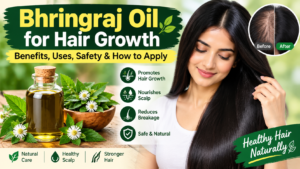

Bhringraj oil has been used in Ayurvedic hair care for centuries and is traditionally associated with stronger, healthier-looking hair and scalp nourishment. Made from Eclipta prostrata, commonly known as bhringraj or false daisy, this herbal oil is now widely used in natural hair-care routines for concerns such as dryness, breakage, scalp discomfort, and hair thinning.
But does Bhringraj oil actually promote hair growth? What are its advantages, how should it be used, and is it safe for all people?
The potential advantages of bhringraj oil for hair growth, proper usage, potential adverse effects, and crucial safety measures are all explained in this guide.
What Is Bhringraj Oil?
Bhringraj oil is a traditional herbal hair oil prepared using bhringraj leaves or extracts. Depending on the product, bhringraj may be infused into coconut oil, sesame oil, amla oil, or another carrier oil.
Bhringraj has a long history in Ayurvedic preparations. Traditionally, it has been used to support scalp health and maintain healthy-looking hair.
Modern research on bhringraj and hair growth is still limited, so it is important to distinguish traditional use from proven medical treatment. Bhringraj oil may be useful as part of a scalp-care routine, but it should not automatically be considered a treatment for every type of hair loss.
Can Bhringraj Oil Help Hair Growth?
One of the most common reasons people use bhringraj oil is to encourage hair growth. Some laboratory and animal research involving bhringraj extracts has investigated effects related to hair follicles, but strong clinical evidence in humans is still lacking.
Therefore, bhringraj oil may support a healthy scalp and help reduce dryness or hair breakage, which can make hair appear fuller and healthier. However, there is not enough high-quality evidence to confirm that it can significantly regrow hair in people with medical hair-loss conditions.
If you are experiencing sudden, severe, or progressive hair loss, identifying the underlying cause is more important than relying on an herbal oil alone.
Potential Benefits of Bhringraj Oil for Hair
1. May Support a Healthy Scalp
A healthy scalp provides a better environment for normal hair growth. Massaging bhringraj oil into the scalp can help moisturize dry skin and reduce the feeling of scalp tightness.
The massage itself may also make a hair-care routine more relaxing and may help distribute the oil evenly across the scalp.
2. May Help Reduce Hair Breakage
Dry and brittle hair can break easily during brushing, washing, or styling. Oils can coat the hair shaft and help reduce friction, which may make hair feel smoother and easier to manage.
Bhringraj oil may therefore be useful for people whose main concern is dryness and breakage rather than hair loss from the root.
3. Helps Condition Dry Hair
Many traditional bhringraj oil formulas contain carrier oils such as coconut or sesame oil. These oils can provide emollient properties that help make dry hair feel softer.
Regular oiling may improve the appearance of rough or dull hair by adding moisture and reducing the appearance of dryness.
4. May Support Scalp Comfort
A dry scalp can sometimes feel itchy, tight, or uncomfortable. A suitable hair oil may help reduce dryness-related discomfort by providing a moisturizing layer.
However, oil should not be considered a treatment for conditions such as scalp psoriasis, fungal infections, or severe seborrheic dermatitis.
5. May Make Hair Look Healthier
Healthy-looking hair is influenced by moisture, breakage, styling damage, nutrition, and scalp condition. Regular conditioning with an appropriate oil may improve softness, shine, and manageability.
These cosmetic benefits can make hair appear healthier even when the oil is not directly stimulating new hair growth.
6. Traditionally Used for Hair Strength
In Ayurvedic hair care, bhringraj is traditionally considered a rejuvenating herb for hair and scalp. It is often included in herbal oils designed for regular scalp massage.
Although traditional use can provide useful context, more human research is needed before strong claims about hair-strengthening or hair-regrowth effects can be made.
How to Apply Bhringraj Oil to Your Hair
Using bhringraj oil is relatively simple. The following routine can help you incorporate it into your hair-care schedule.
Step 1: Choose a Suitable Product
Look for a bhringraj oil from a reputable manufacturer. Check the ingredient list and avoid products containing ingredients that you know irritate your scalp.
If you have sensitive skin, a simple formulation with fewer added fragrances may be preferable.
Step 2: Perform a Patch Test
Before applying a new herbal oil to your scalp, test a small amount on a small area of skin.
Wait and monitor the area for signs of redness, burning, swelling, or itching. If irritation develops, wash the area and discontinue use.
Step 3: Apply the Oil to the Scalp
Divide your hair into sections and apply a small amount of oil directly to the scalp.
You do not need to completely saturate your hair. Using too much oil can make washing difficult and may be unnecessary.
Step 4: Massage Gently
Use your fingertips to massage the oil into your scalp for several minutes.
Avoid scratching with your fingernails or applying excessive pressure. Gentle massage is generally more comfortable and reduces the risk of irritating the scalp.
Step 5: Leave It On
Depending on the product instructions and your hair type, you may leave the oil on for a short period or several hours before washing.
There is no strong evidence that leaving oil on overnight provides better hair-growth results. If overnight oiling causes itching, acne around the hairline, or scalp irritation, wash it out sooner.
Step 6: Wash Your Hair
Use a gentle shampoo to remove the oil. You may need to shampoo twice if your hair is heavily coated.
Follow with conditioner, particularly if your hair is dry or prone to tangling.
How Often Should You Use Bhringraj Oil?
There is no medically established ideal frequency for bhringraj oil use.
For many people, one to two times per week is a reasonable starting point. People with very dry hair may prefer regular oiling, while people with oily or acne-prone scalps may need to use less.
The right frequency depends on your scalp condition, hair texture, and the specific formulation.
Using more oil or applying it more frequently does not necessarily mean faster hair growth.
Bhringraj Oil for Different Hair Types
Dry Hair
Bhringraj oil may be helpful for dry, rough hair because oiling can improve softness and reduce the feeling of dryness.
Oily Scalp
If your scalp becomes oily quickly, use a smaller amount and avoid leaving heavy oil on the scalp for extended periods.
Curly or Textured Hair
Curly and textured hair can benefit from conditioning oils, especially when dryness and breakage are concerns. Apply the oil according to your hair’s needs rather than following a one-size-fits-all routine.
Fine Hair
People with fine hair may find that heavy oil makes their hair look flat or greasy. Use a small amount and concentrate more on the scalp and dry ends as appropriate.
Bhringraj Oil for Hair Fall: What to Expect
Hair fall has many possible causes, including genetics, hormonal changes, nutritional deficiencies, stress, certain medications, thyroid problems, scalp disorders, and autoimmune conditions.
Because of this, bhringraj oil cannot be expected to work equally well for every type of hair loss.
If hair shedding is caused by breakage or dryness, improving hair conditioning may help reduce visible hair loss. However, if you have androgenetic alopecia or another medical cause of hair loss, you may need evidence-based treatment recommended by a dermatologist.
Is Bhringraj Oil Safe?
Bhringraj oil is generally used as a topical hair-care product, but “natural” does not automatically mean risk-free.
Some people may experience irritation or an allergic reaction to bhringraj, essential oils, fragrances, preservatives, or other ingredients in a commercial product.
Stop using the product if you develop significant redness, burning, swelling, rash, or worsening itching.
Avoid getting the oil into your eyes. If accidental contact occurs, rinse thoroughly with clean water.
Who Should Be Careful With Bhringraj Oil?
People with sensitive skin, allergies, eczema, or existing scalp conditions should be especially careful when trying new herbal products.
If you have an active scalp infection, painful sores, severe dandruff, or unexplained hair loss, consider speaking with a healthcare professional before relying on an oil treatment.
Pregnant or breastfeeding individuals should also discuss the use of concentrated herbal products with an appropriate healthcare professional, especially when the formulation contains multiple herbs or essential oils.
Bhringraj Oil vs. Other Hair Oils
Bhringraj oil is only one option for hair care. Coconut oil, jojoba oil, argan oil, almond oil, and other carrier oils are also commonly used.
The best choice depends on the goal. For example, some oils may be particularly useful for conditioning dry hair, while lighter oils may be more comfortable for people with oily scalps.
The most important factor is whether the product suits your scalp and hair without causing irritation.
Common Mistakes When Using Bhringraj Oil
Avoid applying excessive amounts of oil. More oil does not necessarily provide more benefits.
Do not vigorously massage an irritated or painful scalp.
Do not assume that herbal oil can replace treatment for significant hair loss.
Avoid leaving heavily fragranced products on the scalp if they cause irritation.
Finally, do not expect overnight results. Hair grows slowly, and changes in hair density generally take time to become noticeable.
When Should You See a Dermatologist?
Consider professional evaluation if you notice:
- Sudden or severe hair shedding
- Bald patches
- A rapidly widening part
- Significant scalp itching or pain
- Scaling, sores, or inflammation
- Hair loss accompanied by other symptoms
- Persistent hair thinning despite improving your hair-care routine
A dermatologist can help determine whether the problem is caused by genetics, nutritional factors, hormones, scalp disease, medication, stress, or another condition.
Frequently Asked Questions
Does bhringraj oil regrow hair?
There is limited clinical evidence that bhringraj oil can regrow human hair. Traditional use and preliminary research are promising, but more high-quality human studies are needed.
Can I use bhringraj oil every day?
Daily use is not necessary for most people. Starting with one or two applications per week can be more practical, especially if your scalp becomes oily easily.
Can bhringraj oil stop hair fall?
It may help with dryness and breakage, but it cannot be expected to stop hair loss caused by medical or genetic conditions.
How long should I leave bhringraj oil on my hair?
You can follow the instructions on the product. Leaving it on for several hours may be sufficient. There is no strong evidence that overnight use is necessary for better results.
Can I mix bhringraj oil with coconut oil?
Some products already contain coconut oil. If you want to dilute a concentrated formulation, check the product instructions first. Avoid mixing multiple products if you have a sensitive scalp.
Final Thoughts
Bhringraj oil for hair growth is a popular traditional hair-care option that may help nourish the scalp, condition dry hair, reduce breakage, and improve the overall appearance of hair. However, scientific evidence supporting significant hair regrowth in humans remains limited.
Use bhringraj oil in conjunction with a more comprehensive hair-care regimen that includes proper scalp care, protection from excessive heat and chemical damage, gentle washing, and sufficient nutrition for optimal results.
Do not use herbal oil exclusively if you are suffering from severe or ongoing hair loss. The best way to select an effective treatment is to identify the underlying cause and seek appropriate professional advice.