
A heartbreaking story of a little soul born into suffering, yet still hoping for love
He was so small that the world should have felt soft to him.
At that age, life is supposed to be simple. A puppy should know warm milk, playful paws, tiny naps in the sun, and the comfort of curling up beside his mother and siblings. He should know the joy of discovering the world one clumsy step at a time. He should know kindness before cruelty, safety before fear, and love before pain.
But this little puppy did not get that beginning.
Instead of a carefree puppyhood, he was given a face full of suffering.
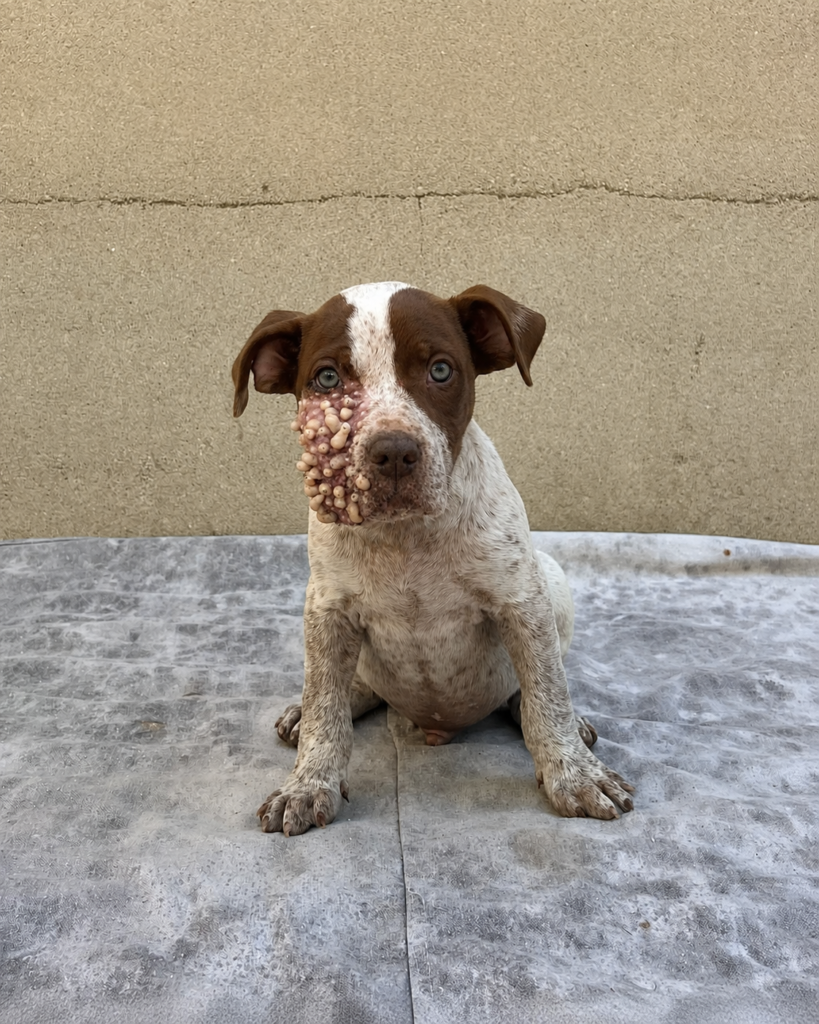
Instead of being held, admired, and kissed on his tiny forehead, he sat quietly with a painful growth spreading across one side of his face—an unbearable cluster of swollen, fleshy lumps that made him look as though life had already punished him before it had even begun. His eyes, however, told a different story. They were not angry. They were not wild. They were not broken.
They were only asking a question no living creature should ever have to ask:
“Why am I hurting when I have done nothing wrong?”
That is the part that breaks the heart the most.
Because he is just a baby.
He doesn’t understand disease. He doesn’t understand neglect. He doesn’t understand why people stare at him with pity, fear, or disgust. He doesn’t understand why his body has become a burden before he has even had a chance to grow into it. He only knows that his face feels heavy, sore, and strange. He only knows that other puppies can run and play without pain while he sits still, carrying something he never chose.
And yet, somehow, he still looks at the world with gentleness.
When you look at him, it is impossible not to feel the weight of his silence. He does not bark to complain. He does not ask for revenge. He does not curse the life he has been given. He simply sits there—small, patient, and heartbreakingly innocent—wearing pain as if it were a part of him, as if suffering has become his first language.
There is something devastating about a sick animal’s eyes.
Human beings can tell you when they are in pain. They can explain where it hurts. They can cry, protest, ask for help, or beg someone to listen. But an animal has no such power. This little puppy cannot say, “My face burns.” He cannot whisper, “I’m scared.” He cannot tell anyone, “Please help me before this gets worse.” All he can do is sit in front of us with those wide, watchful eyes and trust that someone will finally notice what his body has been trying to say.
That is what makes his story so painful.
He is suffering in complete innocence.
He did not choose the street.
He did not choose sickness.
He did not choose neglect.
He did not choose to become a creature people look at with sorrow instead of delight.
And still, despite everything, he remains gentle enough to hope.
Perhaps that is the cruelest part of all—animals never stop hoping, even after humans have given them every reason to.
A puppy like him should have been running through grass, tumbling over his own feet, and chasing after things that don’t matter. He should have been stealing slippers, chewing toys, and falling asleep with his tiny belly full and safe. He should have had a name spoken with affection. He should have known what it feels like to be protected.
Instead, his childhood has become a battle.
Every day he wakes up in a body that is not kind to him. Every movement, every itch, every swelling, every stare from strangers becomes another reminder that he is different. And in a world that often ignores suffering unless it is convenient to notice, being different can be its own kind of loneliness.
There are so many animals like him—silent victims of abandonment, illness, and poverty. They are born into places where medical care is a luxury, where rescue comes too late, where survival itself is uncertain. Some are hit by cars and left to crawl away. Some are tied outside and forgotten. Some are born with conditions that no one treats because they are “just animals.” And some, like this puppy, sit quietly with a face full of pain while the world keeps moving as if their suffering does not count.
But it does count.
His pain counts.
His fear counts.
His life counts.
The tragedy of animals is not only that they suffer. It is that they suffer so quietly that the world often learns to look away.
People scroll past images like his every day. Some pause for a second, feel sad, and move on. Some say, “That’s terrible,” and continue with dinner, work, errands, and sleep. Some cannot bear to look at all. And maybe that is understandable—pain is uncomfortable, especially when it appears on the face of something so young and innocent.
But the puppy cannot scroll away from his own life.
He cannot close the picture.
He cannot look somewhere else.
He cannot decide he has seen enough sadness for one day.
He has to live inside it.
That is the difference.
For us, his image may be heartbreaking. For him, it is reality.
Reality is waking up uncomfortable. Reality is trying to eat, sleep, and sit with a condition that should have been treated long ago. Reality is feeling people’s eyes on him and not understanding why their expressions change when they see his face. Reality is not knowing whether the next day will bring relief, more pain, or simply more waiting.
And yet there is still a softness in him.
That softness is what makes this story impossible to forget.
Somewhere beneath the swelling, beneath the wounds, beneath the terrible unfairness of his condition, there is still just a little puppy who wants what every puppy wants—to be safe, to be loved, and to belong to someone who sees more than his pain. Someone who does not flinch when they look at him. Someone who does not define him by the illness on his face. Someone who can hold him gently and say, “You matter. You are not too damaged to be loved.”
Imagine what it means for an animal to wait for kindness without ever knowing if it will come.
Imagine being born with no language except trust, and offering that trust again and again to a world that has already failed you.
That is what animals do.
They keep believing in us.
Even after abandonment, they wag their tails.
Even after injury, they lean into a gentle hand.
Even after hunger, they share affection.
Even after pain, they look at people as if humans might still be the answer.
That kind of forgiveness is almost unbearable.
This puppy, with his tiny body and wounded face, is not just a sad image. He is a mirror. He reflects back to us the kind of world we have created for the voiceless. He forces us to confront a truth many would rather avoid: suffering does not become less real just because it belongs to an animal.
If anything, it becomes more tragic, because animals are entirely dependent on the mercy of those stronger than them.
And mercy is not always guaranteed.
Somewhere along the way, people learn to rank pain. Human pain is urgent. Animal pain is optional. Human illness deserves treatment. Animal illness can wait. Human fear is understandable. Animal fear is background noise. It is a cruel hierarchy, and little bodies like his are the ones forced to pay for it.
But he is not background noise.
He is a life.
He is a beating heart in a fragile body. He is a creature who still has years ahead of him if someone chooses to fight for him. He is not a “before” photo for sympathy. He is not a temporary sadness on someone’s timeline. He is not an unfortunate sight to pity and forget. He is a living being standing at the edge of hope, waiting to see if compassion will reach him in time.
There is a particular kind of sadness in seeing suffering so young.
Old age can at least say, “I have lived.”
But a puppy has not lived yet.
A puppy has barely begun.
He has not chased enough butterflies. He has not felt enough safe hands. He has not heard his name called with enough joy. He has not slept enough peaceful nights. He has not had the chance to become the dog he was meant to be.
And still, life has already marked him.
Maybe that is why his face is so hard to forget. It is not just the visible condition. It is the contrast—the innocence of a puppy carrying the pain of something far too heavy for such a small life. It is the way his body says suffering while his eyes still say trust. It is the way he sits there not as a monster, not as something frightening, but as a child in need of help.
A child in fur.
A child with no voice.
A child who cannot save himself.
Stories like his should not exist, and yet they do—every day, in shelters, on streets, behind closed gates, in forgotten corners of towns and cities where animals survive on luck more than care. They exist because neglect is easy. Because treatment costs money. Because responsibility is often abandoned when it becomes inconvenient. Because compassion, though powerful, is still not practiced enough.
But stories like his can also become something else.
They can become turning points.
One rescue can become a second chance.
One person can become the reason a life continues.
One act of care can interrupt a lifetime of pain.
One decision—to stop, to notice, to help—can rewrite the future of a creature who has known almost nothing except discomfort.
That is the hope buried inside this heartbreak.
Because as tragic as his condition is, the story is not over while he is still here.
As long as he is breathing, there is still time for treatment. Still time for rescue. Still time for medication, comfort, safety, and healing. Still time for him to learn that not every hand brings harm. Still time for him to discover what it means to be cherished. Still time for him to grow up not as a symbol of suffering, but as a survivor of it.
And perhaps that is what he deserves most—not pity, but a future.
A future where his face no longer hurts.
A future where his body is not carrying untreated pain.
A future where he runs instead of merely enduring.
A future where he is seen not for what happened to him, but for who he is beyond it.
Because beyond the swelling, beyond the sadness, beyond the terrible image that makes people stop and stare, there is still a puppy.
A puppy who may still love toys.
A puppy who may still wag his tail when someone kneels beside him.
A puppy who may still fall asleep feeling safer if a kind hand rests near him.
A puppy who still deserves to live a life that does not begin and end with suffering.
He never asked for pain.
He never asked to become a heartbreaking picture.
He never asked to carry disease on his tiny face while the world decided whether he was worth saving.
He only asked—through silence, through patience, through eyes too innocent for so much suffering—for the one thing every vulnerable life asks from those with power:
Please don’t leave me like this.
And maybe that is the real story here.
Not only that he is hurting.
Not only that he is young.
Not only that his face tells a story of neglect and pain.
But that even now, after everything, he is still here.
Still waiting.
Still trusting.
Still hoping.
For someone.
For help.
For home.
For mercy.
For love.
And if that doesn’t break the heart, nothing will.
