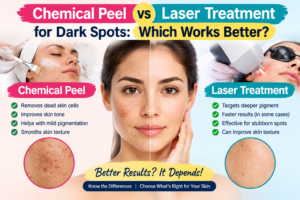

One of the most prevalent skin issues, particularly on the face, is dark spots. Patches of uneven pigmentation that take months to go away can be caused by sun exposure, acne, hormonal changes, and skin inflammation. Sunscreen, vitamin C, and retinoids are examples of skincare products that may be helpful, but for quicker or more noticeable results, some people think about getting professional treatments.
Chemical peels and laser treatment are two common choices. Both can make dark spots appear less noticeable, but they function differently and are not equally appropriate for all skin tones and pigmentation types.
Chemical peel vs laser treatment for dark spots: which works better? The answer depends on the cause of the spots, their depth, your skin type, the treatment used, and how carefully your skin is protected afterward. This guide compares both procedures, including their benefits, risks, recovery time, and expected results.
What Causes Dark Spots on the Skin?
Dark spots, also called hyperpigmentation, develop when the skin produces or stores excess melanin. Melanin is the natural pigment responsible for skin color. Several conditions can cause this uneven pigmentation.
Common causes include:
- Sun exposure: Ultraviolet radiation can trigger excess pigment and make existing spots darker.
- Post-inflammatory hyperpigmentation: Acne, cuts, burns, eczema, and other inflammation can leave brown or gray marks after the skin heals.
- Melasma: Hormonal changes and sun exposure may cause symmetrical brown patches, especially on the cheeks, forehead, upper lip, and nose.
- Age spots: Long-term sun exposure can lead to persistent brown spots on areas such as the face, hands, and shoulders.
The right treatment depends on the diagnosis. A procedure that works well for a superficial sun spot may not be the best choice for melasma or pigmentation caused by inflammation.
What Is a Chemical Peel?
A chemical peel is a professional skin treatment that applies a carefully selected chemical solution to the skin. The solution removes or loosens damaged surface cells and stimulates skin renewal.
Depending on the formula and strength, a peel may improve uneven skin tone, mild pigmentation, acne marks, and rough texture. Some peels also encourage collagen remodeling.
Types of Chemical Peels for Dark Spots
Superficial peels: These affect the outermost layers of the skin. Common ingredients include glycolic acid, salicylic acid, lactic acid, and mandelic acid. They are often used for mild pigmentation and acne-related discoloration.
Medium-depth peels: These penetrate more deeply and may provide more noticeable improvement for certain pigmentation concerns. Trichloroacetic acid, or TCA, is one ingredient used in some medium-depth peels. These treatments require careful professional assessment.
Deep peels: These reach deeper layers of the skin and have a greater risk of complications. They are not usually the first choice for treating ordinary dark spots.
Benefits of Chemical Peels
Chemical peels may help:
- Reduce the appearance of mild sun spots and acne marks.
- Improve dullness and uneven skin tone.
- Smooth rough skin texture.
- Support treatment of certain types of melasma when used appropriately.
- Improve the appearance of some superficial pigmentation with a series of treatments.
A peel does not permanently prevent new dark spots. Sun protection and treatment of the underlying cause remain important.
What Is Laser Treatment for Dark Spots?
Laser treatment uses concentrated light energy to target pigment or stimulate changes in the skin. Different lasers are designed for different purposes, so the term laser treatment does not describe just one procedure.
Some pigment-targeting lasers break up melanin-containing structures, while fractional lasers create controlled microscopic treatment zones to encourage skin remodeling. The best choice depends on the type of pigmentation, its depth, and the patient’s skin.
Common Laser Options
Pigment-targeting lasers: Q-switched and certain picosecond lasers may be used for selected pigmented lesions. They are sometimes considered for individual sun spots, but treatment settings must be chosen carefully.
Fractional lasers: These treat microscopic areas of skin to improve texture and stimulate remodeling. Certain fractional devices may also help pigmentation concerns, although they can worsen pigmentation in some people.
Non-ablative lasers: These deliver energy without removing the entire surface of the skin. They may offer improvement with less downtime than some ablative treatments.
Ablative lasers: These remove controlled layers of skin and can be used for selected skin concerns. They generally involve more recovery and a greater risk of post-treatment pigmentation changes.
Not every laser is appropriate for every skin tone. A laser specialist should assess the skin before choosing a device and settings.
Chemical Peel vs Laser Treatment: Key Differences
Chemical peels and laser treatments can both improve dark spots, but the experience and risks are different.
| Feature | Chemical Peel | Laser Treatment |
|---|---|---|
| Main action | Uses a chemical solution to renew skin | Uses light energy to target pigment or remodel skin |
| Best suited for | Selected superficial pigmentation and uneven texture | Selected pigment lesions and specific skin concerns |
| Downtime | Depends on peel depth | Depends on laser type and settings |
| Number of sessions | Often a series | May require one or several sessions |
| Skin tone considerations | Strongly important | Strongly important |
| Main risk | Irritation and post-inflammatory pigmentation | Burns, pigmentation changes, and scarring in some cases |
Neither treatment is automatically better for everyone. The best choice is the one that matches the diagnosis and offers an acceptable balance between results and safety.
Which Works Better for Acne Dark Spots?
Acne dark spots are usually a form of post-inflammatory hyperpigmentation. They develop after inflammation or injury to the skin and may gradually fade over time.
A superficial chemical peel may be useful for some people with mild acne-related pigmentation. Ingredients such as glycolic acid, mandelic acid, or salicylic acid may be selected based on the skin’s condition. A peel can also help improve texture and clogged pores in suitable patients.
Laser treatment may be considered for persistent pigmentation that has not responded to other options. However, some lasers can trigger inflammation and make dark spots worse, particularly in people prone to pigmentation.
Which is better? For mild, superficial acne marks, a carefully selected superficial peel may be a reasonable option. Laser treatment may be appropriate for selected cases, but it is not automatically the best first treatment. A dermatologist should also control active acne to reduce the risk of new marks.
Which Works Better for Melasma?
Melasma is a challenging condition because pigmentation can return after treatment. It is often influenced by sunlight, visible light, hormones, and skin inflammation.
Chemical peels may improve melasma in selected patients, especially when combined with a dermatologist-guided skincare routine and strict sun protection. However, aggressive peels can irritate the skin and worsen pigmentation.
Laser treatment for melasma requires particular caution. Some pigment-targeting lasers and other energy-based treatments may help selected patients, but recurrence and worsening pigmentation are possible. Laser treatment should not be considered a guaranteed cure.
For many people with melasma, daily broad-spectrum sunscreen, appropriate topical treatments, and careful management of triggers are essential. Professional procedures are best considered as part of a broader treatment plan.
Which Treatment Is Safer for Darker Skin Tones?
Skin tone is an important consideration before any procedure for pigmentation. People with medium to deep skin tones may be more prone to post-inflammatory hyperpigmentation after irritation, burns, or aggressive treatments.
Chemical peels are not automatically safe simply because they are chemical. Strong concentrations, excessive treatment, or poor aftercare can cause irritation and pigmentation changes.
Lasers also require careful selection. Some devices and settings carry a higher risk of unwanted pigment changes in darker skin. A dermatologist experienced in treating your skin tone can choose a suitable device, test treatment areas when appropriate, and reduce unnecessary risks.
Do not choose a treatment based only on before-and-after photos. Ask about the provider’s experience with your skin type and the specific pigmentation condition.
Chemical Peel vs Laser: Recovery Time
Recovery depends on the strength of the peel or the type of laser used.
Chemical Peel Recovery
For a few days, a superficial peel may result in mild redness, dryness, or peeling. Medium-depth peels may take longer to heal and may cause more noticeable peeling.
Refrain from pulling or picking at peeling skin while it heals. Use gentle skincare products, adhere to the provider’s recommendations, and shield your skin from the sun.
Laser Recovery
Some non-ablative laser treatments may cause temporary redness or swelling with limited downtime. Fractional or ablative treatments may involve more substantial redness, crusting, peeling, or skin sensitivity.
Recovery can vary from a few days to several weeks, depending on the procedure. Follow the specialist’s instructions carefully and avoid using irritating products until the skin has recovered.
How Many Sessions Are Needed?
There is no universal number of treatments for dark spots.
In order to give the skin time to heal, superficial chemical peels are frequently carried out as a sequence of treatments spaced apart. The condition being treated and the peel’s strength determine how many sessions are required.
While some laser treatments need several sessions, others may show results after just one. The patient’s reaction, the pigmentation depth, and the device all affect the anticipated outcomes.
Be cautious of clinics that promise complete removal of every dark spot in one treatment. Pigmentation may recur, and some marks require a different treatment altogether.
Chemical Peel vs Laser Treatment Cost
The cost of chemical peels and laser treatment varies by location, provider, procedure type, and the number of sessions required.
Superficial chemical peels are often less expensive per session than advanced laser treatments. However, a series of peels may increase the total cost.
Laser treatment can be more expensive because of the equipment, specialist expertise, and treatment complexity. The total cost should include consultation, aftercare, and possible repeat sessions.
Ask for a complete treatment estimate before starting. A cheaper treatment is not necessarily better if it creates irritation, pigmentation, or the need for additional procedures.
Can You Prevent Dark Spots After Treatment?
Yes, careful aftercare can help reduce the risk of new pigmentation, although it cannot guarantee that spots will not return.
Follow these important tips:
- Apply broad-spectrum SPF 30 or higher every day, and reapply as directed.
- Limit direct sun exposure, especially during peak sunlight hours.
- Wear a hat and protective clothing when outdoors.
- Use gentle cleansers and moisturizers during recovery.
- Avoid picking acne, scabs, or peeling skin.
- Do not restart strong exfoliants or retinoids until your provider says it is appropriate.
- Treat active acne, eczema, or other causes of inflammation.
- Follow any prescribed pigment-control skincare routine.
Sun protection is especially important for people with melasma and those who develop dark marks easily.
When Should You See a Dermatologist?
Consult a dermatologist before choosing a chemical peel or laser treatment if:
- You have widespread, recurring, or unexplained pigmentation.
- The spots are changing in size, shape, or color.
- You have a new dark spot that bleeds, itches persistently, or does not heal.
- You have a history of keloids or unusual scarring.
- You are pregnant, breastfeeding, or using medicines that affect your skin.
- You have active skin inflammation or an infection.
A dermatologist can determine whether the pigmentation is suitable for treatment and whether a biopsy or another evaluation is needed.
Final Verdict: Chemical Peel or Laser for Dark Spots?
There is no clear winner in the competition between chemical peel and laser treatment for dark spots. Both can improve pigmentation in carefully chosen patients, but how well they work depends on the treatment strategy and the reason behind the dark spots.
For some superficial pigmentation issues and minor acne scars, a superficial chemical peel might be a helpful solution. For certain pigment lesions or situations that call for a specialized approach, laser treatment might be more appropriate.
For melasma or darker skin tones, caution is particularly important because irritation and post-inflammatory hyperpigmentation can worsen the problem. A dermatologist-guided plan, consistent sunscreen, and realistic expectations are more important than choosing the most expensive procedure.
The best treatment is the one that safely addresses your specific type of pigmentation while minimizing the risk of new dark spots.