
Acne may disappear, but the dark spots it leaves behind can remain for weeks or even months. If you are dealing with brown, red, or uneven marks after breakouts, choosing the best serum for acne dark spots can make a big difference in your skincare routine.
These marks are often caused by post-inflammatory hyperpigmentation (PIH), which occurs when inflammation from acne triggers increased pigment production. They are especially common after picking, squeezing, or irritating pimples. The good news is that several skincare ingredients can help improve the appearance of post-acne dark spots while also addressing acne itself.
Dermatologists commonly recommend ingredients such as azelaic acid, retinoids, salicylic acid, and vitamin C for acne and pigmentation concerns. The American Academy of Dermatology specifically lists azelaic acid and topical retinoids among useful treatments for acne-related dark spots.
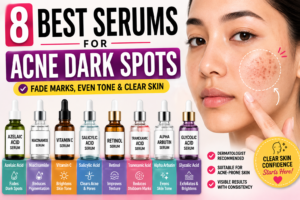
Below are 8 of the best types of serums for acne dark spots, how they work, who should use them, and how to add them to your routine.
1. Azelaic Acid Serum
Best overall serum for acne and dark spots
Azelaic acid is one of the most useful ingredients when you want to target both active acne and post-acne pigmentation.
It has anti-inflammatory properties and can help keep pores clearer while reducing the appearance of dark marks left after breakouts. Dermatology guidance recognizes azelaic acid as an acne treatment that can also fade dark spots after acne clears.
Why choose azelaic acid?
- Helps reduce acne-related inflammation
- Can improve post-acne dark spots
- Helps address clogged pores
- Suitable for many acne-prone skin types
- Can be useful for pigmentation in darker skin tones
Azelaic acid can be particularly attractive if your main concern is acne plus brown marks, rather than pigmentation alone.
Start with a lower-strength product and use it according to the product directions. If your skin becomes irritated, reduce frequency rather than applying more product.
2. Niacinamide Serum
Best for oily, acne-prone, and sensitive skin
Niacinamide, also known as vitamin B3, is a popular ingredient for people who want a simple, versatile serum.
It can support the skin barrier and is commonly included in formulas designed for oily or blemish-prone skin. It can also help improve the appearance of uneven skin tone.
A niacinamide serum is a good option if your skin is easily irritated by stronger exfoliating acids.
Benefits of niacinamide serum
- Helps support the skin barrier
- Suitable for oily and combination skin
- Can improve uneven-looking skin tone
- Works well in simple skincare routines
- Can be combined with moisturizer and sunscreen
For beginners, a moderate-strength niacinamide serum is often a better starting point than immediately choosing a very high concentration.
Remember that higher strength does not automatically mean better results. Irritation can make acne-prone skin more difficult to manage.
3. Vitamin C Serum
Best for brightening and uneven skin tone
Vitamin C is an antioxidant commonly used to improve the appearance of dullness, uneven tone, and dark spots.
The American Academy of Dermatology lists vitamin C among ingredients that may help fade existing dark spots.
Vitamin C can be especially useful as part of a morning skincare routine.
How to use vitamin C
In the morning:
- Cleanse your face.
- Apply vitamin C serum.
- Use moisturizer if needed.
- Finish with broad-spectrum sunscreen.
Vitamin C should not be viewed as a replacement for sunscreen. UV exposure can make pigmentation more noticeable, so sun protection remains an important part of treating dark spots.
If you have sensitive skin, start slowly and stop or reduce use if you experience persistent burning, redness, or irritation.
4. Salicylic Acid Serum
Best for acne, whiteheads, and clogged pores
If your dark spots are accompanied by frequent whiteheads and blackheads, salicylic acid may be one of the most useful choices.
Salicylic acid helps exfoliate the skin and unclog blocked pores. The AAD recommends it as an acne treatment, particularly for clogged pores, whiteheads, and blackheads.
Why use salicylic acid?
- Helps unclog pores
- Targets whiteheads and blackheads
- Helps reduce excess buildup
- Can reduce new breakouts
- May help prevent the cycle of acne followed by dark marks
However, salicylic acid is primarily an acne treatment rather than a dedicated pigmentation serum.
If you continue getting new pimples, treating the acne itself can help prevent additional post-acne marks.
Avoid using multiple exfoliating acids at the same time when starting a new routine. Too much exfoliation can irritate the skin and potentially make pigmentation more noticeable.
5. Retinol Serum
Best for acne, texture, and post-acne marks
Retinol is a vitamin A derivative and belongs to the retinoid family. Retinoids can help unclog pores and are used to treat acne. The AAD also notes that topical retinoids can help lighten dark spots left after acne clears.
Retinol may be a good choice if you have several concerns at once, such as:
- Acne
- Dark spots
- Uneven skin texture
- Clogged pores
- Early signs of aging
How to start retinol
Begin gradually, especially if you have never used a retinoid.
Apply a small amount in the evening according to the product’s directions. You can start a few nights per week rather than using it every night immediately.
Moisturizer can help reduce dryness and irritation.
Retinoids can irritate the skin, and irritation itself may contribute to dark marks, particularly in people prone to hyperpigmentation.
Important: topical retinoids should not be used during pregnancy. If you are pregnant, trying to become pregnant, or breastfeeding, ask your healthcare professional which acne and pigmentation ingredients are appropriate for you.
6. Tranexamic Acid Serum
Best for stubborn-looking pigmentation
Tranexamic acid has become a popular ingredient in modern dark-spot skincare products.
It is generally used in cosmetic formulations designed to improve the appearance of hyperpigmentation and uneven skin tone.
If your primary concern is brown marks left after acne, a serum containing tranexamic acid may be worth considering.
However, acne treatment should not be ignored. If you continue developing inflamed pimples, new marks can continue forming.
For this reason, some people benefit from a routine that addresses both acne and pigmentation rather than relying on a single brightening serum.
7. Alpha Arbutin Serum
Best for targeted brightening
Alpha arbutin is another ingredient frequently found in products designed for hyperpigmentation and uneven skin tone.
It is often used in brightening serums and can be a useful option for people who want a relatively simple pigmentation-focused product.
A serum containing alpha arbutin may work well alongside a basic routine consisting of:
- Gentle cleanser
- Moisturizer
- Sunscreen
- Acne treatment when needed
If you have sensitive skin, introduce one active product at a time. This makes it easier to identify which ingredient is helping or irritating your skin.
8. Glycolic Acid Serum
Best for gentle chemical exfoliation
Glycolic acid is an alpha-hydroxy acid that exfoliates the surface of the skin.
It can be useful for people dealing with uneven texture and pigmentation, but it may be too irritating for some acne-prone or sensitive skin types.
The AAD lists glycolic acid among ingredients that may help fade dark spots.
Who should consider glycolic acid?
It may be suitable if you have:
- Dull-looking skin
- Uneven texture
- Mild pigmentation
- Post-acne marks
However, start slowly. Do not combine several strong exfoliating products simply because you want faster results.
More irritation does not mean faster fading.
Which Serum Is Best for Acne Dark Spots?
There is no single serum that is best for everyone.
Your ideal choice depends on whether you are mainly dealing with active acne, brown pigmentation, clogged pores, sensitivity, or a combination of these problems.
Best choices by concern:
| Skin Concern | Serum Ingredient |
|---|---|
| Acne + dark spots | Azelaic acid |
| Oily acne-prone skin | Niacinamide |
| Dullness + pigmentation | Vitamin C |
| Whiteheads + clogged pores | Salicylic acid |
| Acne + texture + pigmentation | Retinol |
| Stubborn pigmentation | Tranexamic acid |
| Uneven skin tone | Alpha arbutin |
| Texture + pigmentation | Glycolic acid |
For many people, azelaic acid is one of the strongest all-around choices because it can address acne and dark spots at the same time.
How to Use Serum for Acne Dark Spots
Using the right serum is only part of the process. How you use it matters too.
Morning Routine
A simple morning routine can include:
Cleanser → Vitamin C or Niacinamide → Moisturizer → Sunscreen
If you are using an acne treatment recommended by your dermatologist, follow their instructions instead.
Night Routine
A nighttime routine could be:
Cleanser → Treatment Serum → Moisturizer
Do not introduce several powerful ingredients simultaneously.
For example, starting vitamin C, retinol, salicylic acid, glycolic acid, and azelaic acid all at once makes irritation much more likely.
Instead, introduce one active ingredient at a time.
Sunscreen Is Essential for Acne Dark Spots
One of the biggest mistakes people make when treating post-acne pigmentation is skipping sunscreen.
UV exposure can worsen pigmentation, particularly on exposed areas such as the cheeks, forehead, and nose. Dermatology references recommend daily broad-spectrum sun protection when treating post-inflammatory hyperpigmentation.
Choose a broad-spectrum sunscreen with at least SPF 30, or follow your dermatologist’s recommendation.
Apply it every morning and reapply as directed when spending significant time outdoors.
How Long Does It Take for Acne Dark Spots to Fade?
Dark spots do not normally disappear overnight.
The amount of time required depends on:
- Depth of pigmentation
- Skin tone
- Severity of acne
- Sun exposure
- Whether new acne continues
- Consistency of treatment
- Skin irritation
A consistent routine can gradually improve the appearance of marks, but patience is important.
If your acne keeps returning, focus on preventing new breakouts as well as treating existing pigmentation. Dermatologists recommend treating both acne and dark spots because preventing new inflammation can help prevent additional marks.
Common Mistakes That Make Acne Dark Spots Worse
Picking or squeezing pimples
Popping acne increases the risk of inflammation, scarring, and pigmentation.
Using too many active ingredients
Combining multiple acids and retinoids can cause irritation.
Skipping sunscreen
UV exposure can make pigmentation darker and harder to manage.
Using harsh home remedies
Lemon juice, baking soda, toothpaste, and other DIY treatments can irritate facial skin.
Changing products too quickly
Give your skincare routine enough time to work. Constantly switching products makes it difficult to know what is helping.
When Should You See a Dermatologist?
Consider seeing a dermatologist if your acne is painful, severe, frequently recurring, or leaving extensive dark spots or scars.
Professional evaluation is also useful if over-the-counter skincare has not produced the improvement you want.
A dermatologist can determine whether your marks are post-inflammatory hyperpigmentation, redness, or true acne scars and recommend an appropriate treatment.
For persistent pigmentation, professional treatments may sometimes be considered, but procedures such as peels or lasers can also cause additional pigmentation if used incorrectly, particularly in people prone to hyperpigmentation.
Final Thoughts
The best serum for acne dark spots depends on your skin type and the cause of your marks. Azelaic acid is an excellent multitasking option for acne and pigmentation, while niacinamide can be useful for oily or sensitive skin. Vitamin C is a popular morning brightening ingredient, salicylic acid is especially useful for clogged pores and whiteheads, and retinol can target acne, texture, and post-acne pigmentation.
The most important strategy is not simply choosing the strongest serum. Instead, build a consistent, gentle skincare routine, introduce active ingredients gradually, avoid picking your acne, and wear sunscreen every day.
Remember that flat dark marks after acne are usually different from indented or raised acne scars. Serums can help improve pigmentation, but significant texture changes may require professional treatment.
With patience and consistent skincare, acne-prone skin can gradually look clearer, smoother, and more even.