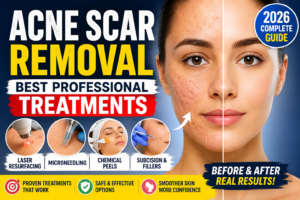

Acne may disappear, but the scars it leaves behind can remain for years. These scars often affect self-confidence and make many people search for effective ways to achieve smoother, healthier-looking skin. Fortunately, modern dermatology offers several professional treatments that can significantly reduce the appearance of acne scars.
Unlike over-the-counter creams or DIY remedies, professional acne scar removal treatments target the deeper layers of the skin. They stimulate collagen production, improve skin texture, and help replace damaged tissue with healthier skin. While no treatment can erase scars completely, many procedures can make them far less noticeable and deliver long-lasting improvements.
In this comprehensive guide, you’ll learn about the different types of acne scars, why professional treatments are often more effective than home remedies, and how dermatologists choose the right treatment based on your skin type and scar severity. We’ll also begin exploring one of the most popular options available today: laser resurfacing.
What Are Acne Scars?
Acne scars develop when inflamed pimples damage the skin’s deeper layers. During the healing process, the body produces collagen to repair the damaged tissue. If too little or too much collagen is produced, permanent scars may form.
Not everyone who experiences acne develops scars. However, severe inflammation, delayed treatment, frequent picking, or squeezing pimples can significantly increase the risk.
Acne scars differ from the temporary dark marks left after pimples heal. These discolorations, known as post-inflammatory hyperpigmentation (PIH), usually fade over time. True acne scars involve permanent changes in the skin’s texture.
Several factors influence scar formation:
- Severe cystic acne
- Picking or popping pimples
- Delayed acne treatment
- Genetics
- Skin inflammation
- Recurrent breakouts
Early treatment of active acne is one of the best ways to prevent permanent scarring.
Types of Acne Scars
Understanding your scar type is essential because different scars respond better to different treatments.
1. Ice Pick Scars
Ice pick scars are deep, narrow holes that extend into the skin. They resemble small puncture wounds and are among the most difficult scars to treat.
Characteristics include:
- Very deep
- Narrow opening
- Common on cheeks
- Often require multiple treatments
Professional procedures such as TCA CROSS, punch excision, or laser resurfacing are often recommended.
2. Boxcar Scars
Boxcar scars are wider depressions with clearly defined edges. They usually appear on the cheeks and temples.
They can be:
- Shallow
- Medium depth
- Deep
Treatment options often include laser resurfacing, microneedling, subcision, and chemical peels.
3. Rolling Scars
Rolling scars create uneven, wave-like skin texture due to fibrous bands pulling the skin downward.
Common characteristics:
- Broad depressions
- Soft edges
- Wavy appearance
- Uneven skin surface
Subcision combined with microneedling or fillers often produces excellent results.
4. Hypertrophic and Keloid Scars
Unlike depressed scars, hypertrophic scars are raised because the body produces too much collagen during healing.
These scars appear more frequently on:
- Chest
- Back
- Jawline
- Shoulders
Treatment may include corticosteroid injections, silicone sheets, cryotherapy, or laser therapy.
Why Professional Acne Scar Treatments Work Better Than Home Remedies
Many skincare products claim to remove acne scars completely. While certain ingredients can improve skin tone and reduce pigmentation, they rarely repair deep structural damage.
Professional treatments reach deeper skin layers where collagen remodeling occurs.
Benefits include:
Stimulate New Collagen
Professional procedures activate the body’s natural healing process, encouraging fresh collagen production that smooths depressed scars.
Improve Skin Texture
Dermatology treatments can soften rough skin, reduce unevenness, and restore a smoother appearance.
Target Deep Scars
Unlike creams that work on the surface, procedures like laser resurfacing and microneedling penetrate deeper to remodel scar tissue.
Faster Visible Results
Although multiple sessions are often required, patients usually notice measurable improvements much sooner than with topical products alone.
Customized Treatment Plans
Dermatologists assess your skin type, scar depth, and medical history to recommend the safest and most effective combination of treatments.
Factors Dermatologists Consider Before Choosing a Treatment
No single acne scar treatment works for everyone. Dermatologists develop personalized plans after carefully evaluating several factors.
Type of Acne Scar
Different scar types require different approaches.
For example:
- Ice pick scars often respond best to TCA CROSS or punch excision.
- Rolling scars usually improve with subcision.
- Boxcar scars respond well to laser resurfacing and microneedling.
Skin Tone
People with darker skin tones may have a higher risk of post-inflammatory hyperpigmentation after aggressive treatments.
Dermatologists often adjust laser settings or recommend procedures like RF microneedling to reduce this risk.
Active Acne
Treating active acne before scar removal is essential.
If new breakouts continue, additional scars may develop even after successful scar treatments.
Overall Health
Medical history, medications, pregnancy status, and healing ability all influence treatment selection.
Certain medications, such as isotretinoin, may require waiting several months before undergoing specific procedures.
Budget
Professional acne scar treatments vary widely in cost.
Some procedures require three to six sessions, while others may need only one or two treatments depending on scar severity.
A dermatologist helps balance effectiveness, recovery time, and budget to create a realistic treatment plan.
Laser Resurfacing: One of the Most Effective Acne Scar Treatments
Laser resurfacing remains one of the most popular professional treatments for moderate to severe acne scars.
It works by delivering concentrated light energy into the skin, removing damaged tissue while stimulating new collagen production beneath the surface.
Over the following weeks and months, the skin gradually becomes smoother, firmer, and more even in texture.
Types of Laser Treatments
Ablative Lasers
These lasers remove the outer layer of skin while heating deeper tissue to encourage collagen remodeling. They typically provide dramatic results but require more downtime.
Examples include:
- CO₂ Laser
- Erbium YAG Laser
Non-Ablative Lasers
These lasers leave the skin surface intact while heating deeper layers to stimulate collagen production.
Benefits include:
- Shorter recovery
- Less redness
- Lower risk of complications
- Suitable for many skin types
Patients generally require multiple sessions to achieve optimal improvement.
Benefits of Laser Resurfacing
- Improves skin texture
- Reduces deep acne scars
- Stimulates long-term collagen production
- Minimizes enlarged pores
- Enhances overall skin appearance
- Long-lasting results with proper skincare
However, laser resurfacing should always be performed by an experienced dermatologist or qualified laser specialist to minimize risks and achieve the best outcome.
we discussed the different types of acne scars, how dermatologists evaluate them, and why laser resurfacing is considered one of the most effective treatments. In this section, we’ll explore several other dermatologist-recommended procedures that can significantly improve acne scars. Many specialists combine these treatments to achieve the best possible results.
1. Microneedling for Acne Scars
Microneedling, also known as collagen induction therapy, is one of the most popular minimally invasive treatments for atrophic acne scars. It uses a device with fine, sterile needles to create controlled micro-injuries in the skin.
These tiny punctures trigger the body’s natural wound-healing process, stimulating the production of collagen and elastin. As new collagen forms, depressed scars gradually become smoother and less noticeable.
Benefits of Microneedling
- Improves mild to moderate acne scars
- Boosts collagen production naturally
- Minimizes enlarged pores
- Enhances overall skin texture
- Reduces fine lines and wrinkles
- Suitable for many skin tones
- Minimal downtime compared to laser treatments
What Happens During the Procedure?
A dermatologist applies a topical numbing cream before using a microneedling device across the treatment area. The session usually lasts 30–60 minutes, depending on the size of the area.
After treatment, your skin may appear red and feel similar to a mild sunburn for one to three days.
How Many Sessions Are Needed?
Most patients require:
- 3–6 sessions for mild scars
- 6–8 sessions for deeper scars
Sessions are generally spaced 4–6 weeks apart to allow the skin to heal.
Recovery Time
Most people return to normal activities within 24–48 hours. Following your dermatologist’s aftercare instructions is essential for optimal healing.
2. Radiofrequency (RF) Microneedling
RF Microneedling combines traditional microneedling with radiofrequency energy. While the needles create tiny channels, radiofrequency heat is delivered into the deeper layers of the skin to stimulate even greater collagen remodeling.
This treatment is particularly effective for rolling and boxcar acne scars.
Advantages of RF Microneedling
- Deeper collagen stimulation
- Faster skin remodeling
- Improves acne scars and skin laxity simultaneously
- Less downtime than many laser procedures
- Lower risk of pigmentation changes in darker skin tones
Many dermatologists recommend RF Microneedling for patients who are not ideal candidates for aggressive laser resurfacing.
Possible Side Effects
Most side effects are temporary and may include:
- Mild redness
- Swelling
- Tenderness
- Temporary dryness
These usually resolve within a few days.
3. Chemical Peels for Acne Scars
Chemical peels remove damaged outer layers of skin using specially formulated acids. They encourage new skin growth and improve uneven pigmentation, fine lines, and shallow acne scars.
The strength of the peel depends on the severity of the scars and the patient’s skin type.
Types of Chemical Peels
Superficial Peels
These use mild acids such as glycolic acid or salicylic acid to exfoliate the outermost skin layer.
Best for:
- Post-inflammatory hyperpigmentation
- Mild texture irregularities
- Maintenance treatments
Medium Peels
Medium-depth peels penetrate deeper into the skin using trichloroacetic acid (TCA).
Suitable for:
- Mild boxcar scars
- Uneven skin tone
- Sun damage
Deep Peels
Deep peels produce dramatic results but involve longer recovery periods and are less commonly used specifically for acne scars.
Benefits
- Brighter complexion
- Smoother skin texture
- Reduced discoloration
- Increased collagen production
- Improved effectiveness of skincare products
Recovery
Recovery varies depending on the peel:
- Superficial peel: 2–5 days
- Medium peel: 7–14 days
- Deep peel: Several weeks
Patients should avoid direct sunlight and use broad-spectrum sunscreen during healing.
4. Dermal Fillers for Depressed Acne Scars
Dermal fillers offer an immediate solution for certain depressed acne scars, especially rolling scars.
Instead of removing scar tissue, fillers raise the depressed area to match the surrounding skin.
Common filler materials include:
- Hyaluronic acid
- Poly-L-lactic acid
- Calcium hydroxylapatite
Advantages
- Immediate visible improvement
- Minimal downtime
- Quick office procedure
- Natural-looking results
- Can be combined with subcision or laser treatments
How Long Do Results Last?
The longevity depends on the filler used.
Typically:
- Hyaluronic acid fillers: 6–18 months
- Collagen-stimulating fillers: Up to 2 years
Maintenance treatments may be required.
5. Subcision
Subcision is considered one of the most effective treatments for rolling acne scars.
Rolling scars develop because fibrous bands beneath the skin pull the surface downward.
During subcision, a dermatologist inserts a small needle under the scar to break these bands.
Once released:
- The skin lifts naturally.
- New collagen forms.
- The scar gradually becomes less visible.
Benefits
- Excellent for rolling scars
- Long-lasting improvement
- Can be combined with fillers
- Often paired with microneedling or laser therapy
Recovery
Patients may experience:
- Bruising
- Mild swelling
- Temporary soreness
Most side effects improve within one week.
6. Punch Excision
Punch excision is commonly used for deep ice pick scars that do not respond well to resurfacing treatments.
The dermatologist removes the scar using a tiny surgical instrument.
The area is then:
- Closed with a small stitch, or
- Repaired with a tiny skin graft if necessary.
After healing, the scar is often much less noticeable and can be further refined with laser resurfacing.
Advantages
- Highly effective for deep scars
- Permanent removal of targeted scars
- Often combined with additional resurfacing procedures
7. TCA CROSS (Chemical Reconstruction of Skin Scars)
TCA CROSS is one of the best treatments for ice pick scars.
Instead of applying acid to the entire face, the dermatologist carefully places a high concentration of trichloroacetic acid (TCA) directly into each scar.
This controlled injury stimulates collagen production inside the scar.
Over several treatment sessions:
- Scar depth decreases
- Skin texture improves
- Ice pick scars become significantly less visible
Typical Treatment Plan
Most patients require:
- 3–6 sessions
- Treatments every 4–8 weeks
Side Effects
Temporary effects may include:
- Redness
- Small scabs
- Mild peeling
- Temporary pigmentation changes
Proper aftercare helps minimize these risks.
8. Combination Treatments Deliver the Best Results
Because acne scars often vary in type and depth, dermatologists frequently combine multiple procedures for optimal outcomes.
For example:
- Subcision + Fillers for rolling scars
- Laser Resurfacing + Microneedling for boxcar scars
- TCA CROSS + Laser Therapy for ice pick scars
- RF Microneedling + Chemical Peels for texture and pigmentation
A customized treatment plan addresses different scar types simultaneously and usually produces more noticeable improvements than a single treatment alone.
Professional acne scar treatments can produce remarkable improvements, but achieving the best results doesn’t end when you leave the dermatologist’s office. Proper aftercare, realistic expectations, and choosing the right specialist are just as important as the procedure itself.
In this final section, you’ll learn how to care for your skin after treatment, understand treatment costs, recognize potential risks, prevent future acne scars, and find answers to common questions.
Recovery and Aftercare Tips
Every professional acne scar treatment has its own healing timeline. However, following a proper skincare routine after treatment can speed recovery and improve results.
1. Protect Your Skin from the Sun
Freshly treated skin is highly sensitive to ultraviolet (UV) rays. Sun exposure can cause pigmentation changes and slow healing.
Dermatologists recommend:
- Wear a broad-spectrum sunscreen (SPF 30 or higher) every day.
- Reapply sunscreen every two hours when outdoors.
- Wear a wide-brimmed hat if spending extended time outside.
- Avoid direct sunlight during peak hours (10 a.m. to 4 p.m.).
Sun protection is one of the most important steps for maintaining long-term results.
2. Keep Your Skin Moisturized
After treatments such as laser resurfacing, microneedling, or chemical peels, your skin needs extra hydration.
Choose:
- Fragrance-free moisturizers
- Ceramide-rich creams
- Hyaluronic acid-based moisturizers
Avoid products containing alcohol or harsh fragrances until your skin has fully healed.
3. Avoid Picking or Scratching
Peeling, redness, and mild flaking are normal parts of the healing process.
Never:
- Pick scabs
- Scratch treated skin
- Peel loose skin
Doing so increases the risk of infection and may create new scars.
4. Pause Active Skincare Ingredients
For several days after treatment, avoid ingredients that may irritate healing skin, including:
- Retinoids
- Benzoyl peroxide
- Salicylic acid
- Glycolic acid
- Vitamin C (if advised by your dermatologist)
Your dermatologist will tell you when it’s safe to restart these products.
5. Follow Your Dermatologist’s Instructions
Every procedure has unique aftercare recommendations.
Always:
- Attend follow-up appointments.
- Take prescribed medications if needed.
- Contact your dermatologist if you notice excessive swelling, severe pain, or signs of infection.
How Much Does Acne Scar Removal Cost?
The cost of acne scar treatment depends on several factors:
- Type of procedure
- Number of sessions required
- Scar severity
- Geographic location
- Dermatologist’s experience
- Clinic reputation
Estimated Cost Per Session (United States)
| Treatment | Estimated Cost |
|---|---|
| Microneedling | $200–$700 |
| RF Microneedling | $500–$1,500 |
| Chemical Peel | $150–$800 |
| Laser Resurfacing | $1,000–$3,500 |
| Dermal Fillers | $700–$2,000 |
| Subcision | $300–$1,000 |
| TCA CROSS | $200–$600 |
| Punch Excision | $500–$1,500 |
Note: Prices vary by clinic and region. Multiple sessions are often required for the best results.
How to Choose the Best Acne Scar Treatment
No single procedure is ideal for everyone. The best treatment depends on your skin type, scar type, goals, and budget.
Mild Acne Scars
Recommended treatments:
- Microneedling
- Superficial chemical peels
- Non-ablative laser therapy
Moderate Acne Scars
Recommended treatments:
- RF Microneedling
- Fractional laser resurfacing
- Medium-depth chemical peels
Deep Acne Scars
Recommended treatments:
- CO₂ laser resurfacing
- Subcision
- Punch excision
- TCA CROSS
- Combination therapy
A board-certified dermatologist can examine your skin and recommend the most appropriate treatment plan.
Risks and Possible Side Effects
Although professional treatments are generally safe when performed by qualified providers, every procedure carries some risks.
Possible side effects include:
- Temporary redness
- Swelling
- Mild pain
- Skin peeling
- Dryness
- Bruising
- Temporary hyperpigmentation
- Infection (rare)
- Delayed healing
- Changes in skin color
- Scarring (very rare)
Following aftercare instructions greatly reduces the risk of complications.
Can Acne Scars Be Removed Permanently?
This is one of the most common questions patients ask.
The honest answer is:
Professional treatments can significantly improve acne scars, but completely removing every scar is rarely possible.
Many patients achieve:
- 50–90% improvement
- Smoother skin texture
- Smaller scar depth
- More even complexion
- Increased confidence
Results continue improving for several months as collagen production increases.
How to Prevent New Acne Scars
Preventing scars is much easier than treating them later.
Treat Acne Early
Don’t wait until acne becomes severe.
Early treatment helps prevent permanent skin damage.
Avoid Picking Pimples
Picking acne lesions damages healthy tissue and increases inflammation.
This is one of the biggest causes of permanent scarring.
Follow a Consistent Skincare Routine
A simple routine may include:
Morning:
- Gentle cleanser
- Lightweight moisturizer
- Sunscreen SPF 30+
Evening:
- Gentle cleanser
- Acne treatment (if prescribed)
- Moisturizer
See a Dermatologist
If over-the-counter products aren’t working after several weeks, schedule an appointment with a dermatologist before acne becomes severe.
Frequently Asked Questions (FAQ)
What is the most effective professional treatment for acne scars?
Fractional CO₂ laser resurfacing, RF microneedling, subcision, and combination therapies are among the most effective options. The best treatment depends on the type and severity of your scars.
Is laser treatment better than microneedling?
Laser resurfacing generally provides more dramatic results for deeper scars, while microneedling is often preferred for mild to moderate scars and for individuals with darker skin tones due to a lower risk of pigmentation changes.
How many sessions will I need?
Most patients require 3–6 treatment sessions, though deeper scars may need additional procedures or combination therapy.
Are professional acne scar treatments painful?
Most procedures involve minimal discomfort because a topical numbing cream is applied beforehand. Some treatments may cause temporary redness or tenderness afterward.
Can dark skin safely receive acne scar treatments?
Yes. Many procedures, including RF microneedling and certain laser treatments, can be safely performed on darker skin when done by an experienced dermatologist using appropriate settings.
How long do results last?
Results are often long-lasting because collagen remodeling continues for months after treatment. Maintaining good skincare habits and preventing new breakouts helps preserve improvements.
Final Thoughts
Acne scars can be frustrating, but they do not have to be permanent. Advances in dermatology have made it possible to significantly reduce the appearance of scars using treatments such as laser resurfacing, microneedling, RF microneedling, chemical peels, dermal fillers, subcision, TCA CROSS, and punch excision.
The most successful outcomes come from personalized treatment plans designed by a qualified dermatologist. Because every scar is different, combination therapies often provide the best results. With patience, proper aftercare, and consistent skincare, many people experience smoother skin, improved texture, and renewed confidence.
If acne scars are affecting your self-esteem, consult a board-certified dermatologist to discuss the treatment options best suited to your skin type and goals.