
Introduction
Face warts are small, non-cancerous skin growths caused by the human papillomavirus (HPV). While many facial warts disappear on their own over time, some persist, spread, become irritated, or affect appearance and self-confidence. Because the skin on the face is delicate, self-treatment is not always the safest option.
Knowing when to see a doctor for face warts is important to avoid unnecessary complications, obtain an accurate diagnosis, and receive appropriate treatment.
This comprehensive guide explains the causes, symptoms, warning signs, available treatments, home care, and prevention strategies for facial warts.
What Are Face Warts?
Face warts are small skin growths that develop when HPV enters the skin through tiny cuts or scratches. The virus causes skin cells to grow more rapidly than normal, creating raised bumps.
Facial warts are usually painless but may become irritated by shaving, makeup, or frequent touching.
Types of Face Warts
1. Flat Warts
Flat warts are the most common type found on the face.
Characteristics include:
- Small
- Smooth
- Flat-topped
- Light brown, yellow, or skin-colored
- Often appear in groups
2. Filiform Warts
These are long, narrow warts that commonly appear around:
- Eyelids
- Lips
- Nose
- Beard area
They grow quickly and may become irritated.
3. Common Warts
Although more common on the hands, common warts may also develop on the face.
They have:
- Rough surface
- Dome-shaped appearance
- Firm texture
What Causes Face Warts?
Facial warts are caused by infection with certain strains of HPV.
The virus spreads through:
- Skin-to-skin contact
- Sharing towels
- Razors
- Touching existing warts
- Small cuts or scratches
People with weakened immune systems may be more likely to develop persistent warts.
Symptoms of Face Warts
Common symptoms include:
- Small raised bumps
- Rough or smooth texture
- Skin-colored, pink, or brown appearance
- Multiple clustered lesions
- Mild itching or irritation
- Bleeding after shaving
- Slow growth over weeks or months
When to See a Doctor for Face Warts
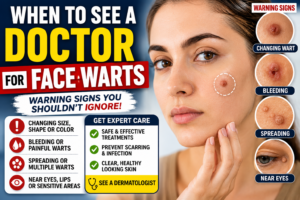
Many facial warts are harmless, but you should seek medical advice if any of the following apply.
1. The Wart Changes Rapidly
See a doctor if the wart:
- Grows quickly
- Changes color
- Develops irregular borders
- Becomes unusually thick
These changes may require evaluation to rule out other skin conditions.
2. It Bleeds Frequently
Occasional bleeding after shaving may occur, but repeated bleeding without injury should be assessed by a healthcare professional.
3. Persistent Pain
Most face warts are painless.
Pain may indicate:
- Infection
- Trauma
- Another skin condition
4. The Wart Spreads
If several new warts appear over a short period, medical treatment may help reduce further spread.
5. Home Treatment Doesn’t Work
If the wart remains after several weeks or months of appropriate treatment—or continues to enlarge—consult a dermatologist.
6. The Wart Is Near the Eyes
Never attempt to remove warts near the eyelids or eyes yourself. Professional treatment is recommended to protect these sensitive areas.
7. Signs of Infection
Seek prompt medical care if you notice:
- Pus
- Increasing redness
- Swelling
- Warmth
- Severe pain
- Fever
8. You’re Unsure It’s a Wart
Some skin cancers, moles, or other growths can resemble warts. Any uncertain or changing skin lesion should be evaluated by a healthcare professional.
How Doctors Diagnose Face Warts
Diagnosis usually includes:
- Medical history
- Visual skin examination
- Dermatoscopy (a magnified skin examination)
Rarely, a skin biopsy may be recommended if the diagnosis is uncertain.
Professional Treatment Options
A dermatologist may recommend:
- Cryotherapy (freezing)
- Prescription topical treatments
- Minor surgical removal
- Electrosurgery
- Laser therapy
- Chemical peeling for selected flat warts
The best treatment depends on the wart type, size, location, and your overall health.
Can You Treat Face Warts at Home?
Home care may help in some cases, but facial skin is delicate.
Avoid:
- Cutting the wart
- Picking it
- Burning it
- Using harsh chemicals intended for thicker skin on the hands or feet unless directed by a healthcare professional
If you choose an over-the-counter product, read the label carefully to ensure it is appropriate for use on the face.
Prevention Tips
Reduce your risk by:
- Washing hands regularly
- Avoiding picking at warts
- Not sharing towels or razors
- Using clean makeup tools
- Treating existing warts promptly
- Keeping your skin healthy and moisturized
Frequently Asked Questions (FAQs)
Should I see a doctor for a face wart?
Yes, especially if it changes, spreads, bleeds repeatedly, becomes painful, is near the eyes, or doesn’t improve with appropriate treatment.
Are face warts dangerous?
Most facial warts are harmless, but some skin conditions can resemble warts, making an accurate diagnosis important.
Can facial warts disappear on their own?
Yes. Some resolve without treatment, but this can take months or even years.
Can I remove a face wart myself?
Self-removal is not recommended for many facial warts because of the risk of scarring, irritation, or misdiagnosis.
Which doctor treats facial warts?
A dermatologist is the specialist most commonly involved in diagnosing and treating facial warts.
Conclusion
Understanding when to see a doctor for face warts can help you receive the right care while reducing the risk of scarring and unnecessary complications. Although many facial warts are harmless and may resolve over time, professional evaluation is recommended if they change, spread, become painful, bleed frequently, occur near the eyes, or fail to improve.
Early diagnosis and appropriate treatment can help restore healthy skin and prevent further spread.