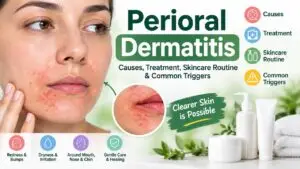

Perioral dermatitis is a common inflammatory skin condition that causes small red or skin-colored bumps, dryness, redness, burning, and irritation around the mouth. Despite its name, the rash can sometimes spread around the nose, chin, and even the area around the eyes.
It can be challenging to recognize at home because it might resemble eczema, acne, or an allergic reaction. Symptoms may worsen if the incorrect skincare products are used or if specific creams are applied frequently.
Fortunately, perioral dermatitis can typically be controlled with the proper skincare regimen and medical care. Reducing flare-ups can also be achieved by being aware of common triggers and avoiding needless irritation.
What Is Perioral Dermatitis?
Perioral dermatitis is an inflammatory rash that usually develops around the mouth. It often appears as clusters of tiny bumps with surrounding redness and dry, flaky skin.
Some people experience itching, while others mainly notice burning, tightness, or sensitivity. The skin immediately next to the lips may remain relatively clear, creating a noticeable border around the mouth.
Although perioral dermatitis is most commonly seen around the mouth, similar bumps can sometimes appear around the nose or eyes. When the rash involves the eye area, it may be referred to as periocular or periorificial dermatitis.
Perioral dermatitis is not usually dangerous, but persistent symptoms can be frustrating and may affect confidence.
Common Symptoms of Perioral Dermatitis
Symptoms can vary from person to person, but common signs include:
- Small red or skin-colored bumps around the mouth
- Redness and inflammation
- Dry or flaky skin
- Burning or stinging
- Mild itching
- Skin sensitivity
- Tight or uncomfortable skin
- Bumps around the nose or chin
- Occasional involvement around the eyes
Unlike traditional acne, perioral dermatitis usually does not produce many blackheads or whiteheads.
The rash may also become more noticeable after applying skincare products, cosmetics, or topical medications.
What Causes Perioral Dermatitis?
The exact cause of perioral dermatitis is not completely understood. Instead of one single cause, several factors may contribute to the development or worsening of the condition.
1. Topical Steroid Creams
One of the most important known triggers is the use of topical corticosteroid creams on the face.
Steroid creams can temporarily reduce redness and inflammation, making the skin appear better initially. However, repeated or prolonged facial use may trigger or worsen perioral dermatitis.
If you have been using a steroid cream on your face and develop a rash around the mouth, speak with a healthcare professional before making changes to long-term prescription treatment.
2. Heavy Skincare Products
Thick moisturizers, occlusive creams, facial oils, and greasy ointments may contribute to irritation in some people.
This does not mean everyone with perioral dermatitis must avoid moisturizer. Instead, choosing a simple, lightweight, fragrance-free product may be more comfortable.
3. Cosmetics
Foundation, concealer, heavy makeup, and certain cosmetic ingredients can irritate sensitive facial skin.
If your symptoms repeatedly become worse after applying makeup, consider reducing cosmetic use while the skin is recovering.
4. Fluoridated Toothpaste
Toothpaste has been reported as a possible trigger or aggravating factor for some people with perioral dermatitis. However, toothpaste is not considered the universal cause of the condition.
If your rash repeatedly flares around the mouth, discuss possible oral-care triggers with a dermatologist or healthcare professional rather than changing products randomly.
5. Hormonal Factors
Hormonal changes may play a role in some cases. Some people notice symptoms around periods or during other hormonal changes.
Hormones are not considered the only cause, but they may influence how sensitive the skin becomes.
6. Skin Irritation
Frequent washing, scrubbing, exfoliation, shaving irritation, harsh cleansers, and strong active ingredients can damage the skin barrier and make inflammation more noticeable.
When the skin is already irritated, a complicated skincare routine can make recovery more difficult.
Is Perioral Dermatitis Acne?
Perioral dermatitis can resemble acne, but the two conditions are different.
Acne commonly includes blackheads, whiteheads, clogged pores, pimples, and sometimes deeper cysts. Perioral dermatitis more often causes small uniform bumps, redness, dryness, and burning around the mouth.
Because treatment is different, using acne products such as strong exfoliating acids or benzoyl peroxide without knowing the cause of the rash may increase irritation.
If you are unsure whether you have acne or perioral dermatitis, a dermatologist can help determine the diagnosis.
Perioral Dermatitis Treatment
Treatment depends on the severity and possible triggers. Some mild cases may improve after removing irritating products, while persistent or moderate cases may require prescription medication.
Stop Potential Irritants
A dermatologist may recommend simplifying your skincare routine.
This can mean temporarily reducing:
- Scrubs
- Strong exfoliating acids
- Retinoids
- Fragranced products
- Heavy facial oils
- Thick occlusive creams
- Irritating cosmetic products
The goal is to minimize unnecessary irritation while the skin recovers.
Prescription Treatments
Doctors may prescribe topical or oral medications depending on the severity of the condition.
Possible treatments can include certain topical antibiotics or anti-inflammatory medications. In more persistent cases, an oral antibiotic may be prescribed for its anti-inflammatory effects.
Treatment can take several weeks, and improvement may not happen immediately.
Always use prescription medication according to your healthcare professional’s instructions.
What About Steroid Creams?
Steroid creams require special caution when perioral dermatitis is suspected.
Although corticosteroids can reduce redness temporarily, they may contribute to the development or worsening of perioral dermatitis in some people.
If you have been using a steroid cream regularly, do not assume that suddenly stopping a long-term prescription is appropriate for you. Speak with the prescribing clinician or dermatologist about the safest way to manage it.
A Simple Skincare Routine for Perioral Dermatitis
When the skin is irritated, simplicity is often helpful.
Morning Routine
Step 1: Gentle cleansing
Use lukewarm water and a mild, fragrance-free cleanser if cleansing is necessary.
Avoid scrubbing the skin.
Step 2: Lightweight moisturizer
If your skin feels dry or tight, use a simple fragrance-free moisturizer that does not contain a large number of potentially irritating ingredients.
Step 3: Sun protection
Sun exposure can aggravate redness and sensitive skin. If sunscreen does not irritate you, consider a gentle, fragrance-free broad-spectrum sunscreen.
If sunscreen consistently causes burning, ask a dermatologist or pharmacist about alternative formulations.
Evening Routine
Step 1: Gentle cleansing
Remove makeup and sunscreen gently without rubbing.
Step 2: Moisturizer
Apply a simple moisturizer if your skin feels dry.
Step 3: Avoid unnecessary active ingredients
During a flare, avoid adding multiple new treatments at once. Retinoids, exfoliating acids, scrubs, and strong acne treatments may be irritating for some people.
Ingredients to Be Careful With
There is no single list of ingredients that everyone with perioral dermatitis must avoid. Individual sensitivity varies.
However, during an active flare, many people benefit from avoiding unnecessary exposure to:
- Fragrance
- Essential oils
- Harsh exfoliating acids
- Physical scrubs
- Strong retinoids
- Alcohol-heavy products
- Very thick occlusive products
The important point is not to create an unnecessarily restrictive routine. Instead, focus on gentle products and introduce new ingredients slowly after the skin has settled.
Common Perioral Dermatitis Triggers
Identifying personal triggers can help reduce repeated flare-ups.
Common potential triggers include:
- Topical corticosteroids
- Heavy facial creams
- Frequent product switching
- Harsh cleansers
- Facial scrubs
- Strong skincare acids
- Certain cosmetics
- Skin irritation
- Excessive face washing
- Some oral-care products
- Hormonal changes
- Heat and environmental irritation
Not every trigger affects every person.
Keeping a simple skincare diary can help you identify patterns between products and flare-ups.
Things to Avoid During a Flare
When perioral dermatitis is active, avoid aggressive skincare.
Try not to:
- Pick or squeeze the bumps
- Scrub the affected skin
- Use multiple acne treatments at once
- Apply steroid creams without medical advice
- Introduce several new skincare products simultaneously
- Use strongly fragranced products
- Overwash the face
- Constantly change treatments
More products do not necessarily mean faster improvement.
Can Perioral Dermatitis Go Away on Its Own?
Some mild cases may improve when irritating triggers are removed. However, perioral dermatitis can persist or return if the underlying triggers are not addressed.
If the rash continues for several weeks, repeatedly comes back, spreads toward the eyes, or becomes painful or significantly irritated, professional evaluation is recommended.
A dermatologist can also rule out conditions that may look similar, including acne, rosacea, contact dermatitis, seborrheic dermatitis, and other facial rashes.
How Long Does Perioral Dermatitis Take to Improve?
Recovery time varies.
Some people notice gradual improvement after removing triggers, while others need several weeks or longer with medical treatment.
It is important to be patient because repeatedly changing products or treatments can irritate the skin further.
Even after the bumps improve, redness or sensitivity may take additional time to settle.
When Should You See a Dermatologist?
Consider seeing a dermatologist if:
- The rash lasts for several weeks
- Symptoms continue to worsen
- The rash spreads around the eyes
- The skin becomes painful or significantly swollen
- You are unsure whether it is acne or dermatitis
- Over-the-counter products are not helping
- You have been using a steroid cream on your face
- The condition repeatedly returns
Professional diagnosis is especially useful when the rash does not respond to a simple skincare routine.
Frequently Asked Questions
Is perioral dermatitis contagious?
No. Perioral dermatitis is not considered a contagious skin infection and cannot normally be spread through everyday contact.
Can I wear makeup with perioral dermatitis?
Makeup may irritate some people during an active flare. If you notice worsening after foundation or concealer, reducing cosmetic use temporarily may help.
Can moisturizer make perioral dermatitis worse?
Some heavy or occlusive products may aggravate symptoms in certain people. However, dry and irritated skin may still benefit from a gentle moisturizer. Choose a simple, fragrance-free formula and stop if it clearly causes worsening.
Is perioral dermatitis caused by poor hygiene?
No. Perioral dermatitis is not simply a result of poor hygiene. In fact, excessive washing and scrubbing may increase irritation.
Can toothpaste cause perioral dermatitis?
Toothpaste has been suggested as a possible aggravating factor for some people, but it is not considered the sole cause in most cases. If you suspect a connection, discuss it with a healthcare professional.
Is perioral dermatitis the same as rosacea?
No. They are different skin conditions, although both can cause facial redness and bumps and may sometimes occur together or look similar.
Final Thoughts
Perioral dermatitis is a common inflammatory facial rash that can cause small bumps, redness, dryness, burning, and sensitivity around the mouth. Topical steroids, irritating skincare products, cosmetics, and other individual triggers may contribute to flare-ups.
The most useful skincare approach is usually simple: gentle cleansing, minimal irritation, appropriate moisturizing, sun protection, and avoiding unnecessary active ingredients during a flare.
If symptoms persist, spread, or repeatedly return, a dermatologist can confirm the diagnosis and recommend appropriate treatment. Avoid self-treating persistent facial rashes with steroid creams, because they can sometimes make perioral dermatitis worse.
With the right diagnosis, trigger management, and treatment plan, many people can achieve clearer and more comfortable skin.