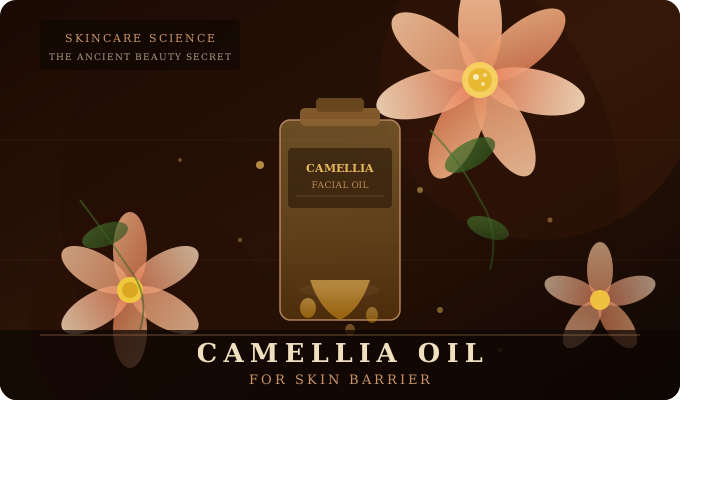

CAMELLIA OIL
& Your Skin Barrier
The Ancient Beauty Secret with Modern Proof
For centuries, Japanese geishas and Korean court women guarded a single beauty secret — the golden oil pressed from camellia blossoms. Today, dermatology confirms what they always knew.
Camellia oil, extracted from the seeds of Camellia sinensis or Camellia japonica, is one of nature’s most sophisticated skin-repair ingredients. Unlike trendy botanical oils that come and go, camellia oil has remained a cornerstone of East Asian skincare for over a thousand years. And now, with modern dermatological research backing its benefits, it has earned its rightful place in global skincare routines.
But what exactly makes this light, golden oil so remarkable for skin health — and specifically for the skin barrier? To understand that, we first need to understand what the skin barrier actually is.
What Is the Skin Barrier?
The skin barrier, also known as the stratum corneum, is the outermost layer of your skin. Think of it as a brick wall: skin cells (corneocytes) are the bricks, and lipids — fats including ceramides, cholesterol, and fatty acids — are the mortar holding everything together. This structure serves as your body’s first line of defense against environmental aggressors: pollution, UV radiation, bacteria, harsh weather, and moisture loss.
When this barrier is compromised — due to over-cleansing, environmental stress, harsh skincare ingredients, or genetics — the skin becomes dry, inflamed, sensitive, and reactive. Transepidermal water loss (TEWL) increases, meaning your skin simply cannot hold onto moisture. This is where camellia oil enters the picture, not merely as a moisturizer, but as a genuine barrier-repair ingredient.
The Science Behind the Oil
Camellia oil’s barrier-supporting power comes from its exceptional fatty acid profile. Unlike most plant oils, camellia closely mirrors human sebum — the skin’s own natural oil — making it uniquely biocompatible.
| Component | Amount | Type | Benefit |
| Oleic Acid | ~83% | Omega-9 | Deep moisturization & barrier repair |
| Linoleic Acid | ~8% | Omega-6 | Anti-inflammatory, barrier function |
| Palmitic Acid | ~4% | Saturated | Emollient, skin softening |
| Squalene | Trace | Antioxidant | Protects against oxidative damage |
| Vitamins A, B, C, E | Present | Antioxidants | Brightening, cell regeneration |
Key Benefits for the Skin Barrier
1. Deep Hydration & TEWL Reduction
Camellia oil forms an occlusive yet breathable layer on the skin’s surface. This film significantly reduces transepidermal water loss, allowing the skin to retain its natural moisture for longer periods. Unlike heavy, pore-clogging oils, camellia achieves this without suffocating the skin.
2. Barrier Lipid Replenishment
With an oleic acid content of approximately 83%, camellia oil integrates seamlessly into the lipid matrix of the stratum corneum. This reinforces the skin’s structural integrity at a molecular level — essentially rebuilding the mortar between the bricks of your skin wall.
3. Anti-Inflammatory Action
Rich in polyphenols and squalene, camellia oil actively calms redness, soothes irritation, and reduces inflammatory skin responses. This makes it particularly valuable for those experiencing barrier disruption, which often presents as sensitivity, burning, or reactive skin.
4. Antioxidant Protection
Vitamins A, B, C, and E present in camellia oil work synergistically to neutralize free radicals — unstable molecules that damage skin barrier cells and accelerate the aging process. This antioxidant shield helps prevent future barrier damage while the fatty acids repair existing damage.
5. Cell Regeneration Support
Oleic acid has been shown to promote healthy cell turnover, helping the skin barrier repair itself more quickly after damage or disruption. Regular use of camellia oil can accelerate the recovery of compromised skin.
6. Fast Absorption Without Greasiness
Despite its rich profile, camellia oil’s molecular structure allows for rapid penetration into the skin without leaving a greasy residue or clogging pores. Its comedogenic rating of just 1 out of 5 makes it suitable even for combination or oily skin types.
Camellia Oil Across Different Skin Types
Dry Skin
Camellia oil is perhaps most transformative for dry skin. It provides immediate relief from tightness and flaking while simultaneously working at a deeper level to replenish the lipid matrix. For severely dry or dehydrated skin, applying 3-5 drops onto damp skin before your moisturizer can dramatically improve the skin’s ability to retain hydration throughout the day.
Oily Skin
Counterintuitively, camellia oil can benefit oily skin. When the skin barrier is compromised, the skin often overproduces sebum as a compensatory response. By reinforcing the barrier with camellia oil — which closely mimics natural sebum — the skin’s oil-regulation signals can normalize. Its low comedogenic rating (1 out of 5) means it is very unlikely to clog pores.
Sensitive Skin
Those with sensitive skin, rosacea, eczema, or reactive skin conditions often find camellia oil to be one of the most tolerable facial oils available. Its high compatibility with human sebum means it rarely triggers reactions. Its squalene and polyphenol content actively calm inflammation. Always patch test before full-face application.
Combination Skin
For combination skin, camellia oil offers a balanced approach — it can be applied as a spot treatment on drier areas while being light enough that accidental application on the T-zone won’t cause breakouts. You can also mix 1-2 drops into a lightweight, oil-free moisturizer to add barrier-supporting benefits without tipping the skin into over-oiliness.
How to Use Camellia Oil in Your Routine
Follow these steps for maximum benefit:
- Cleanse gently. Use a mild, pH-balanced cleanser. Avoid foaming cleansers that strip the skin — they undo what camellia oil works to repair.
- Apply to damp skin. After cleansing, pat skin dry but leave slightly damp. Camellia oil penetrates more effectively and seals in existing moisture when applied this way.
- Use 3-5 drops. Warm the oil between your palms and gently press — do not rub — into the face and neck using upward motions.
- Layer your moisturizer over it if needed, or use camellia oil as your final step at night to lock in all preceding layers.
- Apply SPF in the morning. Camellia oil does not provide sun protection — always follow with a broad-spectrum SPF 30+ during the day.
Choosing the Right Camellia Oil
Not all camellia oils are created equal. The extraction method significantly impacts the oil’s potency and purity. Cold-pressed, unrefined camellia oil retains the highest concentration of fatty acids, polyphenols, and vitamins. Refined versions are lighter in color and scent but have reduced active compounds.
Look for these quality indicators:
- Camellia japonica or Camellia sinensis seed oil in the top ingredients list
- Packaging in dark glass bottles to protect against oxidation
- “Cold-pressed” or “unrefined” clearly stated on the label
- No added fragrance or synthetic preservatives
- Sourced from reputable Japanese or Korean suppliers where possible
Camellia Oil vs. Other Facial Oils
When compared to other popular facial oils, camellia oil holds its own distinctly. Unlike rosehip oil — which is higher in linoleic acid and better suited for hyperpigmentation — camellia oil’s oleic-acid dominance makes it superior for barrier repair and dry skin. Unlike argan oil, camellia absorbs more quickly and has a lighter texture. Unlike marula oil, it has a longer shelf life and greater stability due to lower polyunsaturated fat content.
Its closest competitor in terms of skin compatibility is jojoba oil (technically a wax ester), but camellia surpasses it in antioxidant richness and anti-inflammatory potential. For those specifically focused on strengthening a compromised barrier, camellia oil occupies a unique position that few other plant oils can match.
“In a world of complex, multi-step routines, camellia oil remains beautifully simple — a single ingredient that nourishes, protects, and restores the skin’s most fundamental defense system.”
Note: This article is for informational purposes only and does not constitute medical advice. Consult a qualified dermatologist for personalized skincare guidance.