
Introduction
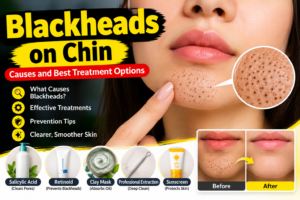
Blackheads on the chin are a common skincare concern that can affect teenagers and adults alike. These small, dark-colored bumps often appear around the chin, jawline, and lower part of the face. Although blackheads are usually harmless, they can make the skin look uneven and may become frustrating when they repeatedly return despite regular cleansing.
The good news is that blackheads on the chin can often be managed with a consistent skincare routine and the right treatment ingredients. Understanding why they develop is the first step toward choosing effective products and preventing new blackheads from forming.
Blackheads are a type of acne known as open comedones. They develop when pores become clogged with excess oil, dead skin cells, and other debris. The dark appearance is not caused by dirt but by the oxidation of material inside the open pore when it comes into contact with air.
In this guide, you will learn about the main causes of chin blackheads, the best treatment options, effective skincare ingredients, common mistakes to avoid, and practical prevention tips for healthier-looking skin.
What Are Blackheads on the Chin?
Blackheads are small bumps that form when a hair follicle becomes blocked by sebum, which is the natural oil produced by the skin, and dead skin cells.
Unlike whiteheads, which remain covered by a thin layer of skin, blackheads have an open surface. When the material inside the pore is exposed to air, it undergoes oxidation and appears dark.
Blackheads commonly develop on the nose, forehead, and chin because these areas can produce relatively large amounts of sebum.
Chin blackheads may appear as:
-
Small black or dark brown dots.
-
Slightly raised bumps around the chin.
-
Rough or uneven skin texture.
-
Clusters of clogged pores near the lower lip.
-
Recurring dark spots that remain visible after cleansing.
Blackheads are different from sebaceous filaments, which are normal structures that help move oil through the pores. Sebaceous filaments usually look smaller, flatter, and more uniform. They are particularly common on the nose and chin and should not be treated as a skin problem that needs complete removal.
What Causes Blackheads on the Chin?
Several factors can contribute to the development of chin blackheads. Identifying the possible triggers can help you choose a more effective treatment.
Youtube Video
1. Excess Oil Production
One of the most common causes of blackheads on the chin is excess sebum production.
Sebum helps protect the skin and maintain its natural moisture barrier. However, when oil combines with dead skin cells inside a pore, it can form a blockage.
People with oily or combination skin may be more likely to develop blackheads, especially in areas with a higher concentration of oil-producing glands.
Hot weather, humidity, genetics, and hormonal changes can also influence how much oil the skin produces.
2. Hormonal Changes
Hormones can affect oil production, making hormonal fluctuations a possible contributor to chin blackheads.
Changes during puberty, menstruation, pregnancy, and other hormonal transitions may increase sebum production in some people.
Hormonal acne often appears around the chin and jawline, although it more commonly includes inflamed pimples, tender bumps, or deeper lesions rather than blackheads alone.
If blackheads appear alongside persistent acne, irregular menstrual periods, or other unusual hormonal symptoms, consider speaking with a healthcare professional.
3. Dead Skin Cell Buildup
The skin naturally sheds dead cells. When these cells accumulate and mix with excess oil, they can block hair follicles and contribute to blackhead formation.
A skincare routine that does not adequately address clogged pores may allow blackheads to persist.
However, excessive exfoliation can irritate the skin and worsen inflammation. The goal is to encourage normal cell turnover without damaging the skin barrier.
4. Comedogenic Skincare Products
Some skincare products, makeup formulas, and heavy moisturizers may contribute to clogged pores in acne-prone individuals.
Products containing rich oils, waxes, or other ingredients that do not suit your skin may worsen congestion for some users.
This does not mean every oil-based product causes blackheads. Formulations vary, and an ingredient’s effect depends on the complete product and the individual’s skin.
Choose products labeled non-comedogenic when possible, and introduce new products gradually so you can identify potential triggers.
5. Sweat, Friction, and Occlusion
Sweat itself does not automatically cause blackheads, but a combination of sweat, oil, friction, and occlusive products may contribute to breakouts.
Frequent contact with the chin from hands, tight clothing, helmet straps, or sports equipment can irritate the skin.
Face masks and other items that trap moisture may also worsen acne in some people.
Cleanse gently after heavy sweating and keep objects that regularly touch your chin clean.
6. Improper Skincare Habits
Certain habits can make blackheads more noticeable or encourage additional breakouts.
Examples include:
-
Skipping cleansing after wearing makeup or sunscreen.
-
Using harsh facial scrubs.
-
Washing the face too frequently.
-
Applying several strong acne products at once.
-
Using thick products that do not suit your skin.
-
Squeezing blackheads with fingernails.
A gentle, consistent skincare routine is generally more helpful than aggressive cleansing or frequent product changes.
Best Treatment Options for Blackheads on the Chin
The most effective treatment depends on your skin type, the severity of the blackheads, and whether you also experience acne or irritation.
Many mild cases improve with over-the-counter skincare ingredients when they are used consistently.
1. Salicylic Acid
Salicylic acid is one of the most useful ingredients for treating blackheads.
It is a beta hydroxy acid (BHA) that helps exfoliate inside the pores and loosen the buildup of oil and dead skin cells. This makes it particularly suitable for clogged pores and blackheads.
Benefits of salicylic acid:
-
Helps unclog pores.
-
Reduces the appearance of blackheads.
-
Improves rough skin texture.
-
Helps prevent some new clogged pores from forming.
A low-strength facial product, such as a 0.5% to 2% salicylic acid cleanser or leave-on treatment, may be appropriate depending on your skin’s tolerance.
Start two or three times per week if you are using a leave-on product, then adjust according to the product directions and your skin’s response.
Avoid applying it to broken or severely irritated skin. If dryness, burning, or peeling develops, reduce use or stop the product.
2. Topical Retinoids
Topical retinoids help regulate skin cell turnover and prevent dead skin cells from accumulating inside pores.
Adapalene is an example of a topical retinoid available without a prescription in some countries. It is commonly used to treat acne, including comedonal acne.
Retinoids may help:
-
Reduce existing clogged pores over time.
-
Prevent new blackheads.
-
Improve uneven skin texture.
-
Treat both blackheads and some types of acne.
Apply the product according to its label, generally in a thin layer to acne-prone areas rather than only on individual spots. Start gradually to minimize dryness and irritation.
Important: Topical retinoids can cause irritation and increase sensitivity to sunlight. They should generally be avoided during pregnancy or when trying to become pregnant unless your healthcare professional advises otherwise. Ask a healthcare professional before use if you are breastfeeding.
3. Benzoyl Peroxide for Associated Acne
Benzoyl peroxide is most helpful when chin blackheads occur alongside inflamed pimples.
It reduces acne-causing bacteria and can help control inflammatory acne. However, it is not usually the first choice for blackheads alone because salicylic acid and topical retinoids more directly address clogged pores.
If your chin has a combination of blackheads and red pimples, benzoyl peroxide may be useful as part of an appropriate treatment plan.
It can cause dryness and irritation and may bleach towels, clothing, and pillowcases.
4. Clay Masks
Clay masks containing ingredients such as kaolin or bentonite can absorb some surface oil and temporarily make oily skin look less shiny.
They may be useful for people with oily or combination skin, but they do not reliably remove deep pore blockages or permanently prevent blackheads.
Use a clay mask according to its instructions, usually once a week if your skin tolerates it.
Avoid letting the mask become excessively dry and uncomfortable. Follow with a gentle moisturizer to help maintain the skin barrier.
5. Professional Comedone Extraction
A dermatologist or trained skincare professional may perform manual extraction to remove stubborn blackheads.
During extraction, the professional uses appropriate tools and techniques to release the blockage while minimizing trauma to the surrounding skin.
Professional extraction may provide immediate cosmetic improvement, but it does not prevent new blackheads from forming.
Combining professional treatment with a suitable at-home routine can help maintain the results.
Avoid trying to force deeply embedded blackheads out of your skin, as this can cause inflammation, infection, discoloration, and scarring.
6. Chemical Peels
Professional chemical peels use exfoliating acids to improve clogged pores and skin texture.
Depending on the formulation, a dermatologist may recommend salicylic acid or another suitable peeling agent for acne-prone skin.
Possible benefits include smoother skin and fewer visible clogged pores. However, results depend on the type of peel, the condition of your skin, and the number of treatments required.
Chemical peels can cause irritation, burns, or changes in pigmentation if used incorrectly. Professional advice is especially important for people prone to dark marks after inflammation.
Simple Skincare Routine for Chin Blackheads
A consistent morning and evening routine can help manage blackheads without overwhelming your skin.

Morning routine
-
Cleanse with a gentle facial cleanser.
-
Apply a lightweight, non-comedogenic moisturizer.
-
Finish with broad-spectrum SPF 30 or higher sunscreen.

Evening routine
-
Remove makeup and sunscreen.
-
Wash your face gently.
-
Apply one suitable blackhead treatment, such as salicylic acid or a topical retinoid.
-
Use a moisturizer to reduce dryness.
You do not need to use every acne ingredient at once. Starting several active products together can cause irritation, making it harder to identify which product is helping or causing problems.
Begin with one treatment, follow its instructions, and introduce additional products only when your skin tolerates the initial routine.
Natural Remedies for Blackheads on the Chin
Many people look for natural ways to remove blackheads. Although gentle skincare habits can support healthier-looking skin, most home remedies do not have strong evidence for clearing established blackheads.
Gentle Cleansing
Wash your face twice daily and after heavy sweating. Use lukewarm water and a mild cleanser rather than aggressively scrubbing the chin.
Gentle cleansing removes surface oil, sunscreen, and makeup without unnecessarily disrupting the skin barrier.
Warm Compresses
A warm, damp washcloth may soften surface debris and make cleansing more comfortable. However, it does not reliably open pores or remove blackheads on its own.
Avoid very hot water and steam treatments that may burn or irritate the skin.
Aloe Vera for Skin Comfort
A simple aloe vera product may help soothe some skin irritation, depending on its formulation and your individual tolerance.
However, aloe vera is not a proven treatment for removing blackheads. Choose a product without irritating fragrance and test it on a small area first.
Avoid Lemon Juice and Baking Soda
Lemon juice, baking soda, toothpaste, and harsh homemade scrubs are not recommended blackhead treatments.
They can irritate the skin, disrupt its natural pH, or cause chemical burns and discoloration. Irritation may be particularly problematic for people who develop dark marks easily.
For more reliable results, use proven acne ingredients rather than harsh household remedies.
How to Prevent Blackheads on the Chin
Prevention focuses on minimizing pore blockage and maintaining a healthy skin barrier.
Follow these practical tips:
-
Cleanse consistently: Wash your face morning and evening with a gentle cleanser.
-
Choose suitable products: Look for non-comedogenic moisturizers, sunscreen, and makeup.
-
Use targeted treatments: Salicylic acid or a topical retinoid may help prevent new clogged pores.
-
Avoid squeezing: Picking at blackheads can lead to irritation, infection, and dark marks.
-
Remove makeup before bed: Use a gentle cleanser or makeup remover.
-
Clean frequently used items: Wash makeup brushes regularly and clean objects that repeatedly touch your chin.
-
Moisturize daily: A suitable moisturizer helps maintain the skin barrier, even if your skin is oily.
-
Protect your skin from the sun: Broad-spectrum sunscreen helps protect against sun damage and can reduce the risk of persistent discoloration.
Consistency is more important than using many products. A simple routine that you can maintain is often more useful than frequently switching between different treatments.
Common Mistakes to Avoid When Treating Chin Blackheads
Even effective skincare products can cause problems when used incorrectly.
Over-Exfoliating
Using multiple exfoliating acids, scrubs, and retinoids together can cause redness, burning, and peeling.
Irritated skin may become more sensitive and difficult to treat. Introduce active ingredients gradually and give your skin time to adjust.
Using Pore Strips Too Often
Pore strips can temporarily remove some material from the surface of blackheads, but they do not address the underlying causes of clogged pores.
Frequent use may irritate the skin and will not prevent new blackheads from developing.
Expecting Overnight Results
Blackheads generally do not disappear permanently after one treatment.
Depending on the product and severity of the problem, noticeable improvement may take several weeks. Some acne treatments need around six to eight weeks or longer to show meaningful results.
Follow the product directions and avoid increasing the frequency simply because results are not immediate.
Applying Too Much Product
Using more treatment than recommended does not necessarily improve results. It can instead increase irritation.
Use the recommended amount and avoid applying acne treatments too close to the eyes, lips, or other sensitive areas unless the product is specifically intended for those areas.
How Long Does It Take to Get Rid of Chin Blackheads?
The timeline depends on the treatment, the severity of the blockage, and your skin’s tolerance.
| Treatment | Typical expectation |
|---|---|
| Gentle cleansing and moisturizing | Supports skin comfort and routine maintenance |
| Salicylic acid | Improvement may begin over several weeks |
| Topical retinoids | Often require 6–8 weeks or longer |
| Clay masks | Temporary reduction in surface oil |
| Professional extraction | Immediate improvement in extracted blackheads |
| Chemical peels | Results vary; several sessions may be needed |
These are general expectations rather than guarantees. Some people respond more quickly, while others need a different treatment approach.
If your blackheads are not improving after approximately eight to twelve weeks of consistent, appropriate care, consider consulting a dermatologist.
When Should You See a Dermatologist?
Most blackheads are harmless and can be managed at home. However, professional evaluation may be helpful if the problem persists or becomes more severe.
Consider seeing a dermatologist if:
-
Blackheads continue to return despite consistent treatment.
-
You develop painful, deep, or inflamed pimples.
-
Your skin becomes severely irritated by acne products.
-
You notice scarring or persistent dark marks.
-
You are unsure whether the bumps are blackheads or another skin condition.
-
The bumps change rapidly, bleed, or develop unusual features.
Not every dark spot on the chin is a blackhead. Small bumps may also represent sebaceous filaments, milia, folliculitis, or other skin conditions that require different care.
A dermatologist can examine the skin and recommend a treatment suited to your specific concerns.
Frequently Asked Questions About Blackheads on the Chin
1. Why do I keep getting blackheads on my chin?
Recurring chin blackheads may be related to excess oil production, dead skin cell buildup, hormonal fluctuations, or products that contribute to clogged pores. A consistent routine using suitable ingredients such as salicylic acid or a topical retinoid may help reduce recurrence.
2. What is the fastest way to remove blackheads on the chin?
Professional extraction can remove selected blackheads relatively quickly. At home, salicylic acid may help loosen pore blockages over time. Avoid squeezing blackheads or using harsh scrubs because these methods can injure the skin.
3. Does salicylic acid remove chin blackheads?
Salicylic acid helps exfoliate inside pores and reduce the buildup that contributes to blackheads. Regular use of a suitable product may improve clogged pores, although results are gradual and depend on individual skin tolerance.
4. Are chin blackheads caused by hormones?
Hormonal fluctuations can increase oil production and contribute to acne. However, chin blackheads may also result from ordinary pore blockage, skincare products, and other factors. Their presence alone does not prove that you have a hormonal imbalance.
5. Should I squeeze blackheads on my chin?
It is best to avoid squeezing them yourself. Pressure from fingernails or extraction tools can damage the surrounding skin, cause inflammation, and increase the risk of infection or scarring. A trained professional can remove stubborn blackheads more safely.
6. Can blackheads on the chin go away naturally?
Some blackheads may clear as the skin naturally sheds dead cells, but many persist or return. Gentle cleansing and suitable skincare treatments can help manage them more effectively than relying on natural clearing alone.
7. Is moisturizer necessary if I have blackheads?
Yes. A lightweight, non-comedogenic moisturizer can help maintain the skin barrier and reduce dryness from acne treatments. Oily skin still needs hydration, although the best formulation will depend on your individual skin type.
Conclusion
Blackheads on the chin are a common skincare concern caused by clogged pores containing excess oil and dead skin cells. Although hormonal changes, product choices, and skincare habits can contribute, these bumps are usually manageable with the right approach.
Salicylic acid and topical retinoids are among the most useful treatments for reducing clogged pores and preventing new blackheads. Gentle cleansing, daily moisturizing, sunscreen, and avoiding excessive exfoliation can also support clearer-looking skin.
Remember that results take time. Introduce one treatment at a time, use products according to their directions, and avoid squeezing or scrubbing your skin aggressively.
If chin blackheads persist, become painful, or leave scars, a dermatologist can help you identify the cause and develop a more effective treatment plan. With consistent care and suitable products, you can gradually improve the appearance and texture of your skin.