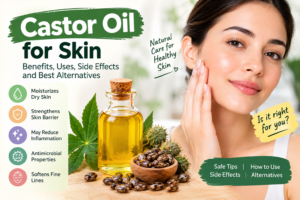

Castor Oil for Skin: Benefits, Uses, Side Effects, and Best Alternatives
Introduction
Castor oil has been used for generations in traditional remedies and personal care. Extracted from the seeds of the castor plant (Ricinus communis), this thick vegetable oil is best known for its historical use as a laxative. However, it has recently gained attention as an ingredient in skin care routines.
Many people use castor oil to moisturize dry skin, improve the appearance of fine lines, and soothe areas that feel irritated. Beauty enthusiasts also recommend it for dark spots and uneven skin tone. But how many of these claims are supported by scientific evidence?
Castor oil contains ricinoleic acid, a fatty acid that may contribute to its moisturizing and skin-conditioning properties. Although these characteristics make it an interesting skin care ingredient, research specifically examining its benefits for human skin remains limited.
Understanding how castor oil works, how to apply it correctly, and which skin types should avoid it can help you decide whether it belongs in your routine.
What Is Castor Oil?
Castor oil is a plant-based oil obtained from castor seeds. It has a thick consistency and is commonly used in cosmetics, soaps, hair care products, and certain skin-conditioning formulations.
One of its primary components is ricinoleic acid, a fatty acid that gives castor oil many of its distinctive properties. When applied to the skin, the oil can form a protective layer that helps reduce moisture loss.
Unlike many edible vegetable oils, castor oil is not commonly used as a cooking oil. Raw castor seeds contain ricin, a highly toxic substance, and should never be consumed. Commercially processed castor oil is used for specific purposes, but cosmetic products should be used only as directed.
For skin care, choose a product specifically labeled for topical or cosmetic use.
Youtube Video
6 Potential Benefits of Castor Oil for Skin
Castor oil may offer several skin-conditioning benefits. However, it is important to distinguish between its known physical properties and benefits that still require stronger clinical research.
1. Helps Maintain the Skin Barrier
The skin barrier is the outermost protective layer of your skin. It helps retain moisture and protects against environmental irritants, pollutants, and other external factors.
When the skin barrier becomes weakened, the skin may feel dry, rough, tight, or sensitive. Moisturizing products can help improve comfort and reduce excessive moisture loss.
Castor oil contains ricinoleic acid and other fatty components that may help condition the skin. Its oily texture also creates a protective layer on the surface.
Although castor oil may help support moisture retention, there is limited direct clinical evidence showing that it repairs the skin barrier better than established moisturizers.
2. Helps Keep Dry Skin Moisturized
One of the most practical uses of castor oil is reducing moisture loss from dry skin.
Castor oil acts primarily as an occlusive ingredient. Occlusives form a layer over the skin that slows the evaporation of water. This can help skin feel softer and more comfortable.
People experiencing dryness around the cheeks, hands, elbows, or other body areas may find a small amount useful.
For better results, apply castor oil over a suitable moisturizer. Moisturizers containing glycerin, hyaluronic acid, or ceramides can help hydrate the skin, while the oil helps reduce moisture loss.
Because castor oil is thick and greasy, you may not need to apply it to your entire face.
3. May Help Other Moisturizing Products Work More Effectively
Castor oil can be used as the final step in a moisturizing routine because its protective layer may help limit water loss.
This approach is similar to a skin care technique called slugging. Slugging involves applying an occlusive product over moisturizer to help retain hydration.
For example, someone with dry skin might cleanse the face, apply a fragrance-free moisturizer, and then use a very thin layer of castor oil on selected dry areas.
However, more oil does not necessarily mean better results. A thick layer may feel uncomfortable, transfer onto bedding, or aggravate breakouts in susceptible individuals.
People using prescription skin treatments or potentially irritating active ingredients should follow their clinician’s instructions before adding an occlusive layer.
4. Contains Compounds With Potential Antimicrobial Properties
Ricinoleic acid has demonstrated antimicrobial activity in some research settings. This has led to interest in whether castor oil might influence certain microorganisms found on the skin.
However, laboratory findings do not automatically mean that applying castor oil will treat bacterial skin infections or acne.
Acne develops through several interacting factors, including excess oil production, clogged pores, inflammation, and the activity of Cutibacterium acnes. Castor oil has not been established as a standalone acne treatment.
If you have frequent pimples, painful breakouts, or persistent acne, evidence-based treatments may be more appropriate than relying on facial oils.
5. May Temporarily Soften the Appearance of Fine Lines
Fine lines can appear more noticeable when the skin is dry or dehydrated. Applying a moisturizing product may make the skin look smoother and temporarily reduce the appearance of these lines.
Because castor oil helps reduce moisture loss, it may offer a similar short-term cosmetic effect.
However, there is insufficient evidence that castor oil stimulates collagen production, reverses skin aging, or permanently removes wrinkles.
For long-term skin-aging prevention, daily broad-spectrum sunscreen, regular moisturizing, and suitable evidence-based skin care products are more reliable choices.
6. May Help Soothe Dry, Uncomfortable Skin
Some research on ricinoleic acid suggests that it may have anti-inflammatory properties. These findings have encouraged further interest in castor oil for skin conditioning.
Nevertheless, much of the available evidence is preliminary, and more human research is needed to establish whether topical castor oil meaningfully reduces skin inflammation.
Castor oil should not be used as a substitute for medical treatment for eczema, dermatitis, infections, or unexplained rashes. It can also cause irritation in some people, particularly those with sensitive skin.
How to Use Castor Oil for Skin Safely
If you want to try castor oil, using a small amount and introducing it gradually can help reduce the chance of irritation.
Step 1: Choose a Suitable Product
Look for castor oil labeled for cosmetic or topical use. Some people prefer cold-pressed products because they are manufactured without high-temperature extraction.
A hexane-free label may also appeal to consumers who prefer products made without hexane extraction. However, these labels alone do not guarantee that a product will be non-irritating or suitable for every skin type.
Choose a product from a reputable manufacturer and follow its instructions.
Step 2: Perform a Patch Test
Before applying castor oil to your face, test a small amount on a limited area of skin, such as the inner forearm.
Check the area for redness, itching, swelling, or discomfort over the following 24 to 48 hours. Stop using the product if a reaction develops.
A patch test can reduce uncertainty, although it cannot guarantee that irritation or an allergic reaction will never occur.
Step 3: Cleanse Your Skin Gently
Wash your face with a mild cleanser that suits your skin type. Avoid harsh scrubs or aggressive cleansing products that may increase dryness and irritation.
Pat your skin dry rather than rubbing it with a towel.
Step 4: Apply Moisturizer First
If your skin is dry, apply a moisturizer while your skin is slightly damp.
A moisturizer containing ceramides, glycerin, or hyaluronic acid may help provide hydration and support comfortable skin.
Allow the moisturizer to settle before applying castor oil.
Step 5: Use a Very Small Amount
Warm a tiny drop of castor oil between clean fingertips and gently spread it over a small dry area.
Avoid applying a thick layer. Keep the oil away from your eyes, eyelids, and mucous membranes, and do not apply it to broken or infected skin unless a healthcare professional recommends it.
If the texture feels too heavy, discontinue it or choose a lighter alternative.
Step 6: Start Infrequently
Begin with occasional use rather than applying castor oil every night immediately.
Monitor your skin for clogged pores, new pimples, itching, or redness. If your skin becomes irritated or develops breakouts, stop using the oil.
There is no universal schedule that works for everyone. Your skin type and tolerance should guide your routine.
Can You Use Castor Oil Every Day on Your Face?
Not everyone needs castor oil in a daily skin care routine.
People with very dry skin may tolerate a small amount on selected areas, while those with oily or acne-prone skin may find its thick texture uncomfortable.
If you decide to use it, begin occasionally and assess how your skin responds. Daily application is unnecessary if a regular moisturizer already keeps your skin comfortable.
For many people, a well-formulated moisturizer offers sufficient hydration without requiring an additional facial oil.
What Are the Side Effects of Castor Oil on Skin?
Although castor oil is used in some cosmetic products, it is not suitable for everyone.
Clogged Pores and Breakouts
The thick texture of castor oil may not work well for every acne-prone person. Individual responses vary, and there is limited evidence establishing exactly how frequently topical castor oil causes clogged pores.
If you notice more blackheads, whiteheads, or pimples after starting it, stop applying the product.
Redness, Itching, or Irritation
Some people may experience skin irritation or contact dermatitis after using castor oil or another ingredient in the formulation.
Possible symptoms include itching, redness, swelling, burning, and a rash. Discontinue use if these symptoms develop.
Seek urgent medical assistance if you experience facial or throat swelling or difficulty breathing.
A Heavy or Greasy Feeling
Castor oil is naturally thick and may leave a noticeable film on the skin. It can also transfer onto pillowcases, clothing, and towels.
Using less product may help, but a lighter moisturizer or facial oil may be a better choice if you dislike greasy textures.
Eye Irritation
Avoid getting castor oil in your eyes. Cosmetic products intended for the skin are not automatically safe for use on eyelashes or eyelids.
If the oil enters your eyes, rinse thoroughly with clean water. Seek medical advice if irritation persists.
Can Castor Oil Remove Dark Spots?
There is not enough strong scientific evidence to conclude that castor oil removes dark spots, melasma, or post-acne marks.
Dark spots can develop because of sun exposure, inflammation, hormonal changes, or other skin conditions. Their treatment depends on the underlying cause.
For many types of hyperpigmentation, daily sunscreen is an important starting point. Ingredients such as azelaic acid, niacinamide, and vitamin C may also help improve uneven skin tone, depending on the condition and the formulation.
If dark patches are persistent, changing rapidly, or unexplained, consult a dermatologist for an appropriate assessment.
Is Castor Oil Good for Wrinkles?
Castor oil may temporarily make fine lines look less noticeable by helping reduce dryness. However, this is different from reversing the structural changes associated with skin aging.
There is no strong clinical evidence that castor oil alone removes wrinkles or significantly increases collagen production.
For a more evidence-based approach to skin aging, consider broad-spectrum sunscreen, a consistent moisturizing routine, and suitable retinoid products if appropriate for your skin and health circumstances.
Retinoids can cause irritation, and some should be avoided during pregnancy. Ask a healthcare professional if you are unsure which product is suitable.
Best Alternatives to Castor Oil for Skin
If castor oil feels too heavy or does not suit your skin, several alternatives may provide hydration and support the skin barrier.
1. Jojoba Oil
Jojoba oil has a relatively lightweight feel and can help soften dry skin. It may be a useful option for people who prefer an oil that spreads easily.
However, individual skin responses vary, so patch-test it before regular use.
2. Squalane
Squalane is a lightweight emollient that helps soften the skin and reduce moisture loss. It is available in many facial moisturizers and skin-conditioning products.
Some formulations are labeled noncomedogenic, although no product can guarantee that every individual will avoid breakouts.
3. Ceramide-Based Moisturizers
Ceramides are lipids naturally found in the skin barrier. Moisturizers containing ceramides can help support barrier function and reduce dryness.
They are often a practical choice for people with dry or sensitive skin who prefer a formulated moisturizer instead of a thick oil.
4. Shea Butter
Shea butter is a rich emollient that helps soften rough, dry skin. It may be useful for areas such as hands, elbows, and legs.
Its rich texture may feel too heavy for some facial skin types, so choose a product according to your needs.
5. Petrolatum-Based Moisturizers
Petrolatum is a well-established occlusive ingredient that reduces water loss from the skin. It can be particularly useful for very dry areas when used appropriately.
Choose a product intended for skin care and follow its directions. People with acne-prone skin may prefer to apply occlusive products only to selected dry patches.
Frequently Asked Questions
Does castor oil make your skin glow?
Castor oil may give the skin a temporary sheen and make dry areas appear smoother. However, it has not been proven to create a lasting glow or permanently improve skin tone.
A gentle cleanser, moisturizer, sunscreen, and consistent skin care routine are more reliable foundations for healthy-looking skin.
Can castor oil remove acne scars?
There is insufficient evidence that castor oil removes acne scars. Flat marks left after pimples and indented scars are different problems and may require different treatments.
If acne scars are a concern, a dermatologist can recommend options based on the type and severity of scarring.
What is the best castor oil for the face?
Choose a reputable product labeled for cosmetic or topical use. Check the ingredient list, avoid products containing ingredients that have previously irritated your skin, and follow the manufacturer’s directions.
Cold-pressed and hexane-free labels may describe the manufacturing process, but they do not guarantee better results for every skin type.
Is castor oil suitable for dry skin?
It may help reduce moisture loss and soften dry skin because it forms an occlusive layer. Many people may find it more comfortable when applied sparingly over a moisturizer rather than directly onto the face in a thick layer.
Persistent dryness, cracking, or itching may require a different treatment.
Can castor oil lighten skin?
There is no strong evidence that castor oil safely lightens natural skin color or reliably removes hyperpigmentation.
Avoid products marketed as instant skin whiteners, particularly those with undisclosed ingredients. For dark spots, choose treatments appropriate for the cause and use sun protection consistently.
Should you leave castor oil on your face overnight?
Some people choose to leave a small amount on dry areas overnight, but this is not necessary for everyone. Its thick texture may cause discomfort or contribute to breakouts in susceptible individuals.
Patch-test the product first and discontinue it if irritation develops.
Final Thoughts
Castor oil is a thick plant-based oil that may help soften dry skin and reduce moisture loss. Its ricinoleic acid content and occlusive properties make it an interesting ingredient for people seeking additional moisture in their skin care routines.
However, scientific evidence supporting many popular claims about castor oil remains limited. It has not been proven to remove dark spots, eliminate acne, or reverse wrinkles.
If you want to try castor oil, choose a suitable cosmetic product, perform a patch test, and apply only a small amount. People with oily, acne-prone, or easily irritated skin may prefer lighter alternatives or a well-formulated moisturizer.
Ultimately, the best skin care routine is one that suits your skin type, avoids unnecessary irritation, and relies on realistic expectations rather than exaggerated beauty claims.