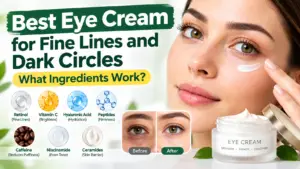

Fine lines and dark circles are two of the most common concerns affecting the delicate skin around the eyes. The under-eye area can become dry, thin, pigmented and wrinkled over time, making the face appear tired or older.
Purchasing the priciest product is not the only way to choose the best eye cream for dark circles and fine wrinkles. Much more important are the ingredients. The best eye cream will depend on whether your primary concerns are wrinkles, pigmentation, dryness, puffiness, or a mix of these. This is because different ingredients address different issues.
For various under-eye issues, dermatologists frequently suggest components such retinol, peptides, vitamin C, niacinamide, hyaluronic acid, and ceramides.
In this guide, we explain which ingredients can help, how to use eye cream safely and what to look for when choosing a product.
Why Do Fine Lines and Dark Circles Appear?
Before choosing an eye cream, it helps to understand why the under-eye area changes.
The skin around the eyes is particularly thin and delicate. With age, it can lose elasticity and become thinner, making blood vessels more visible. Loss of volume can also create shadows around the tear trough, which may make dark circles appear more noticeable.
Other common causes of dark circles include:
- Genetics
- Aging
- Lack of sleep
- Allergies
- Dehydration
- Sun exposure
- Hyperpigmentation
- Eye rubbing
- Dermatitis
- Lifestyle factors
Fine lines, meanwhile, are commonly associated with natural aging, repeated facial movement, dryness and cumulative sun exposure.
Because dark circles can have different causes, an eye cream may improve some types of discoloration but may not completely eliminate circles caused by genetics, deep hollows or significant volume loss.
What Ingredients Should You Look for in an Eye Cream?
The best eye cream should contain ingredients that match your specific concerns. Here are some of the most useful ingredients to consider.
1. Retinol for Fine Lines and Wrinkles
Retinol is one of the most popular ingredients for aging skin.
Retinol is a vitamin A derivative and belongs to the retinoid family. It can help improve the appearance of fine lines, uneven skin tone and sun-related skin changes.
Mayo Clinic notes that retinol is a milder type of retinoid and may help smooth wrinkles and reduce discoloration.
For an eye cream, a properly formulated retinol product can be useful for:
- Fine lines
- Crow’s-feet
- Uneven texture
- Early signs of aging
- Dull-looking skin
However, retinol can cause dryness, redness or irritation, especially when you first start using it.
Because the eye area is sensitive, start slowly rather than applying a strong retinol product every night.
Important: Retinoids should not be used during pregnancy.
2. Peptides for Firmness
Peptides are another popular ingredient in anti-aging eye creams.
They are short chains of amino acids that are used in skincare formulations designed to support the appearance of firmer, smoother skin.
Cleveland Clinic lists peptides among ingredients to look for when targeting wrinkles and crepey skin around the eyes.
Peptide eye creams may be particularly appealing if you have:
- Fine lines
- Crepey texture
- Loss of firmness
- Mild sagging
- Dry, mature-looking skin
Peptides are generally used in formulations designed to be gentle enough for regular skincare routines.
3. Hyaluronic Acid for Dry Under-Eyes
If your under-eye area is dry, tight or flaky, hyaluronic acid can be a useful ingredient.
Hyaluronic acid is a humectant that helps attract and retain water in the skin.
Cleveland Clinic recommends moisturizing ingredients such as hyaluronic acid and ceramides for the delicate skin around the eyes. Hydrated skin can appear plumper, which may temporarily make fine lines less noticeable.
Look for hyaluronic acid if your main concerns include:
- Dryness
- Dehydration
- Fine lines that become more visible when the skin is dry
- Tightness
- Rough texture
A hydrating eye cream can also be helpful when using active ingredients such as retinol, although the products should be introduced carefully to avoid irritation.
4. Vitamin C for Brightness and Uneven Tone
Vitamin C is a popular antioxidant used to improve the appearance of uneven skin tone.
Mayo Clinic notes that vitamin C may help protect skin against damage from the sun and pollution and may improve skin tone.
For the eye area, vitamin C may be useful when dark circles have a pigmentation component.
Look for vitamin C if you are concerned about:
- Dull under-eye skin
- Uneven pigmentation
- Sun-related discoloration
- Early signs of aging
Vitamin C products can be sensitive to air, heat and light, so proper storage is important.
5. Niacinamide for Dark Circles and Skin Barrier Support
Niacinamide, also known as vitamin B3, is another versatile skincare ingredient.
It can help improve skin tone and support the skin barrier. Mayo Clinic lists niacinamide among ingredients that may help reduce signs of aging and improve skin tone.
Cleveland Clinic also mentions niacinamide as an ingredient that may help with under-eye discoloration.
Niacinamide may be useful if you have:
- Uneven skin tone
- Mild discoloration
- Sensitive skin
- Dryness
- A weakened skin barrier
It is often included in moisturizing eye creams because it can be combined with other skincare ingredients.
6. Caffeine for Puffiness and Tired-Looking Eyes
Caffeine is frequently found in eye creams designed for puffiness and tired-looking eyes.
Cold compresses and caffeine-containing products are commonly used to temporarily improve the appearance of puffy under-eyes. Cleveland Clinic also notes caffeine-containing tea bags among home approaches that may help with puffiness.
Caffeine may be worth considering if your primary concern is:
- Morning puffiness
- Tired-looking eyes
- Temporary swelling
- A darker appearance associated with puffiness
However, caffeine does not permanently remove genetic dark circles or structural hollows.
7. Ceramides for Sensitive and Dry Skin
Ceramides are lipids that help support the skin barrier.
Because the skin around the eyes is delicate and can become irritated easily, a moisturizer containing ceramides may be useful for people experiencing dryness or sensitivity.
Cleveland Clinic recommends ceramides and hyaluronic acid as moisturizing ingredients for the delicate eye area.
A ceramide-based eye cream can be particularly useful during colder or drier weather.
Best Eye Cream Ingredients by Concern
There is no single eye cream that is perfect for everyone. Instead, choose ingredients according to your main concern.
| Concern | Ingredients to Consider |
|---|---|
| Fine lines | Retinol, peptides |
| Dry under-eyes | Hyaluronic acid, ceramides |
| Dark pigmentation | Vitamin C, niacinamide |
| Puffiness | Caffeine |
| Crepey skin | Peptides, retinol, moisturizers |
| Sensitive skin | Ceramides, hyaluronic acid, gentle moisturizers |
| Sun-related aging | Antioxidants + daily sunscreen |
A combination formula may contain several of these ingredients.
How to Use Eye Cream Correctly
Even a well-formulated eye cream may not perform well if it is applied incorrectly.
Start with clean skin and use only a small amount. Because the skin around the eyes is delicate, avoid aggressive rubbing or pulling.
Cleveland Clinic recommends gently patting eye cream around the eye area rather than tugging the skin.
A simple routine could look like this:
Morning
- Gentle cleanser
- Vitamin C or niacinamide product, if appropriate
- Hydrating eye cream
- Moisturizer
- Broad-spectrum sunscreen
Evening
- Gentle cleanser
- Retinol eye cream, if appropriate
- Hydrating moisturizer
If you are new to retinol, begin with occasional use and increase gradually according to your skin’s tolerance and the product instructions.
Should You Use Retinol or Peptides?
Both can be useful, but they serve slightly different purposes.
Retinol is generally chosen for stronger anti-aging goals, particularly fine lines and uneven texture.
Peptides are often selected for formulas focused on firmness and skin conditioning.
If your skin is sensitive, a peptide and moisturizing formula may be easier to tolerate than a retinol product.
You do not necessarily need every active ingredient in one product. A simple routine that you can consistently tolerate may be more practical than using several strong products at once.
What About Sunscreen for Under-Eye Aging?
Sunscreen is one of the most important parts of an anti-aging skincare routine.
Sun exposure contributes to skin aging and pigmentation. Mayo Clinic recommends daily broad-spectrum sunscreen with an SPF of at least 30 as part of wrinkle prevention.
When applying sunscreen around the eye area, choose a product that is appropriate for use near the eyes and avoid getting it directly into the eyes.
Sunglasses can also help protect the area from UV exposure.
Can Eye Cream Completely Remove Dark Circles?
Usually, no.
Dark circles are not one single condition. They can result from pigmentation, visible blood vessels, thin skin, shadows from tear-trough hollows, genetics, allergies, aging or a combination of factors.
An eye cream may improve hydration, texture and the appearance of some pigmentation, but it cannot necessarily correct structural causes.
For persistent or pronounced dark circles, a dermatologist may discuss options such as chemical peels, laser treatments or fillers depending on the cause.
Common Mistakes When Choosing an Eye Cream
Choosing the Most Expensive Product
A higher price does not automatically mean better results. Mayo Clinic notes that expensive wrinkle creams may not necessarily work better than less expensive products.
Using Too Many Active Ingredients
Combining retinol, acids, strong vitamin C and other active ingredients around the eyes can increase irritation.
Ignoring Sunscreen
Even an excellent eye cream cannot replace daily sun protection.
Expecting Overnight Results
Skincare ingredients generally require consistent use. Mayo Clinic notes that some wrinkle products may take several weeks before changes become noticeable.
Applying Too Much Product
More eye cream does not necessarily produce better results. A small amount is usually sufficient.
Frequently Asked Questions
What is the best eye cream for fine lines?
Look for ingredients such as retinol, peptides, hyaluronic acid and moisturizing ingredients. Retinol is particularly well known for targeting the appearance of fine lines, although it can cause irritation.
What is the best eye cream for dark circles?
For pigmentation-related dark circles, ingredients such as vitamin C and niacinamide may be useful. However, the best approach depends on the cause of the dark circles.
Can caffeine remove dark circles?
Caffeine may temporarily improve the appearance of puffiness and tired-looking eyes, but it cannot permanently remove genetic or structural dark circles.
Is retinol safe around the eyes?
Retinol can be irritating around the eyes, so use a product specifically formulated for that area and follow its directions. Retinoids should not be used during pregnancy.
How long does eye cream take to work?
Hydrating ingredients can make skin look smoother relatively quickly, while anti-aging ingredients such as retinol generally require consistent use over weeks or months.
Can eye cream get rid of wrinkles permanently?
No. Eye creams may reduce the appearance of fine lines, but they cannot permanently stop natural aging.
Final Thoughts
The best eye cream for fine lines and dark circles depends on what is causing your specific concerns. For fine lines, look for ingredients such as retinol and peptides. For dry, crepey skin, hyaluronic acid and ceramides can provide important hydration. For uneven pigmentation, vitamin C and niacinamide may be useful, while caffeine can be considered for temporary puffiness.
The most effective routine is usually one that combines appropriate ingredients with gentle application, consistent moisturizing and daily sun protection.
Remember that dark circles can have many causes, including genetics, aging, allergies, pigmentation and tear-trough shadows. If an eye cream does not provide enough improvement, a dermatologist can help identify the underlying cause and discuss other treatment options.