
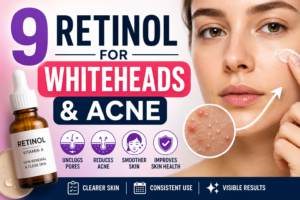

Whiteheads are one of the most common forms of acne. They develop when oil and dead skin cells build up inside a pore, creating a small white or flesh-colored bump known medically as a closed comedone.
If you frequently deal with whiteheads, clogged pores, or recurring breakouts, you may have heard about retinol and retinoids as effective acne-fighting ingredients.
Retinoids work by helping keep pores from becoming clogged. They are among the most established topical treatments for acne. The American Academy of Dermatology recommends topical retinoids such as adapalene, tretinoin, tazarotene, and trifarotene as acne treatments.
But there is an important difference between retinol and prescription-strength retinoids. Retinol is an over-the-counter form of vitamin A commonly used for skin texture, pigmentation, and mild acne concerns, while acne-specific retinoids such as adapalene and tretinoin are more directly established as acne treatments.
Here are 9 retinol and retinoid options and approaches worth knowing about if your goal is clearer pores and fewer whiteheads.
1. Adapalene 0.1%
If your primary concern is acne and clogged pores, adapalene is one of the most important retinoids to know.
Unlike cosmetic retinol, adapalene is specifically formulated as an acne medication. A 0.1% adapalene gel is available without a prescription in the United States and is FDA-approved for acne treatment.
Adapalene helps prevent clogged pores and can treat blackheads, whiteheads, and certain pimples.
Best for:
- Whiteheads
- Blackheads
- Mild acne
- Recurrent clogged pores
- Preventing new breakouts
Because it can cause dryness and irritation, beginners should follow the product directions carefully and avoid applying excessive amounts.
2. Low-Strength Retinol
For people who want an over-the-counter cosmetic retinoid rather than a dedicated acne medication, a low-strength retinol product may be a reasonable starting point.
Retinol is converted by the skin into active retinoic acid through several steps. It is generally less potent than prescription retinoids, but it is widely used for improving skin texture, uneven tone, fine lines, and mild acne-related concerns.
A lower-strength product can be useful for people who are new to retinoids and want to gradually introduce vitamin A into their skincare routine.
How to start:
Use a small amount at night and begin only a few times per week. If your skin tolerates it well, you can gradually increase frequency.
3. Retinol for Clogged Pores
Whiteheads occur when pores become blocked with oil and dead skin cells. Because retinoids help regulate the process that leads to clogged pores, they can be useful for people who constantly develop tiny bumps.
The goal isn’t to aggressively peel the skin.
Instead, consistent use can help keep pores clearer over time.
This is why dermatologists commonly recommend retinoids for blackheads and whiteheads.
If your forehead, nose, chin, or cheeks frequently develop small closed comedones, a retinoid may be worth discussing with a dermatologist.
4. Tretinoin
Tretinoin is a prescription topical retinoid with a long history of use in acne treatment.
It works directly on the skin to help prevent pores from becoming clogged and can also be used for other dermatological concerns.
Because tretinoin can be stronger and more irritating than cosmetic retinol, it is generally best used under professional guidance.
Tretinoin may be considered for:
- Persistent acne
- Whiteheads and blackheads
- Recurrent clogged pores
- Certain acne-related pigmentation concerns
- Long-term acne maintenance
The American Academy of Dermatology lists tretinoin among topical retinoids used for acne.
5. Retinoid + Benzoyl Peroxide
If you have both clogged pores and inflammatory pimples, a combination approach may sometimes be more effective than focusing on one acne mechanism.
Dermatologists may recommend combining a topical retinoid with benzoyl peroxide.
Retinoids help unclog pores, while benzoyl peroxide helps reduce acne-causing bacteria and inflammation.
The AAD’s acne guidelines support topical retinoids and benzoyl peroxide and note that combining treatments with different mechanisms can provide better results for some patients.
However, using multiple active ingredients can increase irritation, particularly when you are just starting treatment.
6. Retinol for Acne-Prone Skin and Dark Spots
Acne can sometimes leave behind dark marks after the breakout disappears.
Retinoids may be useful in an acne routine because they can help improve skin cell turnover and, depending on the retinoid and individual situation, improve the appearance of post-acne discoloration.
The AAD notes that retinoids can help lighten dark spots that develop after acne clears.
This makes retinoids particularly interesting for people dealing with both:
Whiteheads + acne + post-acne marks.
However, irritation itself can worsen pigmentation in some people, particularly those prone to hyperpigmentation. Starting slowly and protecting your skin from the sun are important.
7. Retinoids for Long-Term Acne Prevention
One advantage of retinoids is that they are not only used to treat existing breakouts.
They can also play a role in acne maintenance.
Once acne is under control, dermatologists may recommend continuing a topical retinoid to help maintain clearer skin.
This can be especially useful for people whose acne repeatedly returns after stopping treatment.
Instead of constantly switching between different acne products, a simple and consistent routine may be easier for your skin to tolerate.
8. Trifarotene
Trifarotene is another prescription topical retinoid used for acne.
It is different from cosmetic retinol and is specifically designed as an acne treatment.
It may be prescribed for certain patients with acne when a dermatologist believes a prescription retinoid is appropriate.
The AAD lists trifarotene alongside adapalene, tretinoin, and tazarotene as topical retinoids used for acne.
This is an option to discuss with a dermatologist if over-the-counter acne products are not providing enough improvement.
9. Tazarotene
Tazarotene is a prescription retinoid that can be used for acne.
It is generally considered a stronger treatment than ordinary cosmetic retinol, so it should be used according to a healthcare professional’s instructions.
Tazarotene may be considered when acne is persistent or when other topical treatments haven’t provided adequate improvement.
Because stronger retinoids can produce significant dryness and irritation, they are not necessarily the best starting point for everyone.
How to Use Retinol for Whiteheads and Acne
Starting correctly is just as important as choosing the right retinoid.
Step 1: Cleanse gently
Wash your face with a mild cleanser and avoid harsh scrubbing.
Aggressive scrubbing does not remove whiteheads permanently and can irritate acne-prone skin.
Step 2: Let your skin dry
Apply your retinoid according to the product instructions. Some dermatologists recommend waiting after cleansing if irritation is a concern.
Step 3: Use a small amount
More product does not mean faster results.
Applying too much can increase dryness, peeling, redness, and burning.
Step 4: Moisturize
Use a non-comedogenic moisturizer to support the skin barrier.
If your skin becomes very dry, a moisturizer can make your routine easier to tolerate.
Step 5: Use sunscreen during the day
Sun protection is an important part of an acne skincare routine, especially when using retinoids.
Choose a broad-spectrum sunscreen and apply it during daytime exposure.
The AAD recommends sun protection when using topical retinoids.
How Often Should You Use Retinol for Acne?
If you are new to retinol, starting every night may be unnecessarily irritating.
A simple beginner approach is:
Week 1–2: 2 nights per week
Week 3–4: 3 nights per week if tolerated
Afterward: Increase gradually according to your skin’s tolerance and product directions.
Not everyone needs daily application.
If your skin becomes very red, painful, severely dry, or irritated, reduce use and consider speaking with a dermatologist.
Can Retinol Make Acne Worse Before It Gets Better?
Some people experience an early period of increased dryness, irritation, or breakouts when beginning a retinoid.
This does not mean you should automatically continue through severe irritation.
For example, the FDA labeling for adapalene notes that acne may appear worse during the early weeks and that irritation such as redness, itching, dryness, burning, peeling, or swelling can occur, particularly early in treatment.
If irritation becomes severe, stop and seek medical advice.
Retinol vs. Adapalene: Which Is Better for Whiteheads?
For someone specifically searching for an acne treatment, adapalene has an important advantage: it is an acne medication with established use for treating whiteheads, blackheads, and pimples.
Retinol is more commonly used as an over-the-counter skincare ingredient for skin texture, pigmentation, signs of aging, and mild acne-related concerns.
Choose based on your goal:
Mainly whiteheads and acne:
Adapalene may be more directly appropriate.
Texture, fine lines, pigmentation, and mild acne concerns:
An OTC retinol may be worth considering.
Persistent or severe acne:
A dermatologist can determine whether prescription tretinoin, tazarotene, trifarotene, or another treatment is more appropriate.
Common Mistakes When Using Retinol for Whiteheads
Avoid these mistakes:
Using too much
A larger amount will not necessarily clear acne faster.
Starting every night
Your skin may need time to adapt.
Combining too many active ingredients
Using retinol, strong exfoliating acids, benzoyl peroxide, scrubs, and other irritating products simultaneously can damage your skin barrier.
Skipping sunscreen
Sun protection is especially important when using products that may increase irritation or sensitivity.
Picking whiteheads
Squeezing or picking whiteheads can increase inflammation and raise the risk of acne scarring.
Who Should Avoid Retinoids or Talk to a Doctor First?
Retinoids are not appropriate for everyone.
If you are pregnant, planning pregnancy, or breastfeeding, speak with your healthcare professional before using acne treatments. The AAD specifically advises people who are pregnant or trying to become pregnant to consult a dermatologist before treating acne themselves.
You should also seek professional advice if you have:
- Severe or painful acne
- Deep cysts or nodules
- Significant acne scarring
- Severe skin irritation
- Persistent redness
- An uncertain diagnosis
- Acne that does not improve with appropriate treatment
Large, painful, deep acne lesions often need professional treatment rather than relying solely on OTC skincare products.
Frequently Asked Questions
Is retinol good for whiteheads?
Retinoids can help prevent clogged pores and are commonly recommended for whiteheads. However, acne-specific retinoids such as adapalene have stronger evidence and a more direct acne-treatment role than ordinary cosmetic retinol.
How long does retinol take to clear whiteheads?
Do not expect overnight results. Acne treatments commonly require several weeks of consistent use. The AAD recommends giving acne treatment around 6 to 8 weeks to assess improvement in many mild acne situations.
Can I use retinol every night?
Some people can eventually tolerate nightly use, but beginners may benefit from starting less frequently and increasing gradually. Follow your product instructions and reduce frequency if significant irritation develops.
Can retinol remove acne scars?
Retinoids can help improve certain post-acne dark marks and may support smoother skin texture, but true depressed or raised acne scars often require professional treatments.
Is retinol better than salicylic acid for whiteheads?
Both can help acne, but they work differently. Salicylic acid helps exfoliate and unclog pores, while retinoids regulate skin-cell turnover and help prevent clogged pores. Your best option depends on your skin type, acne severity, and tolerance.
Final Thoughts
Retinol and retinoids can be powerful ingredients for acne-prone skin, particularly when whiteheads and clogged pores are the main concern.
However, not every vitamin A product is the same. Cosmetic retinol is different from acne-specific retinoids such as adapalene and prescription tretinoin.
For mild whiteheads, a carefully introduced retinoid can become an important part of a consistent skincare routine. Start slowly, moisturize, avoid excessive exfoliation, and use sunscreen during the day.