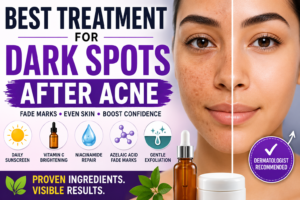

Acne may disappear, but the dark spots it leaves behind can sometimes remain for weeks or even months. These flat brown, red, or dark marks are extremely common and can make the skin look uneven even after active breakouts have cleared.
If you are searching for the best treatment for dark spots after acne, the good news is that several proven skincare ingredients and professional treatments can help fade post-acne marks. The right approach depends on your skin type, the color and depth of the marks, and whether you still have active acne.
In this guide, we explain the most effective ways to treat dark spots after acne, including sunscreen, vitamin C, niacinamide, retinoids, azelaic acid, exfoliating acids, and dermatologist treatments.
What Are Dark Spots After Acne?
Dark spots that appear after an acne breakout are often called post-inflammatory hyperpigmentation (PIH). They develop when inflammation from a pimple stimulates the skin to produce extra melanin.
PIH is different from an acne scar.
A true acne scar usually changes the texture of the skin, creating indentations or raised areas. Dark spots are generally flat and mainly affect skin color rather than texture.
Post-acne marks can appear as:
- Brown spots
- Dark brown patches
- Purple or grayish marks
- Red or pink marks
- Uneven areas of pigmentation
People with medium to deep skin tones may be particularly prone to noticeable post-inflammatory hyperpigmentation, although it can occur in any skin tone.
What Causes Dark Spots After Acne?
Inflammation is one of the biggest causes of post-acne pigmentation.
When acne develops, the skin’s inflammatory response can stimulate melanocytes—the cells responsible for producing melanin. Increased melanin production can leave a darker mark after the pimple heals.
Several factors can make these marks more noticeable:
Picking or Popping Pimples
Squeezing acne can increase inflammation and damage the surrounding skin. This may increase the likelihood of dark marks and, in some cases, permanent scarring.
Sun Exposure
Ultraviolet exposure can stimulate melanin production and make existing pigmentation darker.
Severe Acne
Deep, inflamed acne tends to cause more inflammation and may leave more persistent discoloration.
Irritating Skincare Products
Using harsh scrubs, strong acids, or too many active ingredients can irritate the skin and potentially worsen pigmentation.
Best Treatments for Dark Spots After Acne
The best treatment for acne dark spots usually combines pigmentation-fading ingredients with daily sun protection.
Here are some of the most useful options.
1. Sunscreen: The Most Important Treatment
If you want to fade dark spots after acne, sunscreen should be one of the first products in your routine.
UV exposure can stimulate melanin production and make pigmentation more difficult to fade. Even the most effective brightening treatment may work poorly if the skin continues to receive significant sun exposure without protection.
Choose a broad-spectrum SPF 30 or higher and apply it consistently.
For people concerned about visible-light-related pigmentation, a tinted sunscreen containing iron oxides may also be worth discussing with a dermatologist.
Why Sunscreen Matters
Daily sunscreen can help:
- Prevent dark spots from becoming darker
- Protect against UV damage
- Support pigmentation treatments
- Reduce the chance of new discoloration
- Maintain more even-looking skin
Reapply sunscreen as directed, especially when spending extended periods outdoors.
2. Vitamin C
Vitamin C is a popular antioxidant used in skincare products designed to improve uneven skin tone.
It can help brighten the appearance of the skin and may reduce the appearance of pigmentation over time.
Vitamin C is often used in the morning underneath moisturizer and sunscreen.
However, not every vitamin C product works the same way. Formulation, concentration, stability, and individual skin tolerance all matter.
If you have sensitive skin, introduce vitamin C gradually.
3. Niacinamide
Niacinamide, also known as vitamin B3, is another useful ingredient for people dealing with post-acne discoloration.
It can support the skin barrier and help improve the appearance of uneven skin tone.
Niacinamide is generally well tolerated by many skin types and can be found in cleansers, serums, moisturizers, and other skincare products.
It can be particularly useful if your skin is sensitive and you want a relatively gentle addition to your routine.
4. Azelaic Acid
Azelaic acid is one of the most versatile ingredients for acne-prone skin.
It can help address both acne and pigmentation, making it particularly useful for people who continue to develop pimples while trying to fade old marks.
Azelaic acid may help:
- Improve acne
- Reduce inflammation
- Fade post-acne discoloration
- Improve uneven skin tone
- Support smoother-looking skin
It is available in different strengths and formulations. Prescription-strength products may be recommended by a dermatologist when appropriate.
5. Retinoids
Retinoids are among the most established topical treatments for acne.
They encourage normal skin-cell turnover and can help prevent clogged pores while gradually improving uneven skin texture and pigmentation.
Adapalene is an over-the-counter retinoid in some countries, while other retinoids require a prescription.
Retinoids can initially cause dryness, peeling, or irritation. Start gradually and use moisturizer to support your skin barrier.
Because retinoids can increase irritation and sun sensitivity, daily sunscreen is especially important.
If you are pregnant or trying to become pregnant, speak with your healthcare professional before using topical retinoids.
6. Alpha Hydroxy Acids
Alpha hydroxy acids, or AHAs, include ingredients such as glycolic acid and lactic acid.
They work primarily by loosening the bonds between dead skin cells at the surface of the skin, helping improve skin texture and brightness.
Glycolic acid is often used in products targeting:
- Uneven skin tone
- Dullness
- Hyperpigmentation
- Rough texture
- Post-acne marks
However, overusing exfoliating acids can cause irritation and potentially worsen discoloration.
Start with a lower frequency and avoid combining multiple strong exfoliants at once.
7. Salicylic Acid
Salicylic acid is best known for treating clogged pores and acne, but it can also be useful as part of a routine for people who have both active acne and post-acne marks.
By helping control clogged pores and breakouts, salicylic acid can reduce the cycle of new pimples that may create additional dark spots.
If your primary concern is pigmentation rather than active acne, ingredients such as azelaic acid, retinoids, vitamin C, or professionally selected treatments may be more directly useful.
Best Skincare Routine for Acne Dark Spots
A consistent routine is often more effective than constantly changing products.
Morning Routine
Step 1: Gentle cleanser
Step 2: Vitamin C or niacinamide serum
Step 3: Lightweight moisturizer
Step 4: Broad-spectrum SPF 30+ sunscreen
If your skin is sensitive, you don’t need to use multiple active ingredients every morning.
Night Routine
Step 1: Gentle cleanser
Step 2: Azelaic acid or a retinoid, depending on your skin and treatment plan
Step 3: Moisturizer
Introduce active ingredients gradually rather than starting several new products at once.
Professional Treatments for Stubborn Dark Spots
When topical skincare does not provide enough improvement, a dermatologist may recommend professional treatments.
Chemical Peels
Professional chemical peels use controlled concentrations of exfoliating acids to improve pigmentation and skin texture.
The type and strength of peel should be selected according to your skin type and pigmentation risk.
In darker skin tones, overly aggressive treatments can sometimes cause additional pigmentation, so professional evaluation is particularly important.
Laser Treatments
Certain laser and light-based treatments can target pigmentation. However, lasers are not appropriate for everyone.
The risk of post-inflammatory hyperpigmentation can be higher in darker skin tones, depending on the device and settings.
Always consult a qualified dermatologist or experienced medical professional before undergoing laser treatment for pigmentation.
Microneedling
Microneedling uses tiny needles to create controlled micro-injuries in the skin.
It is commonly used for acne scars and texture concerns. In selected cases, it may be incorporated into treatment plans for pigmentation or uneven skin.
The procedure should be performed by a qualified professional, especially if you have active acne or a tendency toward pigmentation.
How Long Do Acne Dark Spots Take to Fade?
The time required to fade post-acne dark spots varies from person to person.
Some mild marks may gradually become less noticeable within several weeks, while more persistent pigmentation can take several months or longer.
Factors that affect healing include:
- Skin tone
- Severity of inflammation
- Depth of pigmentation
- Sun exposure
- Skincare routine
- Whether new acne continues to develop
- Individual skin response
The most important thing is to avoid repeatedly irritating the skin while waiting for pigmentation to improve.
How to Prevent New Dark Spots After Acne
Treating existing marks is only half the process. Preventing new pigmentation is equally important.
Don’t Pick Your Skin
Avoid squeezing, scratching, or repeatedly touching pimples.
Treat Acne Early
The sooner active acne is controlled, the fewer opportunities there are for new inflammatory marks to develop.
Use Sunscreen Daily
Consistent sun protection can help prevent existing pigmentation from becoming darker.
Avoid Harsh Scrubs
Physical scrubbing can irritate acne-prone skin. Choose gentle cleansing and carefully selected chemical exfoliants instead.
Don’t Overuse Active Ingredients
Using several acids, retinoids, exfoliants, and brightening products simultaneously can damage the skin barrier.
A simpler routine is often easier to tolerate and maintain.
Dark Spots vs. Acne Scars: What’s the Difference?
Knowing the difference can help you choose the right treatment.
Dark spots: Flat areas of discoloration left after acne. They are usually treated with pigmentation-focused skincare and sun protection.
Indented acne scars: Depressions in the skin caused by collagen loss. These often require procedures such as microneedling, subcision, laser treatment, or other professional approaches.
Raised acne scars: Areas of excess scar tissue that become elevated above the surrounding skin. These require a different medical approach.
If you are unsure what type of marks you have, a dermatologist can evaluate your skin and recommend appropriate treatment.
Common Mistakes When Treating Acne Dark Spots
Avoid these common mistakes if you want clearer, more even-looking skin.
Using Lemon Juice
Lemon juice can irritate the skin and should not be relied upon as a treatment for hyperpigmentation.
Applying Baking Soda
Baking soda is not a dermatologist-recommended treatment for acne pigmentation and may disrupt the skin barrier.
Scrubbing Dark Spots
Aggressive scrubbing doesn’t remove pigmentation safely and can increase irritation.
Using Too Many Products
More products do not necessarily mean faster results.
Skipping Sunscreen
This is one of the biggest mistakes when trying to fade hyperpigmentation.
When Should You See a Dermatologist?
Consider seeing a dermatologist if:
- Dark spots persist despite consistent skincare
- You have severe or recurring acne
- You are developing acne scars
- Pigmentation is rapidly worsening
- Your skin becomes irritated by treatments
- You are considering chemical peels or laser treatment
- You are unsure whether the marks are pigmentation or scars
A dermatologist can determine the type of discoloration and recommend a treatment plan based on your skin tone, acne severity, and medical history.
Frequently Asked Questions
What is the best treatment for dark spots after acne?
There is no single treatment that works for everyone. Daily sunscreen combined with ingredients such as azelaic acid, retinoids, vitamin C, niacinamide, or carefully selected exfoliating acids can help improve post-acne pigmentation.
How can I remove acne dark spots quickly?
Dark spots usually cannot be safely removed overnight. Consistent sunscreen and an appropriate treatment routine can gradually improve their appearance.
Does vitamin C remove acne dark spots?
Vitamin C can help brighten uneven skin tone and reduce the appearance of pigmentation over time. Results depend on the formulation and consistent use.
Is niacinamide good for acne marks?
Yes. Niacinamide can help improve uneven skin tone while supporting the skin barrier, making it a useful ingredient for many acne-prone skin types.
Can dark spots after acne be permanent?
Most post-inflammatory dark spots gradually fade, but persistent pigmentation can last for months or longer. Repeated inflammation and sun exposure can prolong the discoloration.
Can I use retinol for acne dark spots?
Retinoids can help with acne and may gradually improve uneven pigmentation. However, they can cause irritation, so they should be introduced carefully.
Final Thoughts
The best treatment for dark spots after acne is usually a combination of prevention, consistent skincare, and patience. Daily broad-spectrum sunscreen is essential because UV exposure can make pigmentation darker and harder to treat.
Ingredients such as azelaic acid, vitamin C, niacinamide, retinoids, glycolic acid, and salicylic acid may all have a role depending on your skin and whether you still have active acne.
Avoid picking pimples, aggressive scrubbing, and unproven DIY remedies. If dark spots are stubborn or you also have acne scars, professional treatment from a dermatologist may provide better results.
With a simple, consistent routine and the right ingredients, post-acne dark spots can gradually become less noticeable and your skin can develop a more even-looking appearance.