
A sad story of pain, neglect, and the quiet hope of survival
He was still just a baby.
Small enough to fit in someone’s lap. Young enough to still look at people with trust. Innocent enough to believe that every hand coming toward him might bring comfort, food, or love. But life had already started teaching him a very different lesson.
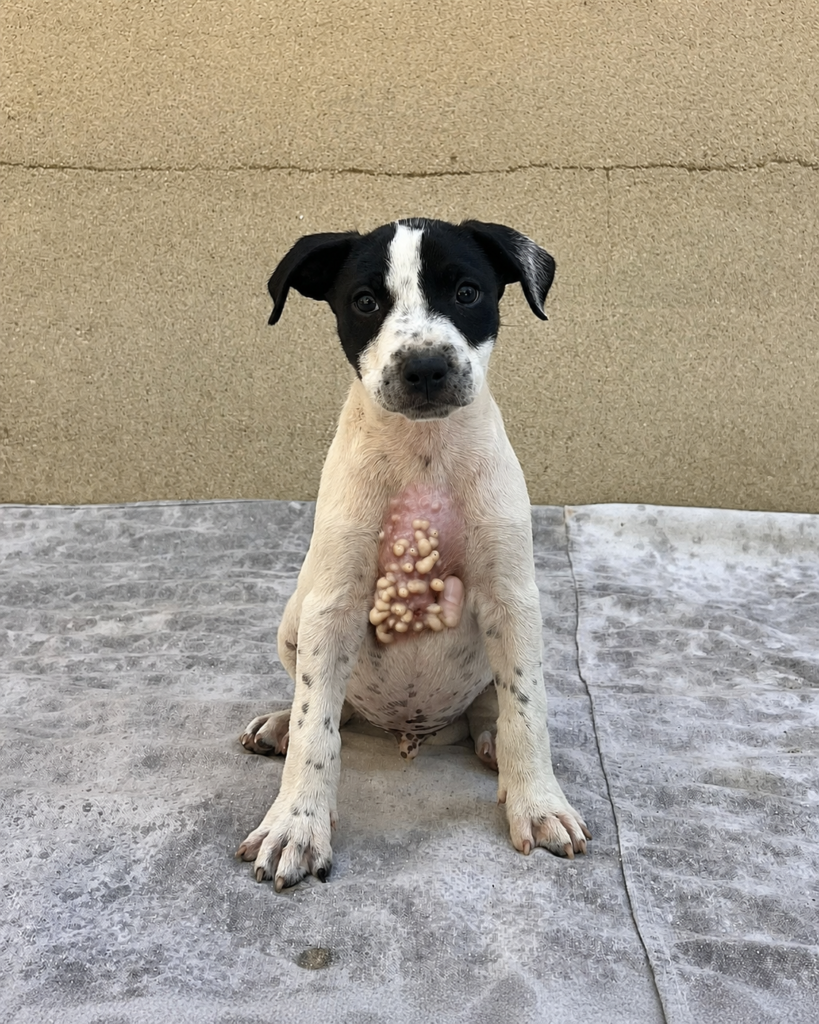
When I first saw the puppy, he was sitting quietly on the cold ground, his tiny body trying to stay upright with the kind of patience only animals seem to have. He didn’t bark. He didn’t run. He didn’t ask for attention. He simply sat there, looking into the world with eyes that were far too calm for a creature carrying so much pain.
At first glance, he looked like any other street puppy—small, black-and-white, thin, and vulnerable. But then your eyes moved lower, and the truth became impossible to ignore. On the front of his little body, a swollen patch of inflamed skin carried a cluster of pale, painful growths. They looked heavy, unnatural, and cruelly out of place on such a tiny chest. It was the kind of sight that makes you pause, not because it is shocking, but because it is heartbreaking. This was not just a wound. This was prolonged suffering.
And the saddest part was that he had probably been living with it for days, maybe weeks.
No one knows exactly when his suffering began. No one knows whether he was born on the street, abandoned by someone who did not want the responsibility of a litter, or lost after wandering too far from a home that never truly cared for him. For animals like him, there is rarely a complete story. There are no records, no witnesses, no careful timelines. There is only the body—and the body tells enough.
His body said he had been ignored.
It said he had endured discomfort in silence.
It said he had learned to live with pain because there was no other choice.
Street animals don’t get the luxury of pausing life when they are injured. They don’t get to lie in a warm bed while someone calls a doctor. They don’t get medicine placed gently beside their food bowl. They continue living through infection, swelling, fever, parasites, hunger, and fear. They continue searching for scraps while carrying wounds that would send a human rushing to a hospital.
This puppy was no different.
Even with that painful mass on his chest, he was still trying to be a puppy. He still sat upright. He still looked at the people around him. He still carried that heartbreaking softness in his eyes—the softness of a soul that had not yet decided that the world was entirely cruel.
That is what makes stories like his so difficult to bear.
Animals do not understand why they are suffering. They do not understand disease, abandonment, neglect, or indifference. They only understand sensations: hunger, cold, pain, fear, relief, affection. They know whether a hand hurts them or helps them. They know whether they are welcome or unwanted. And they know, in ways we often fail to appreciate, when they have been left alone.
Imagine what his days must have felt like.
A tender, swollen wound rubbing against dirt and dust. Flies circling. Heat pressing down on an already weakened body. Hunger twisting in his stomach while he tried to move carefully enough not to worsen the pain. Other dogs pushing past him for food. People walking by, glancing for a moment, then continuing on with their lives.
Maybe some felt pity. Maybe some looked away because they did not know what to do. Maybe some thought, “Poor thing,” and then forgot him before they reached the next street corner.
But for him, there was no forgetting.
He had to live inside that body every minute of every day.
That is the brutal reality of animal suffering: it often happens in full view of the world, and still goes unanswered. Not because everyone is heartless, but because pain becomes background noise when it is common enough. A limping dog. A cat with infected eyes. A horse with visible ribs. A puppy with a chest full of growths. We see them, we feel bad, and then we move on because we have our own lives, our own responsibilities, our own exhaustion.
Meanwhile, they remain there—still hurting after we leave.
The puppy in the picture is not just one puppy. He represents thousands of animals who suffer quietly in streets, alleys, empty lots, and roadsides every single day. Animals born into a world where survival itself is a full-time struggle. Animals who are expected to endure the unbearable simply because they cannot speak.
And yet, if you look at him carefully, there is something even more painful than the wound itself: his expression.
He does not look angry. He does not look aggressive. He does not even look defeated. He looks patient.
That kind of patience in a suffering animal can break your heart more than any visible injury.
It is the patience of a creature waiting for relief that never seems to come.
Waiting for someone to notice.
Waiting for someone to care enough to stop.
Waiting for one kind hand in a world full of people.
Perhaps that is what makes rescue so emotionally overwhelming. It is not only the physical condition of the animal; it is the realization that the animal remained gentle despite everything. That even after neglect, pain, fear, and hunger, many of them still choose trust. They still wag their tails. They still come closer when called softly. They still rest their heads in human hands as if hoping this time the touch will be different.
This puppy could have become fearful. He could have hidden. He could have snapped in pain. Instead, he sat there and allowed someone to hold him, to examine the wound, to look closely at the suffering he had been carrying. In that small act of stillness, he offered something enormous: trust.
Trust is a dangerous gift for an abandoned animal.
Because so often it is betrayed.
Some are picked up only to be dumped elsewhere. Some are fed for a day and forgotten the next. Some are photographed, pitied online, and then left in exactly the same place. Their suffering becomes a moment of content, not a call to action. Sympathy is offered in comments while the animal continues to sleep on concrete.
That is why stories like his should not end with sadness alone.
Sadness, by itself, changes very little.
If this puppy’s image moves us, then the real question is not whether the picture is heartbreaking. The real question is what heartbreak is supposed to do. Is it meant to make us scroll slower? Is it meant to give us a temporary ache in the chest before we move on to the next post? Or is it meant to disturb us enough that we finally choose action over emotion?
Because this puppy does not need our tears as much as he needs treatment.
He needs a veterinarian who can diagnose the condition, clean the wound, relieve the pain, and decide whether surgery, medication, or long-term care is necessary. He needs proper food, rest, warmth, and safety from flies and infection. He needs to be somewhere that pain is not simply something he is expected to tolerate.
Most of all, he needs time—time to heal, time to regain strength, time to learn that not every day has to be a fight.
The tragedy of stray animal suffering is that so much of it is treatable. Not all, but so much. Mange can be treated. Wounds can be cleaned. Tumors can be evaluated. Infections can be managed. Parasites can be removed. Malnourished puppies can recover with food and care. The line between suffering and healing is often just access—access to money, medicine, transport, shelter, and someone willing to take responsibility.
That is where humans come in.
The same species capable of abandoning animals is also the species capable of saving them.
A person can ignore a suffering puppy, or they can stop and help. A neighborhood can treat street dogs like garbage, or it can organize feeding and vaccination. A passerby can choose not to get involved, or they can make one phone call to a rescuer, one donation to a clinic, one effort to get an injured animal off the street. A family can buy a pet from a breeder, or they can adopt one that has already been failed by the world.
The choices are not abstract. They are immediate. They shape whether an animal suffers for another week or gets a chance to survive.
When I look at this puppy, I do not only see injury. I see a life standing at a crossroads.
On one side is the path that so many street animals know too well: worsening pain, infection, weakness, neglect, and a slow fading away in a place where no one remembers your name. On the other side is a different possibility: treatment, recovery, rest, and perhaps one day a home where the body that once carried disease is finally touched with gentleness.
He deserves the second path.
Not because he is extraordinary, but because he is not.
He is one of countless vulnerable animals who never asked to be born into danger. One of countless puppies who did not choose the street, did not choose illness, and did not choose neglect. If compassion means anything at all, it must extend to the ordinary victims too—the nameless, ownerless, voiceless animals whose pain does not make headlines.
This puppy’s story is sad because it reveals something uncomfortable about the world: suffering can exist right in front of us, and still be overlooked. But it can also reveal something hopeful—that one person noticing can change the ending.
Maybe that is how all rescue begins.
Not with a grand plan. Not with perfect resources. Just with refusal.
Refusal to walk past.
Refusal to pretend not to see.
Refusal to accept that a tiny animal should suffer alone simply because he was born without a home.
The puppy in the picture cannot tell us what hurts. He cannot describe the fear, the itching, the pressure, or the exhaustion. He cannot ask for antibiotics or surgery or a clean place to sleep. He cannot say, “Please help me.”
So the image says it for him.
It says: I am hurting.
It says: I am still here.
It says: If someone helps me now, I might still have a chance.
And maybe that is the part that stays with you long after you look away—the possibility that even after all this pain, he still has a future waiting for him. A future where his body no longer carries those painful growths. A future where his stomach is full, his skin is healing, and his eyes are no longer dulled by silent suffering. A future where he gets to do the ordinary things puppies are supposed to do: run badly, sleep deeply, chew things he shouldn’t, and feel safe enough to be playful.
That future is not guaranteed.
For animals like him, it never is.
But it is still possible.
And sometimes, possibility is where compassion begins.
So if this little puppy breaks your heart, let it break it in a useful way. Let it turn sadness into responsibility. Let it remind you that kindness is not measured by how deeply we feel, but by what we do next.
Because somewhere tonight, a puppy just like him will curl up on cold ground with a body full of pain and no way to understand why relief never came.
And somewhere else, one person will decide that this time, it will.
