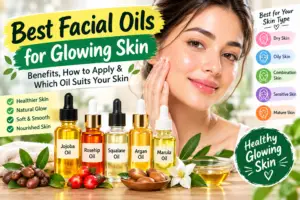

Best Facial Oils for Glowing Skin: Benefits, How to Apply & Which Oil Suits Your Skin
Healthy, glowing skin does not always require a complicated skincare routine. Sometimes, adding the right facial oil can help your skin feel softer, smoother, and more comfortable. Facial oils can support the skin barrier, reduce moisture loss, and give the complexion a naturally healthy-looking glow.
Nonetheless, the skin works for any skin type. On oily or acne-prone skin, a rich oil that feels nourishing on dry skin could feel overly thick. It is so crucial to select an oil according to your skin type, problems, and tolerance.
In this article, we will investigate the finest facial oils for glowing skin, their advantages, how to use them correctly, and which oils may be ideal for dry, oily, combo, sensitive, and older skin.
What Are Facial Oils?
Facial oils are skincare products made primarily from plant oils, botanical oils, or other oil-based ingredients. They can be used alone or as part of a broader skincare routine.
Facial oils do not replace every skincare product. For example, they generally do not provide the same function as a water-based moisturizer, cleanser, or sunscreen. Instead, oils can help soften the skin and reduce water loss from the surface.
Some facial oils contain naturally occurring fatty acids and antioxidant compounds that can complement a gentle skincare routine.
Benefits of Facial Oils for Glowing Skin
Using an appropriate facial oil may provide several benefits when incorporated correctly into a skincare routine.
1. Helps Reduce Moisture Loss
Facial oils can form a protective layer over the skin, helping reduce the amount of water lost from the skin’s surface.
This can be particularly useful for people with dry or dehydrated-feeling skin.
2. Makes Skin Feel Softer
Many facial oils are rich in emollient ingredients. These can help smooth rough-feeling areas and leave the skin feeling softer and more comfortable.
3. Supports the Skin Barrier
A healthy skin barrier is important for maintaining moisture and protecting the skin from environmental irritants. Certain oils can complement barrier-focused skincare by providing lipids that help soften the outer layer of the skin.
4. Creates a Natural-Looking Glow
Facial oils can give the skin a smooth, light-reflective appearance. This can make the complexion look more radiant without requiring heavy makeup.
5. Helps Dry and Flaky Skin
If your skin becomes dry, tight, or flaky, a suitable facial oil may help reduce the uncomfortable feeling associated with dryness.
However, persistent dryness or irritation may have an underlying cause that requires professional evaluation.
Best Facial Oils for Different Skin Types
The best facial oil depends on your individual skin type. Here are several popular options and how they may fit into different routines.
1. Jojoba Oil
Jojoba oil is a popular ingredient in skincare because of its lightweight feel and compatibility with many skin types.
It can help soften the skin and support a comfortable moisture barrier without necessarily feeling as heavy as some richer oils.
Best for: Normal, combination, and dry skin.
Jojoba oil can also be useful for people who want a simple facial oil without an extremely rich texture.
2. Rosehip Oil
Rosehip oil is commonly used in facial skincare products because it contains various fatty acids and naturally occurring compounds.
It has a relatively lightweight texture and is often included in routines focused on improving the appearance of uneven-looking or dull skin.
Best for: Normal, dry, and mature-looking skin.
If you have sensitive skin, introduce rosehip oil gradually and patch test before applying it broadly.
3. Squalane
Squalane is a popular lightweight moisturizing ingredient. Modern skincare products often use plant-derived squalane.
It spreads easily and generally leaves a smooth, soft finish without the heavy feeling associated with some traditional oils.
Best for: Most skin types, including dry and combination skin.
Squalane can be especially appealing if you want the benefits of an oil-like product but prefer a lightweight texture.
4. Argan Oil
Argan oil contains fatty acids and is commonly used in skincare and haircare products.
For facial use, it can help make dry skin feel softer and more conditioned.
Best for: Dry and normal skin.
Because argan oil can feel richer than lightweight options, people with oily skin may prefer using only a small amount.
5. Marula Oil
Marula oil is another botanical oil used in moisturizing skincare products. It has a smooth texture and can help soften dry-feeling skin.
Best for: Normal, dry, and mature skin.
If your skin is prone to clogged pores, introduce richer oils carefully and observe how your skin responds.
6. Sunflower Seed Oil
Sunflower seed oil contains linoleic acid and is used in various moisturizing products.
It can be a useful option for supporting the feel and comfort of dry or compromised-looking skin.
Best for: Dry and sensitive-feeling skin.
Choose a well-formulated facial product rather than assuming every cooking oil is suitable for facial application.
7. Evening Primrose Oil
Evening primrose oil is another botanical oil used in skincare formulations. It contains fatty acids and may be included in products designed for dry or sensitive-feeling skin.
Best for: Dry and mature skin.
As with any new skincare ingredient, patch testing is a good precaution if your skin reacts easily.
8. Grapeseed Oil
Grapeseed oil has a relatively lightweight texture and is often used in facial skincare.
It contains linoleic acid and may be a comfortable option for people who dislike heavy oils.
Best for: Combination and oily-feeling skin.
However, individual reactions vary, so even lightweight oils should be introduced gradually.
Which Facial Oil Is Best for Dry Skin?
Dry skin often benefits from products that reduce moisture loss and improve the feeling of softness.
Good options to consider include:
- Jojoba oil
- Squalane
- Argan oil
- Rosehip oil
- Marula oil
For very dry skin, facial oil can be used as the final step of an evening routine to help seal in moisture from a moisturizer.
Which Facial Oil Is Best for Oily Skin?
Oily skin does not necessarily mean that you need to avoid every oil. The key is choosing a lightweight product and using a small amount.
Possible options include:
- Squalane
- Jojoba oil
- Grapeseed oil
If you frequently develop clogged pores or breakouts, introduce one product at a time. Stop using it if your skin becomes noticeably worse.
Which Facial Oil Is Best for Combination Skin?
Combination skin can be challenging because some areas may be oily while others feel dry.
Lightweight oils such as squalane or jojoba oil may work well for this skin type.
You can also apply a smaller amount to oily areas and slightly more to dry areas rather than applying the same quantity everywhere.
Which Facial Oil Is Best for Sensitive Skin?
Sensitive skin requires extra care when introducing new products.
Rather than choosing an oil based only on its popularity, look for a simple formula with minimal fragrance and fewer potential irritants.
Squalane and simple, fragrance-free formulations may be easier for some sensitive skin types to tolerate.
Always patch test a new facial oil before applying it across your entire face.
How to Apply Facial Oil Correctly
Using too much facial oil can leave your skin greasy and uncomfortable. A small amount is usually enough.
Follow these steps:
Step 1: Cleanse Your Face
Start with a gentle cleanser appropriate for your skin type. Avoid excessively stripping cleansers if your skin is dry or sensitive.
Step 2: Apply Hydrating Products
If you use a hydrating serum or moisturizer, apply those products before the facial oil.
Step 3: Use a Small Amount of Oil
Place a few drops into your palm and gently spread the oil between your fingertips.
Step 4: Press and Massage Gently
Gently press the oil onto your face rather than aggressively rubbing the skin.
Focus on areas that feel dry.
Step 5: Use Sunscreen in the Morning
If you are applying facial oil during the daytime, sunscreen should still be part of your routine. Facial oil is not a substitute for sunscreen.
For many people, facial oils are most convenient as part of an evening routine.
Can You Use Facial Oil Every Day?
Some people can use facial oils daily, while others may prefer using them several times a week.
Your ideal frequency depends on your skin type and the particular product.
Reduce or stop using an oil if it makes your skin feel oily, clogged, irritated, or causes more breakouts.
Individuals may find a cautious cautious cautious cautious cautious skin.
Can Facial Oils Cause Acne?
Facial oils do not automatically cause acne, but some products may be unsuitable for acne-prone skin.
Factors such as the oil’s formulation, concentration, added ingredients, and your individual skin response can influence how your skin reacts.
If you are acne-prone, choose lightweight, non-comedogenic formulations when possible and introduce only one new product at a time.
Do not use facial oil as a replacement for proven acne treatments when you have persistent or moderate-to-severe acne.
Common Mistakes When Using Facial Oils
Avoid these common mistakes:
- Applying too much oil
- Using several new oils at the same time
- Skipping sunscreen
- Applying heavily fragranced products to sensitive skin
- Using cooking oils as a substitute for formulated skincare
- Assuming natural ingredients cannot cause irritation
- Applying oil to irritated or broken skin without knowing the cause
- Expecting facial oil to eliminate wrinkles or acne overnight
A simple and consistent skincare routine is usually more useful than constantly changing products.
How to Patch Test a Facial Oil
Before using a new facial oil on your entire face, perform a patch test.
Apply a small amount to a limited area of skin and monitor how your skin responds. If you experience significant redness, burning, swelling, itching, or irritation, wash the product off and discontinue use.
If you have a history of significant skin reactions, speak with a dermatologist before introducing new skincare products.
Facial Oil vs. Moisturizer
Facial oils and moisturizers are not necessarily interchangeable.
A moisturizer is generally formulated to hydrate and condition the skin using a combination of water, humectants, emollients, and occlusive ingredients.
An oil primarily provides emollient and occlusive properties.
For dry skin, you may use both: moisturizer first and facial oil afterward to help reduce moisture loss.
Final Thoughts
The best facial oils for glowing skin are not necessarily the most expensive or popular products. The right choice depends on your skin type, concerns, and how your skin responds to the formula.
Lightweight options such as squalane, jojoba oil, and grapeseed oil may appeal to combination or oily skin, while argan, rosehip, marula, and jojoba oils may be useful for dry or mature-looking skin.
If you have sensitive skin, start slowly, introduce one product at a time, and patch test new items. Keep in mind that while face oil might enhance a skincare regimen, it cannot take the place of necessities like daily sun protection, proper moisturization, and mild washing.
There are a lot of different ways to apply the application techniques.