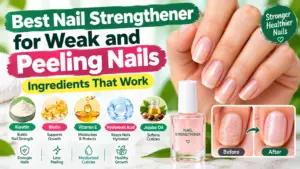

Best Nail Strengthener for Weak and Peeling Nails: Ingredients That Work
Even basic tasks can become difficult and frustrating if you have weak, brittle, and peeling nails. After repeated manicures and exposure to chemicals or water, nails may thin, split at the edges, peel into layers, or break easily.
The first step in choosing the best nail strengthener for weak, peeling nails is figuring out what’s causing the damage. Although a nail hardener could offer a layer of protection, moisturising, lowering chemical exposure, and altering harmful nail behaviours can be equally crucial.
Mayo Clinic recommends keeping nails moisturized, protecting them from prolonged water exposure and considering a nail hardener as part of basic nail care.
This guide explains which ingredients and products may help weak nails, what to avoid and when peeling or brittle nails may require medical evaluation.
What Causes Weak and Peeling Nails?
Peeling nails can happen for many different reasons. Sometimes the problem is caused by everyday nail-care habits, while persistent changes can occasionally be associated with an underlying condition.
Common causes include:
- Frequent hand washing
- Prolonged exposure to water
- Household cleaning chemicals
- Acetone-based nail polish remover
- Frequent manicures
- Gel or artificial nails
- Picking or biting nails
- Using nails as tools
- Dry skin and cuticles
- Aging
- Certain nutritional deficiencies
- Fungal infections
- Psoriasis
- Thyroid disorders
- Some medications
Repeated exposure to water can cause nails to become more prone to splitting, while harsh chemicals and nail products may contribute to weakness.
If your nails suddenly become very weak or change color, thickness or shape, it is better to look for the underlying cause rather than relying only on a nail strengthener.
What Is a Nail Strengthener?
A nail strengthener is a product designed to create a protective coating over the nail or condition the nail surface.
Some products are marketed as nail hardeners, while others are moisturizing nail conditioners or treatment oils.
These products can serve different purposes.
Nail Hardeners
A hardener can create a stronger protective surface and may help reduce tearing and splitting. Mayo Clinic notes that applying a nail hardener might help strengthen nails.
Nail Conditioners
Conditioners focus more on keeping the nail and surrounding skin moisturized. This can be particularly useful when dryness contributes to brittleness.
Nail Oils
Nail and cuticle oils can help moisturize dry cuticles and the surrounding skin. Regular moisturization is an important part of maintaining healthy nails.
The best product for you therefore depends on whether your nails are primarily dry and peeling, thin and flexible, or frequently breaking.
Best Ingredients for Weak and Peeling Nails
When shopping for a nail strengthener, look beyond marketing claims and check the ingredient list.
1. Keratin and Protein-Based Ingredients
Nails are primarily made from keratin, a structural protein.
Some nail treatments contain keratin or other conditioning proteins and are marketed to improve the appearance and feel of weak nails.
These products may be useful as part of a broader nail-care routine, although they cannot repair permanently damaged nail tissue instantly.
The goal is to protect the nail as new nail grows.
2. Biotin
Biotin, also known as vitamin B7, is commonly marketed for hair and nail health.
Some research suggests that biotin supplementation may help certain people with weak or brittle nails. Mayo Clinic notes that healthcare professionals may recommend biotin in some cases.
However, biotin supplements are not automatically necessary for everyone with peeling nails.
The American Academy of Dermatology also warns that biotin supplements can interfere with certain medical blood tests.
If you are considering a high-dose biotin supplement, discuss it with a healthcare professional first.
3. Vitamin E
Vitamin E is commonly found in nail oils and cuticle treatments because of its moisturizing and antioxidant properties.
For people whose nails and cuticles are dry, a moisturizing product containing vitamin E may be useful as part of a daily nail-care routine.
However, vitamin E should not be viewed as a cure for every type of brittle nail.
4. Jojoba Oil
Jojoba oil is frequently used in nail and cuticle oils because it provides an emollient effect and helps soften dry skin around the nails.
Applying a small amount to the nails and cuticles can be especially helpful at night when combined with a hand moisturizer.
5. Lanolin
Lanolin is another moisturizing ingredient used in some nail conditioners.
Cleveland Clinic recommends moisturizing nails and cuticles and notes that a nail conditioner containing lanolin may be used several times a day. It also recommends avoiding nail conditioners containing alcohol because they may contribute to dryness.
6. Glycerin and Humectants
Glycerin and other humectants attract water and are frequently used in moisturizing products.
If your nails are dry and your surrounding cuticles are rough or cracked, a moisturizing formula may be more useful than an extremely hard nail coating.
7. Ceramides and Emollients
Although more commonly associated with skincare, ceramides and other moisturizing ingredients can help support the skin barrier around the nails.
Healthy cuticles and surrounding skin are an important part of overall nail care.
Best Nail Strengthener for Different Nail Problems
Not every weak nail needs the same type of product.
| Nail Problem | Product Type to Consider |
|---|---|
| Peeling nails | Moisturizing conditioner + protective coating |
| Nails that split | Nail hardener + regular moisturizer |
| Dry nails | Nail oil + rich hand cream |
| Thin nails | Gentle strengthening treatment |
| Brittle nails | Conditioning treatment + protective habits |
| Damaged after gel manicures | Break from artificial nails + moisturization |
| Cracked cuticles | Cuticle oil + fragrance-free moisturizer |
A combination of protection and hydration may be more useful than relying on a single product.
Are Nail Hardeners Safe?
Nail hardeners can be useful, but stronger is not always better.
Some older or very strong nail-hardening formulas may contain ingredients that can irritate the surrounding skin or make nails feel excessively rigid.
Mayo Clinic advises using a protective layer such as nail hardener but also emphasizes gentle nail care and avoiding damaging habits.
Mayo Clinic has also noted that some nail hardeners or adhesives can contribute to nail problems in certain situations.
If a strengthening product causes burning, redness, pain, increased peeling or other irritation, stop using it and discuss the reaction with a healthcare professional.
What About Formaldehyde Nail Hardeners?
Formaldehyde has historically been used in some nail-hardening products.
However, repeated exposure can irritate the skin and may make some nail problems worse. Mayo Clinic specifically advises avoiding formaldehyde-containing nail hardeners because they can irritate skin and repeated use may weaken nails.
If you have sensitive skin or already damaged nails, choosing a gentler conditioning product may be preferable.
How to Use a Nail Strengthener Correctly
Even the best nail strengthener will not help much if your nails continue to experience repeated damage.
Follow these steps:
Step 1: Keep Nails Short
Long nails are more likely to bend, crack and catch on objects.
Keeping them shorter can reduce mechanical stress while they recover.
Step 2: Apply the Strengthener as Directed
Follow the product’s instructions rather than applying multiple thick layers.
Some treatments are intended for daily use, while others are designed for several applications per week.
Step 3: Moisturize Daily
Apply hand cream to your hands, nails and cuticles.
Mayo Clinic recommends moisturizing the nails and cuticles as part of healthy nail care.
Step 4: Protect Your Hands From Water and Chemicals
Wear gloves when washing dishes, cleaning or handling household chemicals.
Repeated or prolonged contact with water can contribute to splitting.
Step 5: Avoid Picking
Do not peel off layers of your nails manually.
Picking can remove healthy portions of the nail and increase damage.
Are Gel Manicures Causing Your Nails to Peel?
If your nails became weak after repeated gel manicures, artificial nails or acrylics, your manicure routine may be contributing to the problem.
The American Academy of Dermatology notes that artificial nails can leave natural nails thin, brittle and dry. Gel manicures can also cause brittleness, peeling and cracking.
Consider taking a break from artificial nails and allowing your natural nails to grow.
If you continue getting gel manicures, ask your nail technician about less damaging removal practices and avoid aggressive filing of the natural nail.
Why Nail Polish Remover Matters
Frequent use of nail polish remover can contribute to dryness and weakness.
Mayo Clinic recommends limiting nail polish remover and choosing an acetone-free option when possible.
This does not mean acetone can never be used, but people with already peeling nails may benefit from reducing unnecessary exposure.
Can Diet Help Strengthen Weak Nails?
Your nails require adequate nutrition to grow normally.
A balanced diet should include adequate protein and a variety of vitamins and minerals.
Potential nutritional problems associated with brittle or abnormal nails can include deficiencies involving nutrients such as iron, zinc and certain B vitamins.
However, taking supplements without knowing whether you have a deficiency is not always helpful.
Instead, focus on foods such as:
- Eggs
- Fish
- Lean meat
- Beans
- Lentils
- Nuts and seeds
- Vegetables
- Whole grains
- Dairy or fortified alternatives
If your nails remain unusually weak despite good nail care, a healthcare professional can determine whether testing for nutritional or medical problems is appropriate.
How Long Does It Take to Strengthen Weak Nails?
Nails cannot become completely healthy overnight because the damaged portion has to grow out.
Fingernails grow gradually, so visible improvement may take several weeks or months depending on the severity of the damage.
Cleveland Clinic notes that when using measures such as biotin for brittle nails, noticeable improvement can take weeks as the nail grows out.
Consistency is therefore more important than using a large amount of product for a short period.
Best Nail Care Routine for Peeling Nails
A simple routine can help protect weak nails.
Morning
- Apply hand moisturizer.
- Massage a small amount of cuticle oil around the nails.
- Use gloves for household cleaning.
- Avoid using nails to open packages or scrape surfaces.
During the Day
Reapply hand cream after washing your hands when possible.
If your hands are frequently exposed to water, use protective gloves for prolonged wet work.
Night
Apply a rich hand cream.
Massage moisturizer or cuticle oil into the nails and surrounding skin.
If your hands are extremely dry, Cleveland Clinic suggests nail slugging with an occlusive product such as petroleum jelly at bedtime.
When Should You See a Dermatologist?
Weak nails caused by everyday dryness or cosmetic damage often improve with better nail care.
However, persistent or unusual nail changes deserve medical attention.
See a healthcare professional if you notice:
- Nails becoming significantly thicker or thinner
- Yellow, green or unusual discoloration
- Nails separating from the nail bed
- Pain or swelling around the nail
- Bleeding
- Significant changes in nail shape
- Persistent peeling despite nail-care changes
- Multiple nails suddenly becoming abnormal
Mayo Clinic recommends medical evaluation for changes such as nail discoloration, changes in shape, thinning or thickening, nail separation, bleeding, swelling, pain or failure of nails to grow.
Fungal infections can also cause nails to become thick, discolored, brittle or crumbly.
Other conditions associated with nail changes can include psoriasis and thyroid disorders.
Frequently Asked Questions
What is the best nail strengthener for weak and peeling nails?
The best choice depends on the cause. A gentle nail hardener can provide a protective coating, while moisturizing nail conditioners and cuticle oils may be more useful when dryness is a major factor.
Can nail strengtheners stop peeling nails?
They may help protect the nail and reduce splitting, but they cannot correct an underlying medical condition. Consistent moisturizing and reducing water and chemical exposure are also important.
Is biotin good for weak nails?
Some research suggests biotin may help certain people with weak or brittle nails. However, it should not be taken automatically, and biotin can interfere with some blood tests. Talk with a healthcare professional before taking high-dose supplements.
How often should I use nail strengthener?
Follow the manufacturer’s instructions. Using a stronger product more frequently than recommended does not necessarily produce better results and may increase irritation or dryness.
Should I stop gel manicures if my nails are peeling?
Taking a break can give damaged nails time to grow out. The American Academy of Dermatology notes that artificial nails and gel manicures can contribute to brittleness, peeling and cracking.
Does petroleum jelly help weak nails?
Petroleum jelly can help reduce moisture loss and protect dry nails and cuticles. It does not directly rebuild damaged nail tissue, but it can be useful as part of a moisturizing routine.
How can I make my nails stronger naturally?
Keep nails short, moisturize the nails and cuticles, protect your hands from prolonged water and chemicals, avoid picking and biting, limit harsh nail products and eat a balanced diet.
Final Thoughts
The best nail strengthener for weak and peeling nails is not necessarily the strongest nail hardener available. For many people, the best approach combines a gentle strengthening or protective product with consistent moisturization and better nail-care habits.
Look for products designed to protect and condition the nail, and consider ingredients such as moisturizing agents, keratin or conditioning proteins, vitamin E, jojoba oil and other emollients. A nail hardener may help reduce splitting, but excessive use of harsh formulas can sometimes cause additional problems.
Most importantly, protect your nails from prolonged water exposure, cleaning chemicals, aggressive manicures and frequent acetone use. Keep your nails at a manageable length and moisturize the nails and cuticles every day.
If peeling, discoloration, thickening, pain or nail separation continues despite good care, do not simply keep applying nail strengthener. A dermatologist or healthcare professional can determine whether an infection, nutritional issue, skin condition or another medical problem is contributing to the nail changes.