

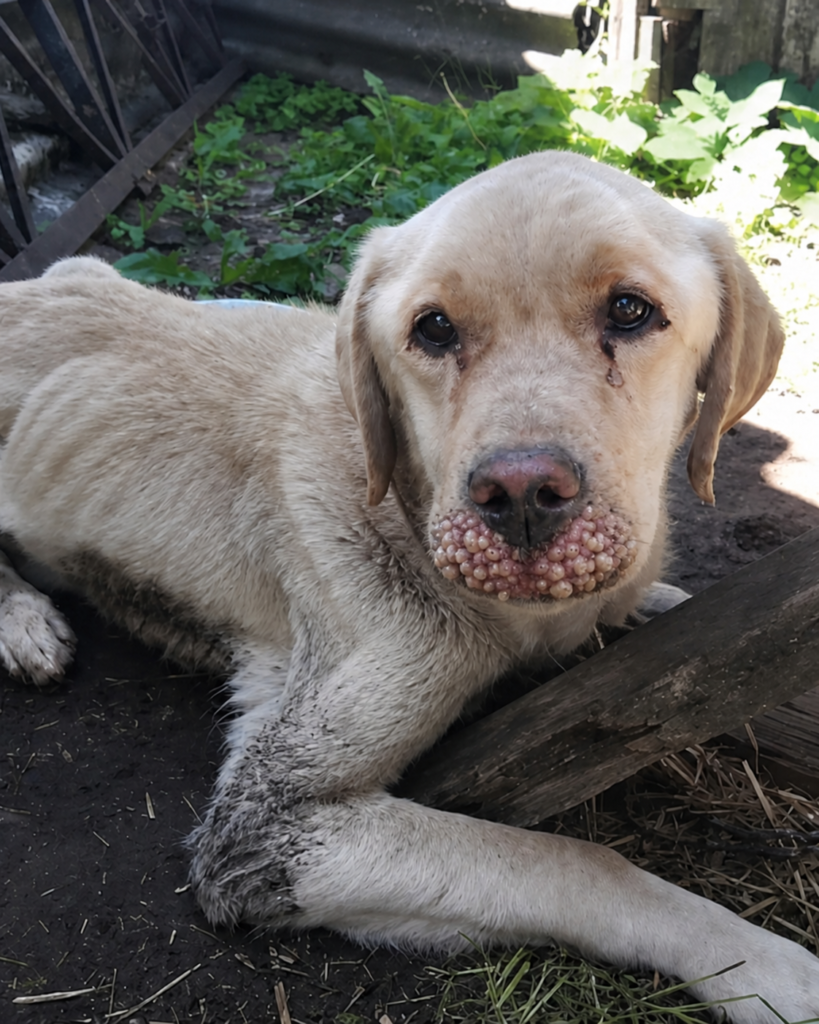
In a quiet, forgotten corner of the world, where broken wood and overgrown weeds tell stories of neglect, a dog lies still—his body present, but his spirit slowly fading under the weight of pain and abandonment. His once-healthy coat is now dull and dirty, clinging to a fragile frame that has endured far more than it ever deserved. But what draws the deepest ache is not just his physical condition; it is the silent suffering written in his eyes. Around his mouth, a severe infection has taken hold, swelling and covering his lips in a way that makes even the simplest acts—eating, drinking, breathing—feel like unbearable challenges. Flies gather, drawn to the wound, and yet he barely reacts anymore. Perhaps he is too weak, or perhaps he has simply grown used to the discomfort, accepting it as part of his reality.
This dog was not always like this. There was a time when he belonged somewhere, when his days were filled with simple joys—a warm place to sleep, a bowl of food, and the comforting presence of a human he trusted completely. Dogs do not question love; they give it freely, without conditions, without hesitation. And so, when that love is taken away, they do not understand betrayal the way humans do. They only feel the absence, a deep and confusing emptiness that they cannot explain. It is likely that this dog, like so many others, was left behind without warning. One moment, he may have been following familiar footsteps, his tail wagging with excitement, and the next, he was alone—watching as the only world he knew disappeared in the distance.
As days turned into nights and nights into more lonely days, survival became his only purpose. Hunger and thirst replaced comfort, and the environment around him turned harsh and unforgiving. Without care or protection, his health began to deteriorate. The infection around his mouth likely started small—something that could have been easily treated—but in the absence of help, it grew into a painful condition that now defines his existence. Every movement hurts. Every attempt to eat brings discomfort. And yet, he continues, driven by an instinct to live and a faint hope that things might somehow change.
What is perhaps most heartbreaking is his unwavering loyalty. Despite everything he has been through, there is still a trace of hope in his eyes. Whenever a shadow passes or a sound breaks the silence, he lifts his head slightly, as if expecting someone to return. That small, fragile hope refuses to die, even when reality offers him no reason to hold onto it. It is this loyalty that makes a dog’s suffering so profound—they do not stop believing in kindness, even when the world has shown them otherwise.
This image is not just a picture of a sick and abandoned animal; it is a reflection of a larger issue that exists quietly in many parts of the world. Countless animals suffer in silence, their pain unnoticed or ignored by the very society that once domesticated them for companionship. They rely on humans not just for food, but for care, protection, and dignity. When that responsibility is neglected, the consequences are devastating—not just physically, but emotionally.
Yet, even in this sadness, there is a message that cannot be ignored. Compassion has the power to change stories like his. A single act of kindness—a rescue, a visit to a veterinarian, a moment of care—can transform suffering into healing. It can give a creature like him a second chance at life, a chance to feel warmth again, to trust again, to live without pain. His story, though filled with hardship, is not beyond hope. Because as long as there are people willing to see, to care, and to act, there is always a possibility that even the most broken lives can be mended.
In the end, this dog’s silent pain speaks louder than words. It asks a simple question: in a world where loyalty is given so freely by animals, why is compassion so often withheld by humans? The answer lies not in grand gestures, but in small, everyday choices—to notice, to care, and to help when it matters most.
