

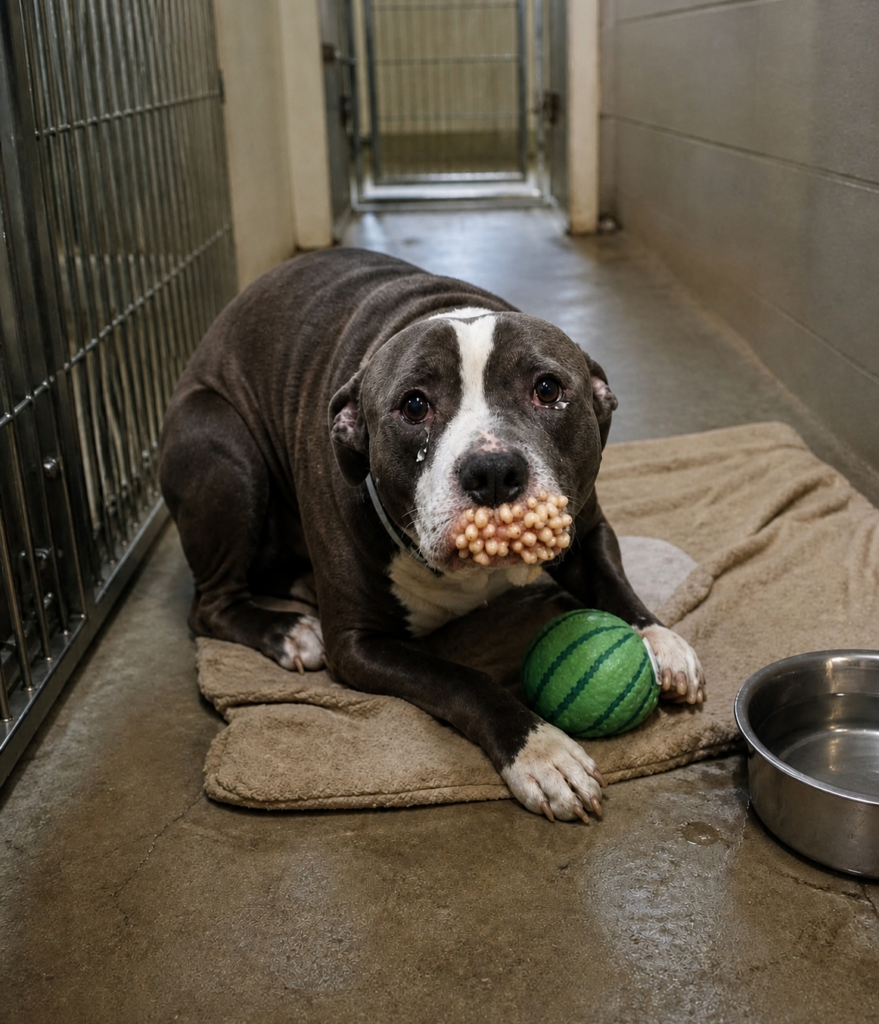
In a quiet corner of a cold, echoing shelter, where the sound of distant barking fades into a dull, constant hum, a single dog lies curled on a thin, worn blanket. The concrete floor beneath him is unforgiving, seeping its chill into his fragile body, yet he barely moves, as if he has already surrendered to discomfort. His eyes—deep, dark, and glistening with tears—tell a story far heavier than his still frame can carry. They are not the eyes of a dog simply waiting for a meal or a walk; they are the eyes of a soul that has known pain, confusion, and abandonment. Around his mouth, an unsettling cluster of growths has taken over, distorting the natural shape of his face, making even the simplest act—like eating or breathing—seem like a burden. It is a cruel reminder of how long he must have suffered, unseen and unheard, before ending up here. And yet, despite everything, there is something heartbreakingly gentle about him. He rests his paw on a small green ball, as if clinging to the last fragment of a happier past, a time when life may have been kinder, when he might have played freely without pain weighing him down.
No one knows exactly what he has been through. Perhaps he once belonged to someone who promised to care for him but turned away when things became difficult. Perhaps he wandered the streets, battling hunger and illness, invisible to the busy world passing him by. Or maybe he was born into hardship, never knowing what it feels like to be safe, to be loved without conditions. Whatever his story is, it has led him here—to a place that is meant to be a refuge, yet still feels so lonely. The walls around him are sterile and silent, offering shelter but not warmth, protection but not comfort. Volunteers may pass by, offering food and water, but they cannot erase the memories etched into his spirit. Trauma does not disappear overnight. It lingers, quietly shaping the way he looks at the world, the way he hesitates to trust, the way he curls into himself as if trying to disappear.
There is a quiet kind of heartbreak in the way he watches. His gaze follows every movement, not with excitement, but with cautious hope—as if he wants to believe that someone might finally stop, kneel down beside him, and see him not as a burden, not as a hopeless case, but as a living being worthy of care. He does not bark for attention. He does not wag his tail wildly or jump against the bars of his enclosure. Instead, he waits in silence, as though he has learned that asking for too much only leads to disappointment. It is this silence that speaks the loudest. It is the silence of a dog who has given everything he had—his loyalty, his trust, his love—and received pain in return.
And yet, even in his suffering, there is resilience. It is there in the way he still holds onto that small ball, as if some part of him refuses to let go of the idea of play, of joy, of a life beyond these walls. It is there in the way he lifts his head slightly when someone walks by, even if just for a moment, as though testing the possibility that this time might be different. This fragile thread of hope is what keeps him going. It is thin, barely visible, but it has not broken. Not yet.
The tragedy is not just his condition, though it is painful to witness. The real tragedy is how easily a life like his can be overlooked. In a world filled with countless animals in need, it is often the healthiest, the happiest-looking ones who are chosen first. They are easier to love, easier to take home, easier to imagine as part of a perfect life. But dogs like him—dogs who carry visible scars, who require patience and care—are often left behind. They wait longer. They hope longer. And sometimes, they never get their chance at all.
But what if someone saw him differently? What if someone looked beyond the surface, beyond the illness and the fear, and recognized the heart that still beats with quiet loyalty? Because beneath the pain, beneath the trembling uncertainty, he is still a dog who can love. He is still capable of forming a bond so deep and pure that it could change both his life and the life of the person who chooses him. Healing may take time. Trust may not come easily. There will be challenges, setbacks, moments of doubt. But there will also be small victories—the first time he wags his tail without hesitation, the first time he leans into a gentle touch, the first time he realizes that he is finally safe.
For now, he waits. He waits in that same corner, on that same thin blanket, holding onto that small green ball like it is the last piece of a dream he refuses to forget. His eyes remain fixed on the world beyond his immediate space, searching, hoping, questioning. Will someone come? Will someone see him—not just his pain, but his potential for love? Or will he remain just another quiet story hidden behind shelter walls, fading slowly into the background?
There is something profoundly human in the way his story unfolds, in the way it mirrors our own need for compassion, for connection, for understanding. He does not ask for much. He does not demand perfection. All he needs is a chance—a single moment where someone decides that he is worth the effort, worth the care, worth the love he has been denied for so long. And perhaps, in giving him that chance, we are reminded of something important: that even the most broken souls still carry the capacity for hope, and sometimes, all it takes to change a life is the simple decision to care.
