

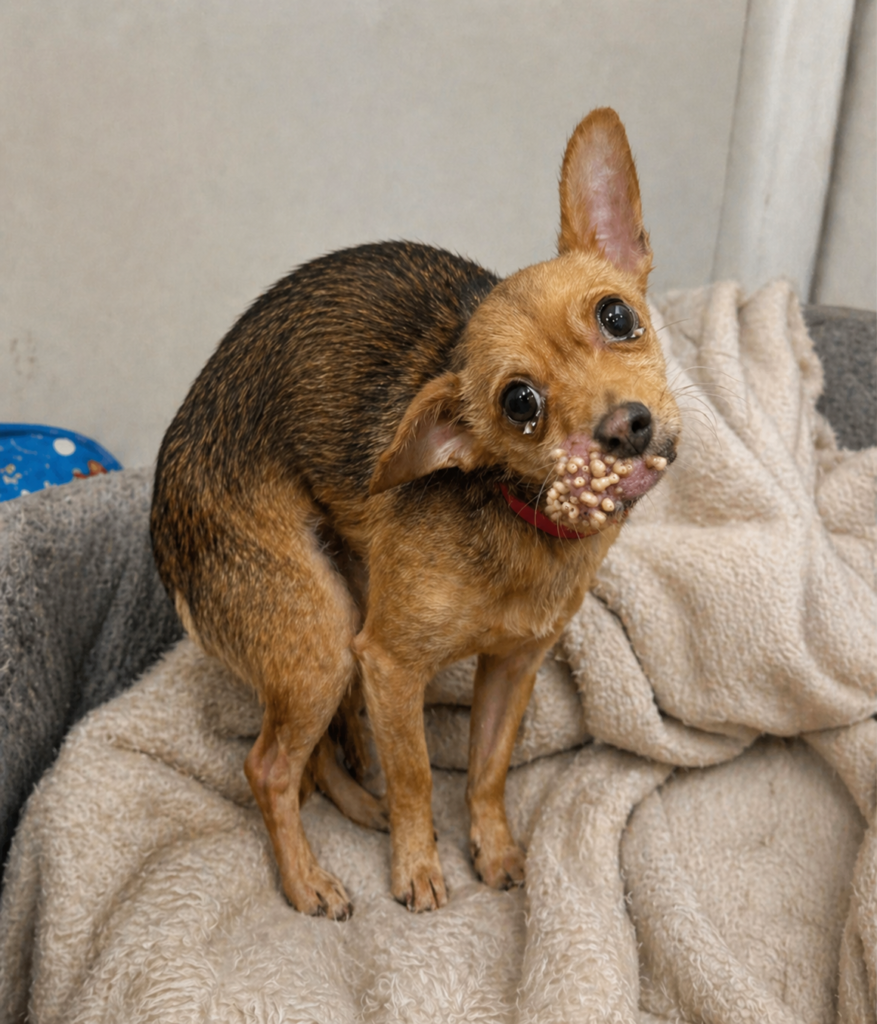
He stood on the blanket because the floor still felt too much like the places he had been left. Even in a quiet shelter room, safety was not something he understood yet—it was something he questioned. His small body carried memories heavier than it should have, and every sound reminded him that comfort could disappear without warning. The red collar around his neck, bright and new, did not yet mean love. It meant uncertainty. It meant maybe.
Days passed, but nothing about him changed quickly. He still stood more than he lay down. He still watched more than he moved. The staff noticed how carefully he studied every hand that reached toward him, how he flinched at sudden sounds, and how he froze when someone turned too fast. This was not a dog who had forgotten kindness—this was a dog who had learned not to expect it.
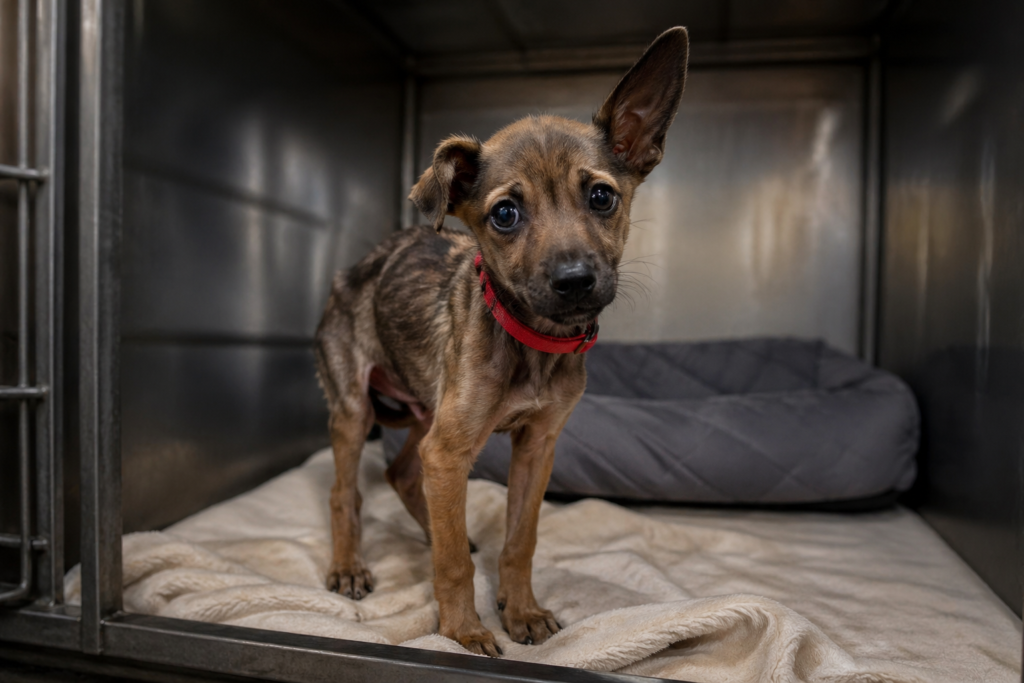
But the shelter team did something important: they did not try to force him to be brave.
Instead, they gave him time.
Each morning, someone would sit quietly outside his kennel. Not speaking. Not reaching. Just being there. At first, he kept his distance, his wide eyes fixed on them, measuring every breath they took. But slowly, curiosity began to compete with fear. One day, he took a single step forward. The next day, he stayed a little longer near the front of the kennel. Progress was almost invisible—but it was there.
Food helped, but not in the way people might expect. He did not rush to eat. Instead, he would glance between the bowl and the person nearby, as if asking permission, as if checking whether this moment would be taken away too. When he finally ate without stepping back, it felt like a quiet victory.
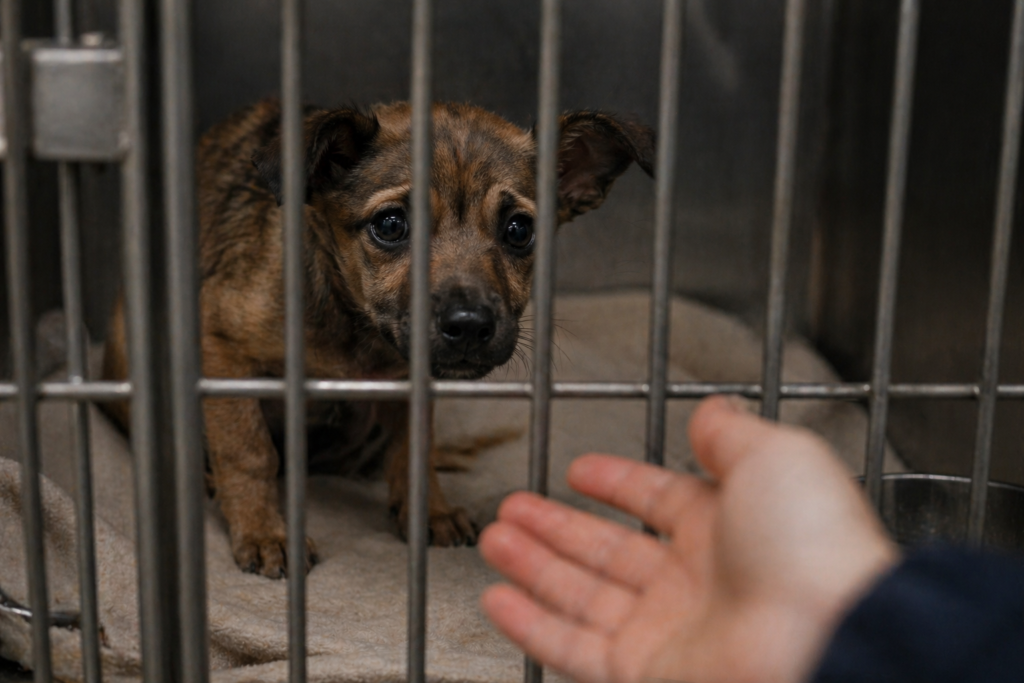
The turning point came on a calm afternoon.
A volunteer sat by his kennel longer than usual, gently talking in a soft voice. Not directly to him, but around him—telling small, soothing stories, letting the words fill the silence. The door was opened slowly, carefully. The dog froze, his body tense, his ears caught between fear and curiosity.
Then something changed.
Instead of backing away, he lowered his head and took a cautious step forward. His nose twitched. He moved closer, inch by inch, until he could smell the volunteer’s hand. For a moment, time seemed to stop. This was the moment where fear usually won.
But this time… it didn’t.
He touched the hand with his nose.
It was brief. Light. Almost uncertain. But it was the first time he chose connection instead of distance.
From that day on, everything began to shift—slowly, gently, but surely. He started lying down on the blanket instead of standing. He slept a little deeper each night. His trembling lessened. One ear still stood alert, but the other began to relax more often, as if his body was finally learning what peace could feel like.
He even wagged his tail once.
It was small. Almost unnoticeable. But for those who had been watching him, it meant everything.
Weeks later, a family came to the shelter. They weren’t looking for the loudest dog or the most playful one. They noticed him because he was quiet. Because he watched instead of jumped. Because there was something in his eyes that spoke of a story unfinished.
They sat near him, just like the volunteers had done. They didn’t rush. They didn’t expect. And when the kennel door opened, he hesitated—but not for as long as before.
He stepped forward.
Not all the way. Not fearlessly. But enough.
Enough to say, I’m trying.
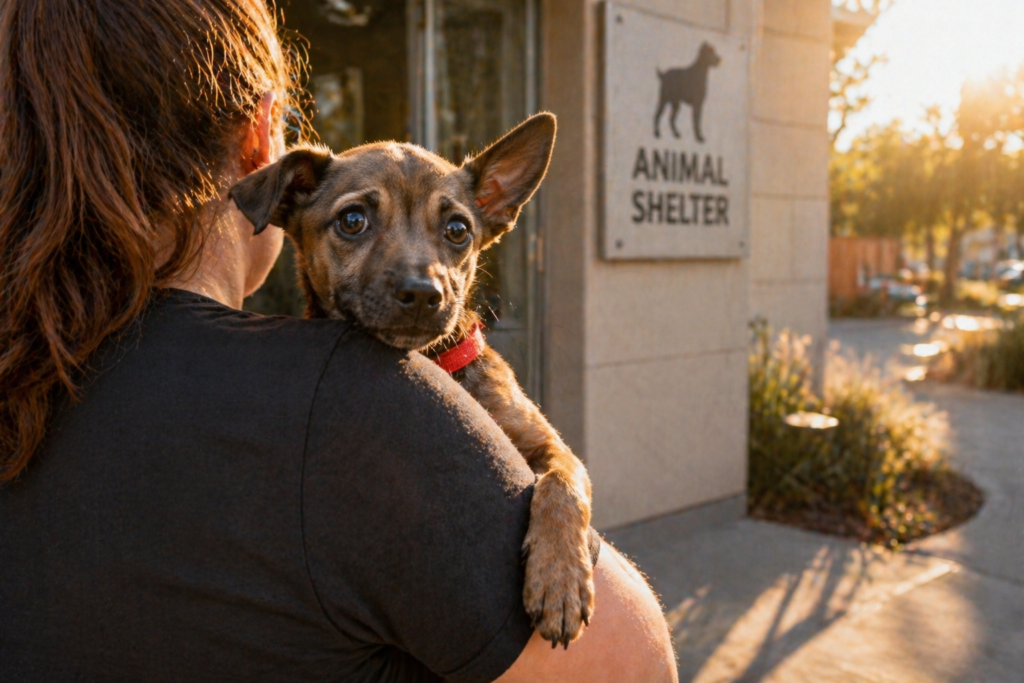
The day he left the shelter, he still carried pieces of his past. Healing is not instant. Trust is not automatic. But he also carried something new—a beginning.
In his new home, there would be soft voices, patient hands, and a blanket that did not remind him of abandonment. There would be days when he felt brave and days when he didn’t. But for the first time in his life, he wouldn’t have to face those feelings alone.
The little dog who once stood trembling on a blanket had taken his first steps toward trust.
And sometimes, that’s the most unforgettable journey of all.
